
Blast | March 12, 2026
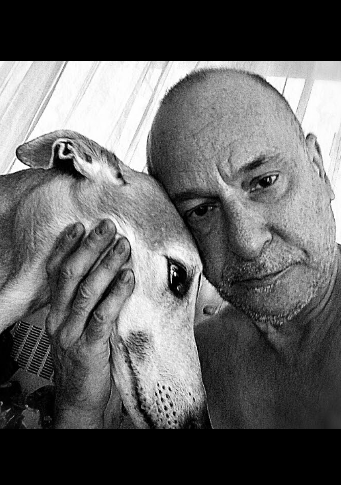
“When Lindy Saved My Life” by Mark Elliott Paull
Photo credit: Mark Elliott Paull. Not approved for duplication or download.
“When Lindy Saved My Life” honors Mark Elliott Paull’s profound connection with a beloved greyhound; whose companionship anchored him while he navigated type 1 diabetes and immense grief. This essay prompts us to reconsider grief and comfort as solely psychological experiences and explores their physical and cellular manifestations through Paull’s kinship with Lindy.
TMR’s online-only prose anthology, BLAST features prose too vibrant to be confined between the covers of a print journal.
***
When Lindy Saved My Life
I was standing in my kitchen with the intention of ending my life when my greyhound stepped between me and death.
The morning light cut harsh angles across the countertop. My hands had stopped shaking, which should have been a relief but wasn’t—the stillness felt final, like a decision my body had already made without consulting my mind. The kitchen smelled of yesterday’s coffee and something else I couldn’t name. Defeat, maybe. Or just the metallic taste that grief leaves in the air.
That’s when Lindy moved. Not quickly—greyhounds are built for bursts of speed, but this was deliberate, careful. He pressed his chest against my thighs, his long legs bracketing mine like parentheses around a sentence that wasn’t finished yet. Sixty pounds of bone and muscle and warmth became an argument my mind couldn’t refute.
His breathing pressed against my leg, steady as a metronome. The tunnel vision that had consumed everything began to widen, just slightly, just enough. He held me there until my hands started working again. Until breath felt possible.
It sounds dramatic, but the science is not. What was happening in that kitchen had a vocabulary that researchers understand: co-regulation, when one nervous system steadies another. Lindy’s body had become the intervention my mind could not accept.
He steadied me in the kitchen that morning, but Lindy had been teaching me how long before. To understand why this worked, you need to know what he was.
Before I ever touched Lindy, I knew what he was. Not a pet. Not a rescue. Not even a dog in the way most people thought of dogs. Lindy was a force—a machine designed for speed, for precision, for the hunt.
Before greyhounds became the silent, docile creatures of the racetrack, they were predators. Apex hunters, moving faster than the eye could follow, built to chase, built to win. Lindy had been one of them. At his peak, he had raced at sixty-two kilometers per hour, faster than any land animal except a cheetah. His entire body was shaped by instinct—long, lean, coiled muscle, built for motion.
His beige coat stretched over a frame of pure power. His ribs cut sharp beneath his skin; his hindquarters rippled with muscle. His legs were impossibly long, built like a bowstring drawn back, waiting for release. His ears flicked constantly, listening to everything, his golden eyes unreadable. He didn’t look at me. He looked through me.
For a moment, I felt something ancient staring back—something older than the tracks, older than domestication. Something that remembered what it meant to run wild.
Lindy came to me through the greyhound adoption network. Retired racers need homes when their speed fades, and I needed something to anchor me to the present. The match seemed practical until I saw him at the foster home. Then practicality dissolved into recognition. He walked toward me with measured steps, this lean predator who somehow felt familiar. I knew immediately: this was the dog I’d been unconsciously preparing for—the reason I’d planted a linden tree the month before, the tree that would give him his name.
The first few days, we learned each other’s rhythms. His careful morning stretch. My careful glucose checks. His alert scanning of windows and doorways. My constant checking of pockets, cabinets, the small rituals of staying alive with type 1 diabetes.
We were returning from our evening walk—Lindy on my left, settling into the comfortable rhythm we’d developed. The street was quiet, shadows lengthening as the sun dropped behind the houses. Then the loose dog appeared.
No owner in sight. The animal emerged from between two parked cars, body language tense, focused. Not curious—hunting.
Everything slowed.
Lindy’s entire body shifted in an instant. Not panic, not fear—pure assessment. He stepped forward, placing himself between the threat and me. His stance communicated something I couldn’t name but the other dog clearly understood. Authority without aggression.
The loose dog hesitated, then reconsidered entirely, turning and trotting away. Only then did Lindy relax, but he remained alert until we reached home.
That was Lindy’s nature. Guardian. He was training me to trust his instincts—small lessons in letting him lead when danger appeared. Then came the day when that trust meant survival.
I was diagnosed with type 1 diabetes at age eleven, back in 1967—the dark ages of diabetes management. No continuous glucose monitors, no insulin pumps, just urine tests and educated guesses. Years later, I learned I also had ADHD—a constant push-pull between hyperfocus and forgetfulness. It was like having a Ferrari brain with bicycle brakes, always sprinting ahead but never quite stopping in time.
That autumn morning, my ADHD mind had hyper focused on the run, not the preparation. I forgot glucose tablets—a potentially fatal mistake.
An hour into the trail, I felt the familiar wave of dizziness. My blood sugar was crashing. My legs faltered, sweat turning cold despite the exercise. I reached into my pocket for glucose tablets. Nothing. My vision began to narrow.
I collapsed onto the trail, leaves bright and indifferent overhead. My body wanted to fold itself into the dirt and stay there.
That’s when Lindy threw his head back and rooed—a deep, melodic howl that sent chills down my spine. ROOOO! ROOOO! It was as if he were summoning help, a primal call I’d never heard from him before.
A woman running nearby slowed down. “Hey! Is he okay?” she asked, eyeing Lindy as he continued his siren-like call.
I tried to speak, but my lips barely moved. “Diabetes . . . low . . .”
Her face changed instantly. “Oh—wait! I have something.” She reached into her running pouch and pulled out a granola bar, pressing it into my hand. With shaking fingers, I tore it open, shoving a bite into my mouth. The sugar hit my bloodstream like fuel to an empty tank.
My vision cleared. My breath steadied. Lindy finally stopped rooing, his job done. He leaned his warm body against mine, standing guard.
The woman exhaled in relief. “I think your dog just saved your life.”
That night, I watched Lindy sleep, his long legs twitching as he dreamed of running. He had spent years on the track, chasing something he would never catch. The irony wasn’t lost on me—I had spent my life chasing control over my blood sugar, my thoughts, my focus. And, like Lindy, I never seemed to catch it.
But maybe control wasn’t the goal. Maybe the real skill was knowing when to stop, when to listen, when to trust.
What Lindy provided wasn’t sentiment. It was physiology. When bodies collapse under trauma, they need more than words to heal.
My son Elijah took his own life at thirty-one. The grief didn’t just break my heart—it hijacked my nervous system. Sleep collapsed into two or three fractured hours. My immune system turned traitor. Every sound became a threat. The body that had carried me through life suddenly felt like an enemy.
Studies confirm what I lived: grief at this scale reshapes the brain itself. Parents who lose children to suicide face increased rates of depression and physical illness. My nervous system had chosen shutdown before my mind caught up.
When the crisis hit that morning in the kitchen, my body moved ahead of thought. Chest collapsing, vision narrowing to a tunnel, breathing mechanical and wrong. This wasn’t just suicidal ideation—it was my nervous system rehearsing death.
That’s when Lindy stepped in. Not once, but again and again. When my breathing shortened, he leaned his head against my chest. When I collapsed under grief’s weight, he curled until his ribs matched mine.
Research shows therapy animals reduce cortisol, slow heart rates, activate the parasympathetic nervous system. But Lindy wasn’t performing therapy. He was offering nervous system attunement—one stable system helping another find its rhythm. Medicine that came on four legs, treating grief at the cellular level.
After the kitchen incident, something fundamental changed in our dynamic. Protection became daily practice. Lindy positioned himself between me and the front door—not possessively, but protectively. He monitored windows, sounds, the spaces where threat might enter.
We developed routines. Morning coffee while he stretched. Evening walks that became moving meditations. Afternoons when he would settle against my leg during phone calls, offering warmth I didn’t know I needed.
I began to understand that what I’d thought was training was in fact translation. He wasn’t learning to be my pet. We were both learning to speak the same language—one of presence, awareness, and mutual respect.
Living with Lindy was living in pack rhythm. His gaze held me accountable for being here, again, another day. Through every loss—my business collapsing, my marriage ending, the slow accumulation of betrayals that stripped away the life I thought I knew—Lindy remained.
He was the continuity my nervous system clung to when everything else fractured. I learned to trust his instincts more than my own. If he stood at the window and trembled, I paid attention. If he settled close on a bad morning, I let him take some of the weight.
This translated directly to my relationship with writing. Instead of fighting my ADHD tendencies—the hypervigilance, the pattern recognition, the inability to ignore peripheral information—I began to see them as strengths. My tendency to notice everything happening in a scene, even details that seemed tangential, often revealed the hidden connections that gave a piece its power.
Living with him, I started understanding what intimacy means in writing—those moments when you and the reader seem to exist in the same emotional space. But I realized you can’t fake it through technique alone. It grows from accumulated trust, from the slow work of learning to move in sync with other lives.
When Elijah died, every survival drill Lindy and I had practiced was tested. The hypoglycemic rescues, the daily nervous system steadiness, the accumulated trust—it all led to the moment when grief broke my body and only his presence kept me tethered.
Elijah was brilliant, tender, neurodivergent like me. His death by suicide wasn’t just loss—it was cellular mutiny. Sound warped. Air thickened. The simplest tasks became mountainous. Time became elastic, looping back on itself, trapping me in moments I couldn’t escape.
Through it all, Lindy stood guard. He leaned into my grief like he had positioned himself in the kitchen. He didn’t flinch when I screamed. He didn’t argue when I lay on the floor for hours. He simply stayed, his breathing steady against my ribs, his warmth the only thing that felt real.
That morning in the kitchen wasn’t an isolated incident. It was the culmination—the moment when everything we’d learned about survival and presence and physiological regulation was tested against the ultimate darkness.
And Lindy passed. We both did.
I used to think healing was about control. Count carbs. Track minutes. Measure progress. Force the chaos of ADHD into manageable boxes. Control time, control attention, control the uncontrollable.
Lindy showed me something different. He didn’t reason me out of despair. He didn’t give me language for grief. He gave me rhythm—breath matched to breath, heartbeat matched to heartbeat.
If grief really is biological—as my body kept proving—then maybe support has to be biological too. Yet our health care system continues to treat bereavement as a psychological problem requiring psychological solutions. We offer counseling and support groups, which have their place, but we miss the fundamental truth that trauma lives in the nervous system, not just in the mind.
I spent months in therapy talking about my feelings, processing my loss, working through the stages of grief. All valuable. All necessary. But none of it addressed what was happening in my amygdala at three a.m., or why my immune system had declared war on my own body, or why the simple act of breathing felt like work I was too tired to do.
Lindy did. Without training or credentials or a treatment plan, he provided what the medical model couldn’t: embodied presence that regulated my dysregulated system.
This suggests something profound about how we approach trauma care. If we know that grief rewires the brain, spikes cortisol, and sends the nervous system into prolonged distress, then interventions should target these physiological responses directly. Therapy animals aren’t luxuries or nice-to-haves. They’re medical interventions in fur and bone.
In writing, I learned the same lesson. I stopped trying to write like other people and started writing like myself—but with intention, with awareness, with respect for both my neural architecture and my readers’ need for connection. Some sentences need to loop back, circle, investigate the same territory multiple times before moving forward.
Lindy taught me that there’s a difference between accommodation and authenticity.
Accommodation changes the environment to make difference more tolerable. Authenticity finds contexts where difference becomes strength.
Lindy died at fourteen and a half—ancient for a greyhound. I buried him on my land, beneath the linden tree that bore his name, and planted a pear tree over him. The roots stretch deep, wrapping around the place where he rests. The branches reach toward the heavens. Every year, the tree bears fruit—a tangible reminder that even in loss, life continues.
For months after, I couldn’t pass that spot without collapsing. The silence was unbearable. The space at my side where he used to settle felt like an amputation.
And then Gaia came—another greyhound, another guardian. Not Lindy, never Lindy, but breath against my thigh at night, paws against the kitchen tile, a reminder that survival is always a plural act.
I still run. Not to escape, but to stay in relationship—with my body, with my grief, with the dogs who keep me tethered to earth. I still write in spirals rather than straight lines, but I’ve stopped trying to escape the story I’m telling. Instead, I circle back, I investigate, I let the narrative find its own rhythm.
This is what I mean by the craft of motion: not the elimination of movement, but its integration. Not the suppression of neurodivergent tendencies, but their transformation into literary strengths.
Lindy didn’t just save my life that morning in the kitchen. He saved it every day he settled beside me and whispered without words: stay. He taught me that healing happens between bodies, not just inside them. That sometimes the most sophisticated intervention is also the most primitive—one animal helping another remember how to breathe.
And even now, buried under the pear tree, he continues. Every time I trust my instincts over convention. Every time I write a sentence that moves the way my mind moves. Every time I choose presence over escape, relationship over isolation, the long work of staying alive over the quick exit of giving up.
The wind moves through the pear tree branches, and I feel him there—not gone, but transformed. Still running, but not away from me. Still protecting, but in a different form. Still teaching me that love doesn’t leave. It changes. It carries on. It finds new ways to exist.
***
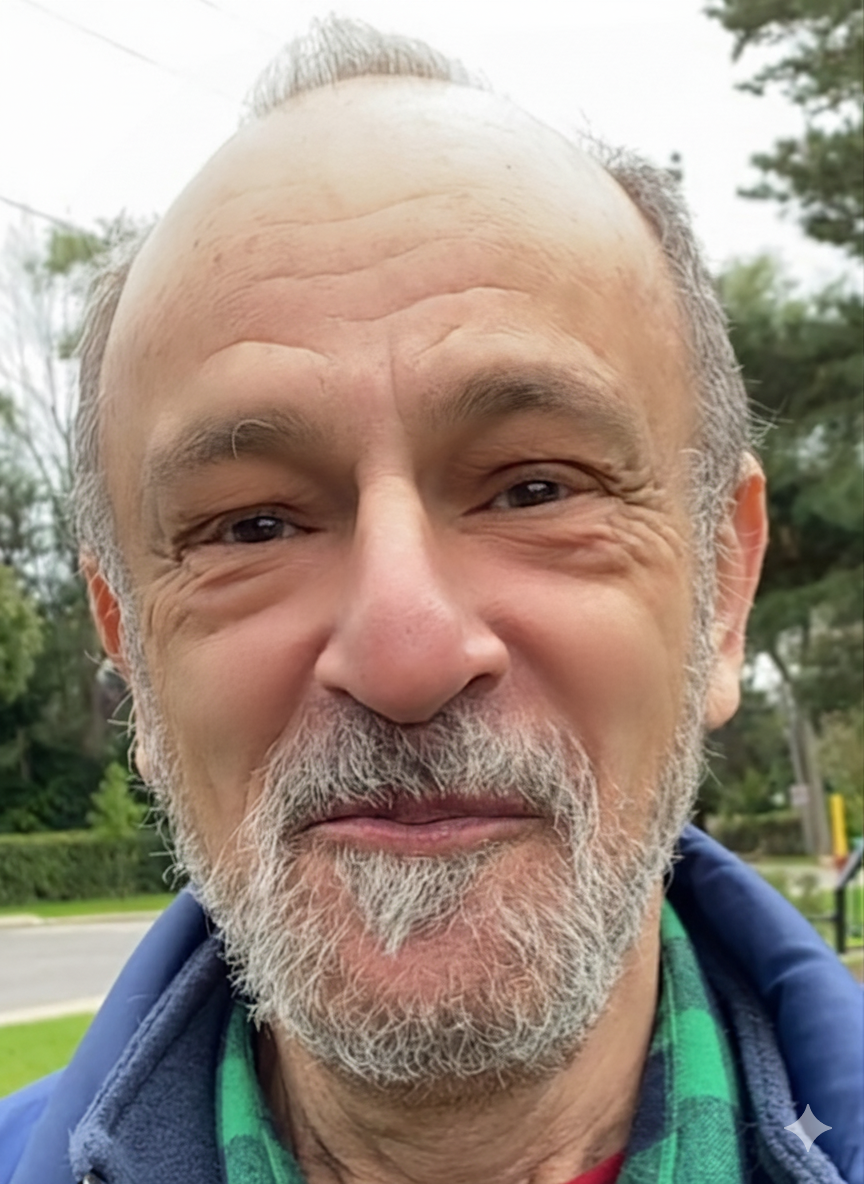
Mark Elliott Paull is a Montréal-based writer and educator whose work explores type 1 diabetes, neurodivergence, grief, and lived-experience medicine. Diagnosed with type 1 diabetes in 1967, he has spent more than five decades writing and advocating at the intersection of narrative, physiology, and human decision-making. His work has appeared in The New York Times, The Globe and Mail, STAT News, Intima: A Journal of Narrative Medicine, Chicken Soup for the Soul, Attention Magazine, and elsewhere. His World War II diabetes narrative published in Minyan Magazine received a Pushcart Prize nomination. He serves as a peer reviewer for Diabetes Care.
SEE THE ISSUE
SUGGESTED CONTENT

Blast
Jun 04 2026
“Was Home Always This Bad?” by L.F. Khouri
L.F. Khouri’s heart-wrenching microfiction details a father’s reflection on the hardships of war, the weight of survivor’s guilt, and the deep desire for safety and normalcy. “Was Home Always This… read more

Blast
May 21 2026
“The Yellow Suitcase” by Aizhan Yesbolatova
This essay by Aizhan Yesbolatova explores the complicated relationship between a mother and her father as she watches him be a different sort of grandfather to her child. “The Yellow… read more

Blast
May 07 2026
“Handsome Crying Boy” by Lee Conell
In this black comedy by Lee Conell, the emotionally repressed pay for group crying sessions administered by attractive men. “Handsome Crying Boy” asks what it means to be vulnerable with… read more