
Blast | January 01, 2026
“Instant Ramen” By Jennifer Jang
Jennifer Jang’s “Instant Ramen” is a story of trying to find where one belongs. When two Taiwanese expats meet in New York, they are drawn to each other even as they plan their separate ways.
BLAST, TMR’s online-only prose anthology, features prose too vibrant to be confined between the covers of a print journal.
***
Instant Ramen
A week ago, when we were alone and watching the sunset and pretending it wasn’t a romantic thing to do, Wei said, “We should do something before my flight. Go to Philly or something.”
I’d only known him for one month. Every community has its designated activity for meeting mutual friends: bar hopping, dinner parties, beer and barbecue on the beach. For Taiwanese people in New York City, it was karaoke in Flushing.
Wei had arrived late and proceeded to talk to every girl in the room.
“Nice necklace,” he said when it was my turn.
“My boyfriend brought it from Korea.”
“He’s Korean?”
“American,” I said, then added, “White.”
Wei was tall and slender. He had nice eyes—one might think he’d gotten eyelash extensions. But his eyebrows were a tangled smudge. I didn’t think he was my type at all.
Then his JJ Lin song came on, and he nailed every note. It was the way the blue lights flashed over his tilted head, like lightning, that helped me decide, upon learning that he was part of my neighborhood run club, that I could add running to my yoga routine.
He didn’t look as fresh when he showed up at the run club the following week. There were shadows under his eyes. His legs looked even skinnier in the full sun, and I felt reassured, almost smug, that his looks had been but a trick of the light.
I said, lightly, “Did you ask out anyone from karaoke?”
“I went on a date with Lily, but we had zero chemistry.”
I snorted. “You’d turn down Angelina Jolie herself.”
“I’m only dating Taiwanese right now,” he said, taking my comment literally. “I’d like to preserve the option of going home.”
Preserve the option. Like it was a pickle. I couldn’t stand people who came all the way to New York just to date within their own group—it was close-minded, even wasteful.
“I’ve made up half my mind to go back,” he continued. “I’ll miss the art scene, though—there are so many places I haven’t visited yet.”
Places we ended up visiting together—Wei was probably leaving anyway, and my boyfriend, Mark, wasn’t interested in artsy places, like MoMA, Mercer Labs, or the art galleries in Chelsea.
That, too, was what I told myself on the train to Philadelphia: it was just another artsy trip between friends. Not just another—the last; Wei had finally booked his flight. Plus, I’d gotten Mark’s blessing; he was going on a hiking trip with friends.
“Hey,” Wei said, sitting straight and showing me some Airbnb listing. “How about this room? It has a king-size bed—should be big enough.”
“Let’s just get two hotel rooms,” I said. My cheeks felt warm.
We stepped off the train and took an Uber to the Barnes Foundation. Stepped through the large atrium of the museum, where light fell through a length-long crack in the high ceiling, and into the inner galleries, where I followed Wei through the chain of small, intimate rooms, from painting to painting, always two paces behind him, watching his too-narrow back, the spirals in his ears, and the rapid thrust of his every step.
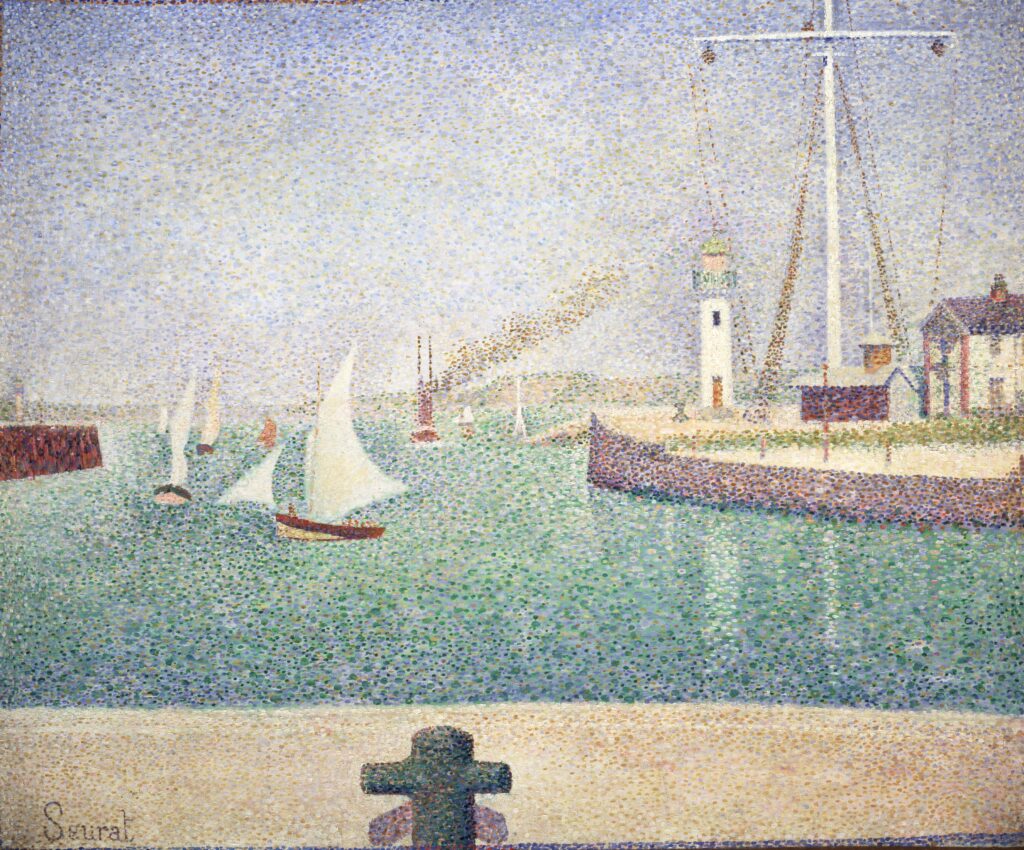
“That’s a Seurat,” he exclaimed. “Look at those pinpointed hues, like light scintillating off sand . . .”
Seurat always made me think of summer, or, how summer was supposed to be: clear skies, periwinkle shadows, and shimmering turquoise seas.
I met Mark in such a summer, on Manhattan Beach in Los Angeles. I had just left Taipei, that furnace of a city aggravated by churning air-conditioning exhausts; left the moody afternoon thunderstorms and the humidity that clung to my skin like tar; left behind two years of my youth—roiling summers, bipolar autumns, snowless winters, and rain-filled springs—that had blended into a dark mauve nightmare of mock examinations and cram school lectures. Years I’d staked on getting into my dream school, only to fail.
Mark had woken me from the nightmare and led me into a golden Hollywood movie. That smart Stanford kid whose snowbird parents called me sweetie. Mark was eager, quick to jump into things, a bit brash—not as meticulous as Wei, who planned every detail of our Philadelphia trip. Mark, who was never jealous—a fact I found odd, but oddly freeing.
After the museum, Wei suggested we head downtown.
“There’s no one on the streets,” he commented, and I knew he was comparing to Taiwan.
“That graffiti looks like President Tsai,” I chimed in.
He pointed at a traffic signal. “How can a flashing red hand possibly mean go?”
With Wei, who also grew up in Taipei, our conversations seemed like common reminiscence. And though I was reluctant to admit it, it was comforting how he understood the small things, the defaults I’d taken for granted.
Mark and I had fought so much when we first moved in together. I couldn’t understand his sarcasm, and he missed my passive-aggressive hints. There were Taiwanese holdovers like not letting him in bed without showering, and Asian ones like no shoes in the house and wanting to sit down for every meal; then there were immigrant peculiarities like calling my parents every week but sticking to lighthearted scripts—something he found dishonest. And though most things we’d ironed out over time, the wrinkles were still there, perceptible at second glance.
I slowed my pace, and, noticing me, Wei slowed too.
I stopped.
“I’m exhausted,” I said.
“I could carry your backpack,” he said, taking me literally again. It would never occur to Mark to offer such a thing—perhaps I might even be annoyed—but I gave my backpack to Wei and was surprised to feel relief.
“How are you still single?” I teased him.
“Spent my twenties buried in books instead of chasing girls.”
“I could set you up with my girlfriends in Taiwan.”
He said nothing. His slender fingers tugged at my backpack straps, loosening them. I felt a burst of fear and shame; I’d crossed the line, offended him. He’d hate me forever.
But he straightened, slung my backpack over his shoulder, and said, “Why not?”
“They’re all my age though,” I said.
“Five years is not a big difference.”
So he remembered how old I was—how young. Retrieved the fact so easily, as if it were a postcard he kept in his shirt pocket.
He continued, “As long as they want kids eventually.”
We started walking again. I walked next to him now, small skipping steps.
“How can you know for sure you want kids?”
“Just like how you know you don’t want them.”
“I don’t know that,” I said, and, feeling that we were talking about something other than children, changed the subject.
After dinner in Chinatown, we stepped into a grocery store to pick up breakfast for the following day and ended up with beer and instant ramen. Cup noodles brought me back to elementary school: school field trips and first nights spent outside of home. Some of my classmates had cried. Not me. I was thrilled to be away, to have freedom—however limited it had been. Mark—he probably didn’t have any memories related to instant ramen, did he? How many memories of his will I never be able to relate to?
Wei and I checked in at the hotel and agreed to reconvene in half an hour. I freshened up in my room, took out the chilled beer from the fridge, and, after debating for six minutes in front of the mirror, ditched the cardigan and marched over next door in not-too-short shorts and a sleeveless bra T-shirt. He was in a loose T-shirt and shorts and had put on the indie rock music that I loved; not that it mattered that we had the same taste in music. Not that it mattered at all.
We busied ourselves making cup ramen, running our hands over the crinkled plastic, searching for a hitch or a knot to pinch and peel away. I watched over the steeping cups as he dragged the metal desk over to the bed. We sat like that, at the edge of the king-size bed, bent over our steaming cups, slurping noodles and drinking beer.
I thought again of Taiwan, of the last time I had instant ramen there.
It was the night after the exams. The three of us, high school classmates, all aiming for medicine, celebrated—certain that all uncertainty was conquered—by bringing a bottle of whiskey to the beach, where we watched the sunset. Later, drunk-footed, we had sought refuge from the cold sea wind dredging our hair and found it under the familiar banner of a convenience store. We had gotten a large bowl each, had slurped all the noodles and were working on the soup when one of us said, with the certitude of a clairvoyant, “We’ll get full marks this time. I know it like I know the taste of MSG.”
“We’ve gone through hell and back, but it’ll be worth it.”
“We’ll be classmates, then colleagues,” I said. “We’ll be friends forever.”
I had said it as a promise, because back then, promises came easily. Words like definitely, always, and forever hung off my sentences like silver charms, except they were hollow, made from nickel, and tarnished easily with time.
I didn’t know then that my scores would be one point away from perfect, and rather than settle for another major, my pride would drive me abroad. That years later, after all my friends had gone on to college before me and grown up without me, grown into the versions of themselves they had foreseen on that beach, I’d still be an unmoored boat, drifting, uncertain if what I sought was even on this shore.
“Would you ever go back?” Wei asked.
I set down my empty ramen cup and was about to answer when I saw his gaze; saw that, again, we’d slid into double entendres.
Mark never presumed to have any answers to life. But here was Wei, looking at me like he knew all my doubts and held all the answers to them. How could anyone make up their mind like that, have enough mind made up for two people?
No, Wei wasn’t a Californian sun overhead; he was an island sunset, one you thought was lost behind the serpentine green mountains, only to come across again, unexpectedly, after turning the corner—there he was, just above the horizon, over the low, lapping waves, his gaze still patient, persistent, and warm.
“I—I never thought of going back,” I said.
“But you have dual citizenship now.”
“I have no life in Taiwan. I don’t even have a Taiwanese bank account.”
“So what?”
He stacked my empty cup over his, aimed and threw it overhead at the trash bin. Like some high schooler trying to show off.
“I suppose I’d feel like a failure,” I said.
“Do you think I’m a failure?” he said, teasingly.
I shifted in my seat; my overlapping legs felt warm.
“It doesn’t matter what I think of you.”
“It matters to me.”
“It doesn’t matter,” I said, too strongly, because then he sat back.
“Do you think Mark would be okay with this?”
He gestured with his eyes. Us on the same bed. His hand resting next to mine, a palm’s length away from touching.
I snatched my hand away.
“Of course. It’s about trust. He trusts me.”
“Because I’m not real to him,” he said. “I’m not real to you either.”
“I’m tired,” I said.
“We both are. Exhausted.”
And I knew he understood what I had meant earlier that day, when I had stopped outside the museum.
It pained me then, that I’d asked for two rooms. I’d much prefer to face the torture of lying in bed with him, together yet apart, on either edge of the bed. To, after the lights had gone out, stare out over the precipice and watch the darkness melt away into a cloudy gray. To suffer the vigil of silence, silence broken by dams of saliva being swallowed. To wonder if he wondered, too, what would happen if our limbs sought the other’s, and if they were to seek, what, by the end of the night, would be found?
Instead, I went back to my room and lay down on the large, impersonal bed, among too many pillows, thinking about that salmon sunset a week ago, how I had gaped at him while the sun’s afterimage shone like a silver coin between his eyes.
***
 Jennifer Jang (she/her) is a coder, web designer, and writer. Her writing has appeared in the Massachusetts Review and JMWW. Originally from Taipei, she now lives in New York City, where she’s at work on a collection of short stories that explore connection and alienation in close relationships.
SEE THE ISSUE
SUGGESTED CONTENT
Blast
Nov 05 2026
“Talking with My Mother at Midlife” by Andrew Cohen
A meditation on the crossroad that occurs at the cusp of middle and old age, “Talking with My Mother at Midlife” by Andrew Cohen approaches the grounding effect familial love… read more
Blast
Oct 22 2026
“Buckle Up” by Tyler Ayres
“Buckle Up,” is a story about two relationships of well-intentioned dysfunction and how they compare in a spontaneous moment. TMR’s online-only biweekly series, BLAST features prose too vibrant to be… read more

Blast
Oct 08 2026
“Starting Over” by Joseph Hamaker
In Joseph Hamaker’s short story, set in the busy years after World War II, the young son of a father who can do anything witnesses sudden devastation. Something can be… read more