
Blast | May 21, 2026

“The Yellow Suitcase” by Aizhan Yesbolatova
This essay by Aizhan Yesbolatova explores the complicated relationship between a mother and her father as she watches him be a different sort of grandfather to her child. “The Yellow Suitcase” invites us to embrace the nuances of relationships and to acknowledge the impossibilities of parenthood, while holding space for mistakes that will inevitably be made along the way.
TMR’s online-only prose anthology, BLAST features prose too vibrant to be confined between the covers of a print journal.
***
The Yellow Suitcase
One night, on the verge of a mental breakdown after another episode of my six-month-old daughter’s sleep regression, I made a desperate call to my parents in Kazakhstan and asked them for help. To my surprise, my father, a retired military doctor, offered to come. I was skeptical at first, but too exhausted and sleep-deprived, I accepted his help. At fifty-eight, having flown only once due to his extreme fear of flying, he boarded a plane to New York.
The first morning he woke up in our Jersey City apartment, I dressed my daughter, handed them a milk bottle, and sent them for a walk. He was terrified of holding the baby, taking the stroller outside, and walking alone with his granddaughter in unfamiliar places, but I didn’t care. I was too tired to give him time to adjust.
At first, they would be out for only half an hour, then an hour, and by a couple of weeks later, they would be gone for five hours straight, exploring the neighborhood.
He quickly blended in with the crowd of Chinese grandparents pushing strollers at the Newport playground. Although none of them spoke English, they communicated with each other through Google Translate.
Whenever my father and daughter would return home, he would enthusiastically tell me about their journey outside. The simplest and most mundane things turned into captivating stories in the style of Jack London, and his descriptions of his granddaughter and her interactions with the outside world sounded like profound psychoanalysis. The way he told stories was something I was used to. The way he cared for my daughter was unexpected.
My earliest and most vivid memories of my dad are when he would blast music at the highest volume, Pink Floyd or Space, close his eyes, and dance, grinning happily in our two-bedroom Khrushchevka apartment in Semipalatinsk. My brother and I would dance around, pretending we were on the stage with him. Minutes later, we would sit in our shared bedroom, shrunk to the size of mice, listening to our parents’ heated arguments in another room. My heart would sink deep, beating so fast as if ready to escape through my heels. Later, my mother would storm into our room and tell us to follow her. The three of us would flee outside and sit at a bus stop until Dad quieted down and fell asleep, so that we could return to our apartment.
If one thing was consistent in our family, it was my father’s appalling mood swings.
My father grew up as one of six brothers in the family of a geography teacher and a woman who grew up in extreme poverty and without any sense of security. She was full of rage, resorting to physical violence against her sons. Music became my father’s only solace when, as a child, he found an old accordion in the closet and spent days and nights playing it. As a teenager, he toured from one summer camp to another, playing in a local band in the late 1970s.
“Nothing brought me more joy than being away from home and playing accordion,” he would tell us over dinner.
But full of self-doubts and insecurities, he never fulfilled his creative aspirations. Instead, he went to medical school and later worked as an anesthesiologist. When the Soviet Union collapsed, bringing chaos and uncertainty, he reluctantly turned to military service.
My father started drinking. When drunk, he would pack his suitcase and sneak out, saying he was going to leave for America. He was obsessed with the idea of immigrating there. Later, Mom would ask me to bring him back. I knew where I would find him—outside our old building, holding his small yellow suitcase and looking far away with a smile. Even as a child, I felt his deep sadness and wanted to take it away, but I didn’t know how.
Back in those days, I often wished for my parents to divorce, as anything could spark anger in seconds, and I did not understand my mother’s forgiveness of my father’s rage. I imagined our life without him would be so much calmer and happier. And though his presence was vivid through his temper, he still seemed absent in my life. He never asked about my school or dreams or cuddled or cheered me on. I felt invisible and grew up thinking he didn’t care at all.
And now, here he was, the most affectionate and loving grandfather I could have ever imagined. He read to my daughter, took her for long walks, and played with her patiently through sleepless nights. I liked how he turned any object into a musical instrument, teaching her to tap rhythmically with her chubby hands. “She has a natural talent for music,” he’d beam with pride.
I felt ambivalent about seeing my father capable of being so nurturing. While I was happy that he and my daughter shared this beautiful bond, it felt like reopening my old wounds, as if his gentleness with his granddaughter gave me permission to be angry with him. Why couldn’t he have been this calm, patient, and loving parent when I was a child? Suddenly, all the suppressed feelings toward him that I’d carried for years started crawling out—anger, irritation, resentment, and sadness. And though I tried so hard to continue to contain them, they still burst out of me one calm November morning when my daughter was napping. What started as an ordinary conversation over breakfast became a tsunami of tears, blame, and fury.
“You were always angry! All the time, I was scared of you!” I shouted, my heart pounding.
“That’s not entirely true,” my father tried to defend himself.
“You were always unhappy or drunk or grim. Growing up in your house felt like hell,” I said, tears running down my neck.
He sat hunched in his chair, staring at the floor. “I don’t remember everything being this bad,” he whispered and tried to leave. But I followed him, spilling all the darkness that had built up in me over the years. He left, and I continued sobbing until my daughter woke up.
This was the first time in my life when I could finally tell him how I felt. Though I was relieved, I still felt devastated and empty.
Mom called me later and said Dad wanted to leave.
“We will buy him return tickets today,” I said, putting the phone down.
When my daughter and I returned from the afternoon walk that evening, my father was washing the dishes, wearing my Ikea apron. He looked at me fondly and terrified, then at his granddaughter, and talked as if nothing had happened.
“There are always so many dishes as if ten people are living here,” he said, smiling and rinsing the plates.
At night, he said, “I don’t want to leave like this. It’s not right.” I agreed.
He stayed for another month and left right before Christmas. When I returned from the airport that night, I cried in my bed because I already missed him terribly. When he called the next day from the Istanbul airport, he said he had cried on the plane too.
All my life, I’ve listened for my father’s steps and the tone of his voice to predict whether I could relax or had to buckle up. His rage and perpetual discontent dissolved into my skin, filling me with rage too. And I’ve hated him for that.
But as a grown woman, I realize that looking at my father is like looking into the mirror and seeing my own reflection. Not only did I inherit his deep brown eyes, appalling mood swings, and all-consuming anxiety, but also my own dissatisfaction with being torn between my creative aspirations and the demands of adulthood seems so familiar. I’m stained with his sadness and a sense of frustration that he’s carried all his life.
My memories shift back to when he stood outside with his little suitcase and looked far away with a smile. And the older I get, the more I realize that it was a goodbye smile to his dreams of becoming a musician or a doctor and living in America. He ended up in military service, and despite hating it, he woke up every morning for twenty-five years, put on the dreaded army uniform, and went to serve because he had a family to feed. I understand him more now, but I can’t say I forgive him. We still fight a lot, and when I yell, I almost suffocate with anger. But afterward, he apologizes and tries to hug me awkwardly.
My daughter is four now, and my father still visits us every year because he misses her. They go for long walks, and he spoils her with ice cream and new toys. He started learning English to talk to his granddaughter. When he is back in Kazakhstan, they keep in touch through video calls. He taps rhythmically on the kitchen table or plays accordion in his apartment in Almaty, and my daughter dances in the living room in Jersey City. “I love you, Grandpa,” she says, when saying goodbye over the phone, and he replies, “I love you, too, Adiya.” Though he never said those words to me, I will take his love for my daughter as his way of saying “I love you.”
***
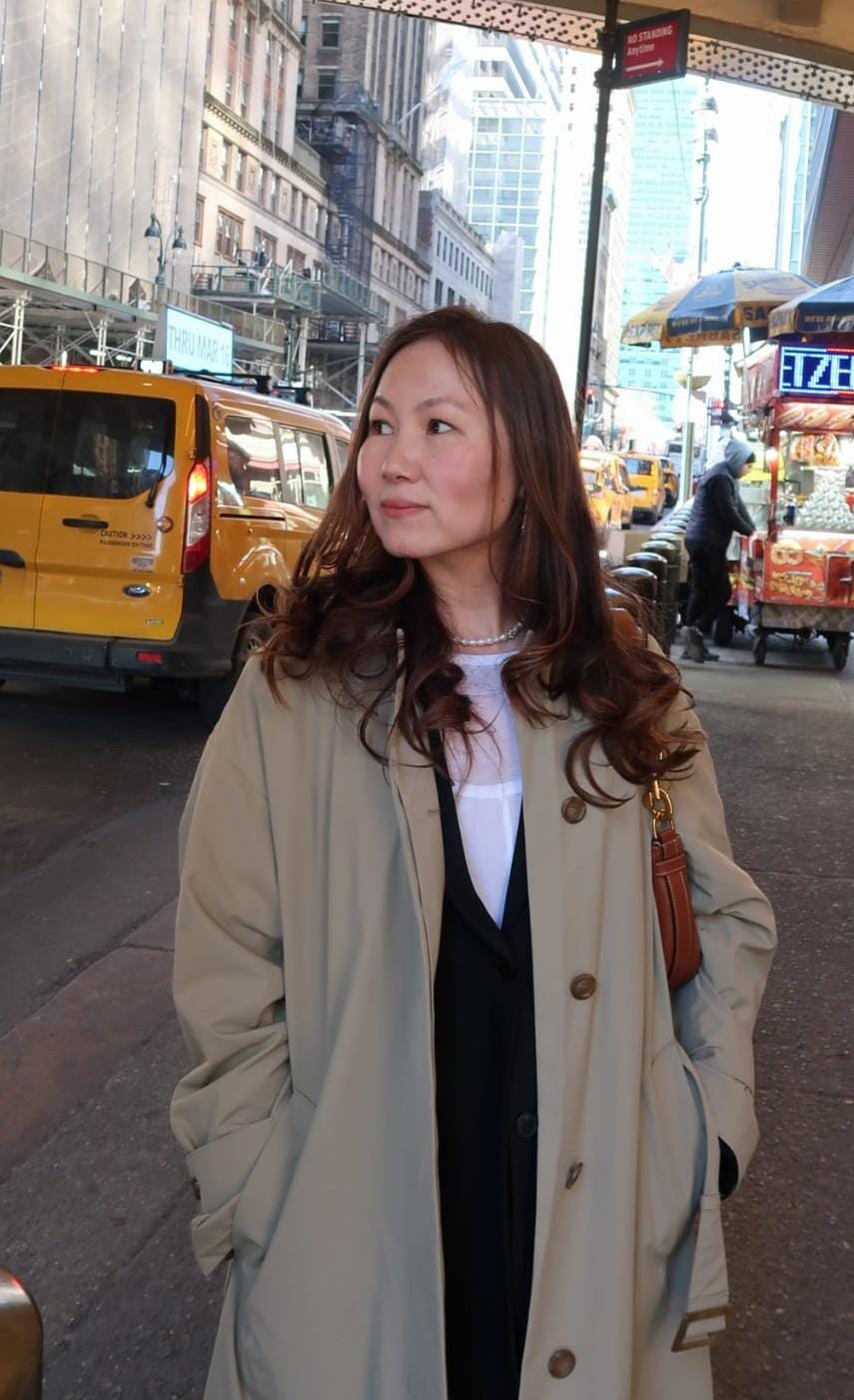
Aizhan Yesbolatova is a writer from Kazakhstan currently living in Jersey City, New Jersey. Writing in English as her third language, after Kazakh and Russian, she explores cultural belonging, motherhood, and identity in displacement from a Central Asian perspective. Her works have been published in HuffPost and Tint Journal, and she is the recipient of the Iceland Writers Alumni Award.
SEE THE ISSUE
SUGGESTED CONTENT
Blast
Nov 05 2026
“Talking with My Mother at Midlife” by Andrew Cohen
A spritely meditation on the rekindling of a son’s relationship with his mother after the death of his father, “Talking with My Mother at Midlife” by Andrew Cohen considers the… read more

Blast
Oct 22 2026
“Buckle Up” by Tyler Ayres
“Buckle Up,” is a story about two relationships of well-intentioned dysfunction and how they compare in a spontaneous moment. TMR’s online-only biweekly series, BLAST features prose too vibrant to be… read more

Blast
Oct 08 2026
“Starting Over” by Joseph Hamaker
In Joseph Hamaker’s short story, set in the busy years after World War II, the young son of a father who can do anything witnesses sudden devastation. Something can be… read more