
Blast | September 10, 2026
“Deep Background” by Douglas Abeles
Reflecting on his time as a background actor on the set of Severance, this Perkoff Prize finalist essay “Deep Background” by comedy writer Douglas Abeles asks what it means to live through something as life-changing as a stroke.
TMR’s online-only prose anthology, BLAST features prose too vibrant to be confined between the covers of a print journal.
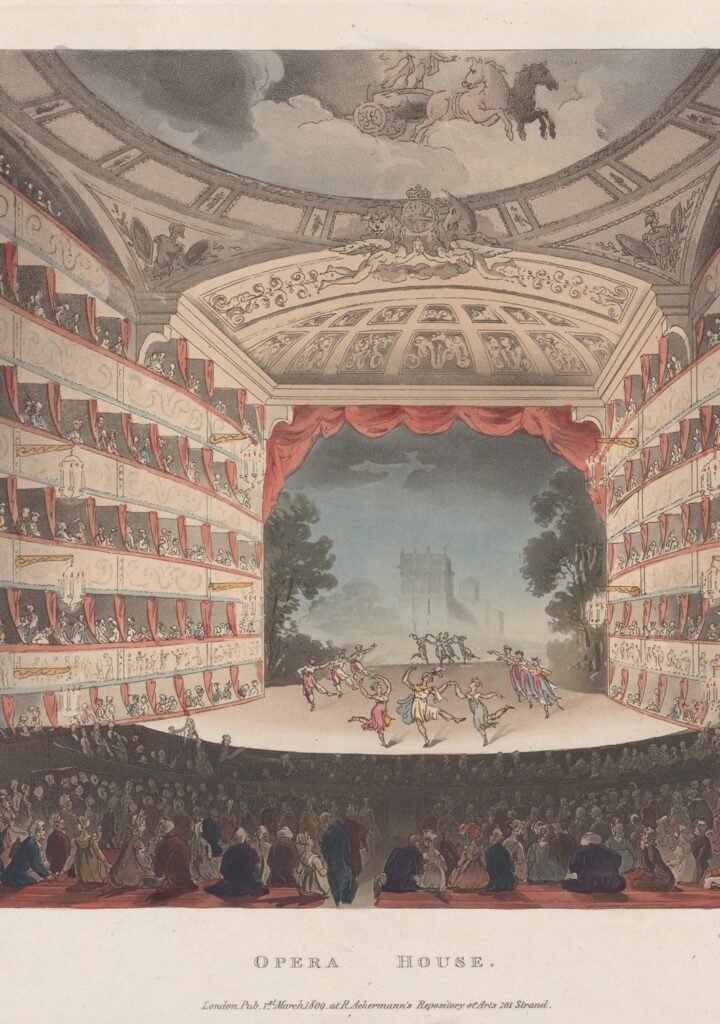
Artwork: Opera House (1809), Thomas Rowlandson (English, 1756–1827), Artvee.
* * *
Deep Background
Sometimes, you really have no idea what’s inside.
That’s certainly the case with the modernist Bell Labs building in Holmdel, New Jersey. Once home to some six thousand scientists and researchers, the mirrored-glass edifice, which stretches the length of three football fields, is today most recognizable as the headquarters of Lumon Industries, the darkly mysterious company at the heart of the Apple TV+ workplace drama Severance.
I’m at the building because I’ve been hired as a background actor for the show, which is shooting its second season. According to a production email, for the next two days I’ll be portraying “Lumon Worker #99.” For the unfamiliar, the conceit of Severance is that Lumon employees voluntarily undergo a microchip implantation that results in a memory split between their work and home lives. Each day as they descend the office elevator to their subterranean workspace, memories of their personal lives are temporarily erased. Conversely, as soon as they leave the office, they have no memory of what they did at work. It’s an arrangement that is, in its own creepy way, a disturbing commentary on work-life balance.
I hadn’t planned on becoming a background actor at the age of sixty-two. I’m here out of necessity, having suffered a stroke that left me with significant short-term memory deficits. Background work is one of the few jobs I can handle without frustration. In a previous lifetime, I was a late-night television comedy writer, having spent ten years writing and producing Saturday Night Live’s “Weekend Update.” More recently, I’d pivoted to screenwriting. At the time of my stroke, I was working on a dark comedy called The Obituary Writer. Yes, I know; given my near-death experience, the irony of the title is almost too on-the-nose.
My day as a Severance extra starts in Manhattan at six a.m. That’s when some one hundred of us board the two chartered production buses idling on Varick Street for the one-hour ride to Holmdel. Upon entering the Bell Labs building, we are collectively gobsmacked as we take in the vast atrium, naturally lit by a skylight soaring far overhead. Four floors of concentric balconies ring the interior, giving the space the vibe of a futuristic opera house.
The last time I was this stupefied was June 6, 2021, the day my stroke hit. Hit is the wrong word. A stroke doesn’t hit you. It flows over you, envelops you, the way a boa constrictor envelops an uncomprehending bunny. I was alone in my Manhattan apartment, standing at my bathroom mirror, trimming my already trim beard when a wave of dizziness overcame me. The room began to whirl and the floor seemed to recede from under me as if I were on a spinning anti-gravity carnival ride. Without warning, a black cloud descended. My field of vision ebbed from my periphery like the shrinking picture on an old-timey TV set after it’s been turned off, reducing to a single point of light before going all black. Oh shit, I’m about to pass out, I said to myself in italics.
In a surprisingly sober act of self-preservation, I dropped to my knees and braced the sink so I wouldn’t bash my head on the side of the tub should I keel over. I tried to calm myself by taking deep, slow breaths as I focused on the vortex of salt and pepper beard trimmings pasted to the inside of the basin. Damn, I thought, my beard looks good even in the sink. Somehow, I had the presence of mind to reach over and close the toilet seat lid so no one would think I’d died while attempting to defecate, the way Elvis did, and the way President Trump inevitably will when his time comes. Then, through some miracle, the black curtain retreated. I remained conscious.
***
“If you’ve already COVID-tested, please go to Wardrobe!” a Severance production assistant shouts. I wander to the far end of the holding room, where racks of costumes are waiting. We had been fitted for them two weeks earlier at the show’s production offices in the Bronx. Behind His and Her privacy scrims, I and the other men change into conservative business suits, while the women don modest skirts, white blouses, and heels. Hairstyles notwithstanding, we look like volunteers for Richard Nixon’s 1960 presidential campaign.
After Wardrobe, we’re sent to Hair and Make-Up and then to the props department, where we are handed customized, laminated Lumon ID badges displaying our actual photos. My inner fan-boy is ecstatic. What’s next, I wonder: my very own Waffle Party? (In Severance, a “Waffle Party” is a reward of sex and waffles given to the highest-achieving Lumon employees.)
Once fully costumed and outfitted, we’re lined up for inspection by the Head of Wardrobe. Eyeballing us like a drill sergeant, she slowly walks down our ranks, occasionally stopping to pull one of us out for an adjustment. The man next to me is unceremoniously relieved of his wool scarf. I half-expect him to be sent to the “Break Room” for his transgression, but it doesn’t happen. (The “Break Room” is where rule-breaking Lumon employees are punished and in essence are “broken.”) Next, our photos are taken, five at a time, front and back, like felons in a perp lineup.
Eventually, we’re sent back up to the sun-filled atrium where today’s scenes will be shot. Across the expansive floor I spot Ben Stiller, the series director, huddled with the Director of Photography and other crew. Another production assistant gathers us and explains the about-to-be-shot scene. In pairs and groups of three, we are to crisscross the lobby as the show’s star, Adam Scott, traverses solo. I’m paired with Philip, a pleasant man of about thirty, who I learn is a professional photographer. That’s pretty typical. Not everyone who does background work is an aspiring actor. Earlier, in the holding room, I sat with a former Rikers Island guard turned novelist. He proudly revealed he hasn’t cashed any of his recent background work paychecks. “What am I going to do with a hundred sixty-five dollars?” he laughed. Several others at our table quickly offered suggestions.
***
I didn’t know I was having a stroke. I thought I was simply dehydrated from my morning bike ride. Still, the dizziness didn’t subside. Unable to get to my feet, I reached for my phone and called my eldest son, Bennett, nineteen, who was upstairs at his mom’s apartment (we lived in separate apartments in the same building). He came down instantly and handed me a Gatorade, then gently applied a cold washcloth to my head and neck. Twenty minutes later, still too dizzy to stand, I called 9-1-1.
What transpired in the New York Presbyterian Emergency Department is still a blur. After scans were taken, I vaguely recall being informed by a very young, very serious doctor that I’d had a stroke. He said he needed my consent to administer TPA, a clot-busting drug that could potentially prevent brain damage, but also came with the risk of death. Even in my confabulated state, it struck me as absurd that I was being asked to make a life-or-death decision, but that’s medical protocol for you. I gave my consent without hesitation.
Sometime later, my ex-wife, Lori, still my best friend, arrived at the hospital and was quickly brought up to speed on my condition. I, on the other hand, couldn’t remember why I was there. “Stroke, Doug, you had a stroke,” Lori kept having to repeat for me. I believe my inability to recall the word was as much a result of cognitive dissonance as it was of my compromised memory. How could I have had a stroke? I cycled over a hundred miles per week. I was rail-thin. I ate sensibly. I’m embarrassed to admit this, but I secretly harbored the belief that I would be the oldest surviving member of my high school class. Me having a stroke just didn’t compute.
I soon learned I had incurred a number of deficits, including the loss of 25 percent of my vision—the upper right quadrant for each eye. Other tests revealed an assortment of pre-existing medical issues, previously undiagnosed, which my doctors believed may have been contributing factors. One such condition was a somewhat rare gene mutation called methylenetetrahydrofolate reductase, aptly known as MTHFR. Motherfucker indeed. The mutation made my blood thicker than normal, and therefore more likely to clot. This likely explained why my brain scans revealed evidence of prior strokes I never knew I had.
I also had a hole in my heart. Not the first time I’d been told this, though in the past, that sort of information usually came from an ex-girlfriend. The working theory was that the hole, called a patent foramen ovale (PFO), allowed my extra-thick blood to backwash into the chamber from which it had just been pumped, where it lingered, allowing a clot to form, which then traveled to the base of my brain. After my release from the hospital, I would need to undergo a PFO closure, a routine procedure in which a tiny patch is snaked up through an artery in the groin until it reaches the heart, where it is placed over the hole. Fun!
***
“Standby!” the assistant director (AD) yells from across the atrium. Then: “Rolling!” followed by “Background!” As instructed, Philip and I traverse the atrium in a loose J-pattern while trying not to steal a glance at the crossing Adam Scott. That’s rule number one in background work: never stare at the talent. “Cut!” yells the AD. “We’re going again!”
***
More tests and evaluations followed over the next several hours, but none revealed what I most wanted to know: was I still my essential “me”? I wasn’t cracking jokes yet, but then again, I was never that kind of comedy writer. I was more the “funny on the page” type. Indeed, I owed my longevity at SNL to the fact that social interaction wasn’t necessary to write for “Weekend Update.” The job mostly required me to sit at my desk, read the news, and crank out topical jokes. What I needed now was an indicator that signaled I was still my old self. But what would reveal that? I knew it was too soon to attempt writing jokes. Then it hit me. The New York Times crossword puzzle. I had long been a daily solver, obsessive enough to clock and record my completion times. Now, in an ironic turnaround, I hoped the puzzle would give me an answer.
I reached for the paper, turned to the puzzle, and started solving. Okay, yes, it was a notoriously easy Tuesday puzzle, but to my great relief, I completed it. Some core part of me was intact. And yet, despite this victory, my short-term memory was still very much MIA. I couldn’t, for example, recall the names of friends, first cousins, or for that matter, my doctors. In her demure British accent, my neurologist urged patience, telling me my recall might improve over time.
After two days in the Emergency Department, I was transferred to Intensive Care. There was still some petechial hemorrhaging going on, but my doctors were confident it would eventually cease, despite the high-dose aspirin and blood thinners they had me taking in order to prevent further clots. Five days after the stroke, I was released from the hospital.
It took months longer than expected for the hemorrhaging to finally stop, but when it did, I underwent the outpatient PFO closure. Shortly thereafter I started every therapy in the book: physical, vestibular, occupational, and cognitive. I know I saw a physiatrist, though I can’t tell you what she did. The cognitive therapist encouraged me to try sudoku. My sudoku skills improved. My memory did not.
By the end of the summer I found myself depressed and withdrawing socially. At a pool party at a friend’s Long Island house, I retreated to the far end of the property to sit by myself. And at home I would get weepy over TV commercials. Not the lugubrious ASPCA ones, the ones for McDonald’s and Carnival Cruise Lines. Also, my temper was on a hair-trigger. I became enraged over minor things, like my inability to orient myself upon emerging from the subway—a disconcerting experience for a lifelong New Yorker.
Thank God I could still read and write, if only in short bursts. I continued to work on The Obituary Writer, but that wasn’t paying my bills. With my savings running low, I needed additional income, but what kind of work could I do with my compromised short-term memory? I shared my predicament with a friend, Merrill, an immigration lawyer. With unaccountable faith in me (or was it pity?), she offered me a job drafting legal letters in her Midtown office. It would be easy, she promised.
There’s a learning curve on every job, but even after weeks working for Merrill, I couldn’t remember what floor her office was on, much less the technical aspects of the O-1 immigration letters I was tasked with drafting. Once at my desk, I would scribble Merrill’s various assignments and instructions down on colorful Post-it notes, which I taped to the inside of my cubicle. In short order, my workstation resembled the multicolored plumage of a large exotic bird. Even so, I felt as lost as the Severance character Helly R when she first finds herself in Lumon’s Macrodata Refinement Department, staring at the matrix of seemingly random numbers on her computer screen and not having a clue what she’s supposed to do with them. “It doesn’t make sense till you see it” she’s told by Adam Scott’s character, Mark. “And it takes a while to see.” Unfortunately for me, I never saw it. After three months in the office, Merrill had no choice but to let me go. In truth, I was relieved.
When I related this story to my friend Carolyn, she suggested I try movie and TV background work. She had been doing it for years and assured me the only thing it required was the ability to stand around for hours doing nothing. Though pre-stroke me would never have considered such a mind-numbing job, post-stroke me thought it sounded perfect. Nothing was something I could do.
***
Today, as I stand on my mark in the vast Bell Labs atrium, waiting for yet another take, I’m hit with a realization: in a way, my stroke has left me like the Lumon workers I’m here to portray. Like them, I too am missing large swaths of memory. Like them, I too cannot recall significant chunks of my daily experience. Like them, I too am severed. And like the protagonist, Mark, I too yearn for wholeness, to be able to put the severed pieces of my life back together. And yet . . . I recognize that in my case, the wholeness I seek may not mean a return to my pre-stroke self. That may never come. I will need a new definition of wholeness, one that includes all that I am and all that I am not.
I recall an experience I had weeks earlier, after my Severance costume fitting in Queens. Upon exiting the studio, I became lost and disoriented. I felt a familiar rage rising inside, disproportionate to what was really just a minor inconvenience. Then, for the first time since my stroke, I stopped myself from a boilover. I took a breath and calmed myself. And then I made a choice: to accept that being lost, being momentarily disoriented, was okay. This was part of my life now. This was who I am.
“Standby!” shouts the AD once more from across the atrium, jolting me out of my musings. “Rolling!” he yells, then “Background!” The other extras and I begin yet another slow amble across the atrium. Halfway across, I walk through a shaft of angled sunlight streaming through the glass skylight overhead. It momentarily blinds me, but I continue walking, confident that as soon as I pass through, I will be able to see again.
* * *
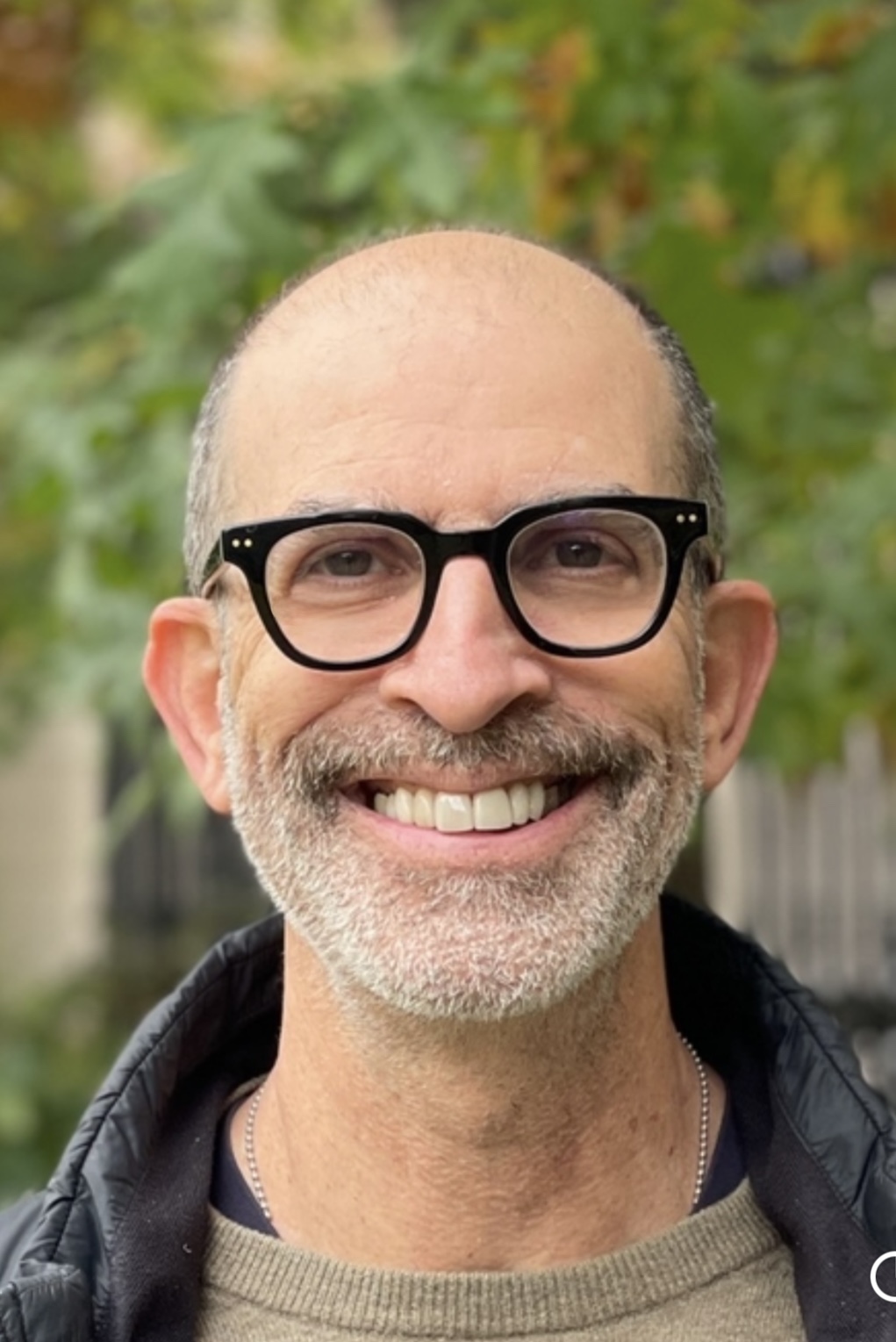
Douglas Abeles lives in New York City, where he worked in late-night television for several decades. Among his credits, he wrote and produced Saturday Night Live’s “Weekend Update” from 2001 to 2011, writing for anchors Tina Fey, Amy Poehler, Jimmy Fallon, and Seth Meyers. During his tenure at SNL, he received an Emmy, numerous Writers Guild of America awards, and a Peabody Award. His first published piece of nonfiction appeared in the summer 2026 issue of The Missouri Review.
SEE THE ISSUE
SUGGESTED CONTENT
Blast
Nov 05 2026
“Talking with My Mother at Midlife” by Andrew Cohen
A meditation on the crossroad that occurs at the cusp of middle and old age, “Talking with My Mother at Midlife” by Andrew Cohen approaches the grounding effect familial love… read more
Blast
Oct 22 2026
“Buckle Up” by Tyler Ayres
“Buckle Up,” is a story about two relationships of well-intentioned dysfunction and how they compare in a spontaneous moment. TMR’s online-only biweekly series, BLAST features prose too vibrant to be… read more

Blast
Oct 08 2026
“Starting Over” by Joseph Hamaker
In Joseph Hamaker’s short story, set in the busy years after World War II, the young son of a father who can do anything witnesses sudden devastation. Something can be… read more