
Blast | October 08, 2026
“Starting Over” by Joseph Hamaker
In Joseph Hamaker’s short story, set in the busy years after World War II, the young son of a father who can do anything witnesses sudden devastation. Something can be lost in an instant, but “Starting Over” is a long process that often begins in the past.
TMR’s online-only biweekly series, BLAST features prose too vibrant to be confined between the covers of a print journal.
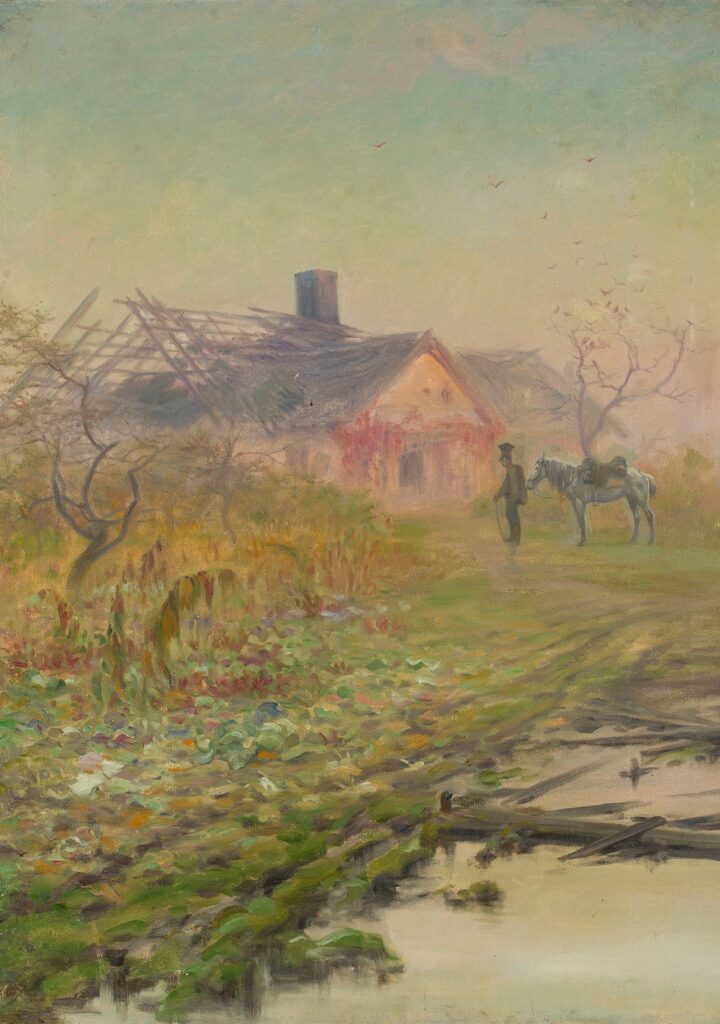
Title image: Return to a burned house (1916), Józef Ryszkiewicz
***
Starting Over
My Daddy stood at the bottom of the pole and waited for me to slide down. He had some business at the fire hall that afternoon, and he had brought me with him.
My Daddy was a fireman. He worked twenty-four hours on and twenty-four hours off. During the twenty-four hours off, he was a used car salesman, mechanic, weekend auctioneer of Chinese junk he acquired somewhere and brought to the auction house he rented from Columbus Ferrel in a 1950 GMC dually cargo truck, occasional truck driver, sometime peddler of Woodmen of the World life insurance. He had Don and Loretta Shockley and No Tail Bear run the Stick Willa Plaza Drive-in Movie Theater outside of town. During all national holidays, he had No Tail Bear clerk a fireworks stand out of a concrete block building right at the edge of Stick Willa.
Every so often, he and No Tail Bear would catch the train at the Stick Willa train station. My Mother would drive them to the station in my Daddy’s giant 1955 Buick Roadmaster, me in the back seat with No Tail Bear. When we got to the train station, we would wait for the arrival of the Dixie Flyer passenger train. The Dixie Flyer was the most magnificent man-made device my ten-year-old self had ever seen or hoped to see. There were two gigantic tandem diesel electric locomotives, sleek, streamlined, steel. They pulled a number of passenger cars including lounge cars and Pullman sleepers with large dark windows, followed by a line of baggage cars. When the train came, No Tail Bear, a big African American man, would wrestle two automobile tow bars from the trunk of the Roadmaster and carry them both, one in each hand, to the waiting Dixie Flyer baggage cars. He would slide open a baggage car door himself and toss the tow bars inside, never mind that each one probably weighed more than I did. No Tail Bear was supposed to ride in a segregated car at the end of the train, but my Daddy was having none of that, having been rescued wounded from a Battle of the Bulge battlefield by No Tail Bear. They sat together in the lounge car for ten hours all the way to Chicago smoking innumerable cigarettes. Once in Chicago, they stayed one night or maybe two nights at Bill Yancy’s LampLighter Club, a rare integrated environment. The day after arriving, they would attend a used car auction and purchase exactly four cars. Two men and two tow bars could get four cars five hundred miles back to Stick Willa in a fourteen-hour marathon of driving.
Once, when the Stick Willa News printed my Daddy’s photograph because he had killed a large rattlesnake at the Plaza Drive-in, the caption identified him as local businessman. He had laughed and told my mother he thought busy man would have been more apt.
But today he was an off-duty fireman, and he wanted me to slide down the pole. I was at the top, and when I grasped the big pole, slick and shiny as a snake, and pushed down, a pneumatic mechanism caused the clam shell doors in the floor to open, revealing my Daddy at the bottom of the pole, expectantly looking up for me to slide down.
“Wrap your legs around it and slide down,” he said.
When I took my weight off the pole, the clam shell doors would whoosh shut, and when I leaned my weight into the pole again, they would open, and my Daddy would be down there waiting. This little drill was repeated for quite some time, but the truth was I was afraid. Twice he went around by the steps and slid down by way of demonstration. Technique I understood; it was gathering courage enough to fling myself to the pole.
“Come on, Jimmy,” he said, “We haven’t got all day.”
Suddenly the fire alarm went off, the loudest noise I had ever heard in my life. I had to open my mouth to keep it from hurting, it was so loud. I jumped back and the doors whooshed shut, damping the noise a little. In just a minute, several full-time firemen came tromping out of the living quarters, pulling on various pieces of firefighting regalia as they came, and I watched enviously as each one slid down the pole without a thought.
I ran down by way of the steps and caught up with Daddy outside. He was wrestling firefighting clothes and equipment to the top of the heap in the trunk of the Roadmaster. Finally, from amid the fishing tackle, hunting gear, auctioneering bullhorns, jumper cables, Woodman of the World literature, he managed to extract firefighter’s boots, heavy canvas overcoat, gloves, and helmet, all of which he threw into the back seat of the Buick.
“Hop in,” he said.
I couldn’t believe it. I was finally going to get to go to a fire. Of course, what else was he going to do with me? For years, he had been a volunteer fireman, and every time the alarm had sounded, which could be heard all over town and for several miles out into the country, Daddy had rushed off to the fire. My dog Rocky had learned to bark Daddy awake when an alarm sounded during the night. When Daddy went to twenty-four hours on and twenty-four hours off, Rocky didn’t understand shifts and still tried to bark Daddy out of the house every time the alarm sounded.
But today, I leapt into the front seat beside him and we were off, following the big red pumper truck right through the center of Stick Willa and out the county highway. When we arrived at the scene, it was a two-story house burning. The house sat on a big lot all by itself a long way from the road, and there were spectators standing in the front yard watching. I couldn’t see any flames, but a surprising amount of dark smoke boiled out from around the cornice of the house. The house was amazingly quiet to have all that smoke pouring out of it. I wanted them to hurry and put out the fire, but all the firemen, including my Daddy, seemed to work slowly and deliberately like in a dream where everything is sluggish. They were taking forever to uncoil fire hoses from the truck and string them back down the road to the nearest fire hydrant a long way off. Before they could get water, fire was beginning to lick out of a couple of downstairs windows and had spread out of the open front door and onto the porch. It wasn’t as quiet now, and I could hear a rush of air as a whorl of sparks and smoke rose up into the sky. Then the house seemed to almost explode, and it was obvious that it wasn’t going to be saved. By the time they got water, there was nothing left to do but wet down the grass around the house to keep it from spreading.
We stayed there a long time, until the roof fell in and then the back wall, and still it kept on burning. Most of the spectators were beginning to leave, and I saw the family that lived there huddled together. The woman was wrapped in a blanket and stood staring at the ground, sobbing with two older children clinging to her while the youngest played at her feet. The husband standing beside her stared blankly at the house, and every now and then he answered when people wandered by him and said something. Occasionally somebody shook his hand, and once he and a passerby even laughed about something, but he didn’t laugh long and went back to staring at the house. Somebody said the fire had started from grease in the kitchen, but somebody else said it was an electrical short.
In the front yard, there were scattered possessions that somebody had managed to pull out before the fire department had arrived. There were several pieces of furniture, a few armfuls of clothes torn from a closet, some cardboard boxes full of things. The man and his wife wandered through in a daze, picking up things and laying them back down. Every now and then they would look at the smoldering ruins and just stare for a moment. Some firemen were hosing down the ashes, and some others just wandered around aimlessly. When it cooled off enough, they would try to see what started the fire.
I felt sad watching these people who had lost their house. I tried to make myself feel the way they must feel, but I knew I didn’t get it right, that I didn’t feel as awful as they felt. Their oldest was a boy about my age, but I didn’t go near him. I didn’t know what to say or do.
Then my Daddy went up to the man and his wife. I heard him say he was sorry that they hadn’t been able to save their house. The man said he understood, he knew they did the best they could. Daddy asked them if they had a place to stay, if there was anything he could do. The woman said maybe they could move in with her sister for a while. She said it vacantly, like maybe it wasn’t a very good possibility. My daddy and the man stood there together for a minute over one of the cardboard boxes, neither of them saying anything. The man moved the box a little with the toe of his shoe. Finally, my Daddy said, “Tough times.”
“Yeah,” the man said. He had his back to me, and I saw him shaking before I realized with a shock that he was crying. I was embarrassed that the man was crying, but it didn’t seem to embarrass my Daddy at all. He took off his helmet and tossed it down on the ground like it was worthless and gathered the man and woman together in his arms under that big canvas coat he had on. He stood there with them gathered in like that for a long time. When he finally let them go, the man and his wife were a lot better. Standing there watching that, I was really proud of him. My Daddy always seemed to know what needed doing, and he did it. I looked over at the oldest son again, who was observing all of this, and I felt like I ought to do something for him, but I didn’t. I just stood there.
When we finally left and were driving home in the big Buick, my Daddy was real quiet. I said, “What did you tell those people to make them feel better?”
He glanced over at me as if he had to think what I had said. “I just let them know I cared, that’s all.”
“What will they do now?”
“Start all over,” he said.
I hadn’t thought of that, starting over. I guess I didn’t know then that you could start over. It had seemed to me that once something happened like your house burning down that you had to live with it forever.
We stopped at a red light. My Daddy reached over and shook my knee the way he did. “They had insurance on the house. So, they can use that to rebuild. But even if they didn’t, they didn’t lose everything by a long shot. They all got out of that house alive. That’s all that’s important, don’t you think?”
I thought about that for a while. It seemed to me that the people had looked awfully sad for somebody that hadn’t lost anything important.
One night when Daddy was working, we got a telephone call in the middle of the night. Mother woke me up. She was real scared. Daddy was sick. By the time we got to the Stick Willa hospital where the ambulance had taken him from the fire hall, he was dead. He had had a heart attack in his sleep and had really died even before the ambulance could get there. He was forty, and I was ten, and I didn’t have a Daddy anymore.
That was in August, and along about October when the evenings were cooler and it was pleasant outside, my mother and I often sat out in the yard and watched the stars come out. I was in the fifth grade, and we were studying astronomy. I knew the names of some of the constellations, and I liked to show her. I showed her the Northern Cross, Pegasus, Pisces. Sometimes we talked about Daddy and usually we both cried there in the dark, although I tried not to. We shared the aching loss, tried to assimilate reality from disbelief, and cushioned each other’s anger. Mother talked about us having to rebuild our lives even though it wasn’t going to be easy. From that time forward, I have always felt less than whole, aware of a piece missing, a certain incompleteness.
One day, Mother and I were driving out County Line Road and happened to pass where the fire had been. I told her it was the place where I had seen Daddy fight the fire, and she slowed down. They were rebuilding the house. They had it framed up and were putting down the decking for the roof. Several men were up there in the hot sun working, and I recognized one of them as the man who had cried. I watched him nailing down a big piece of plywood.
It was a couple of days later that I rode my bike to downtown Stick Willa to the fire hall. Both bays were open, and they had the trucks pulled out, and several shirtless men wearing big boots were washing them. The red trucks gleamed in the bright sunlight. They liked to keep their fire engines clean. When one of them men saw me, he called out, “Hey, it’s Jimmy.” One of the others dropped his hose and came and put his arm around my shoulder. “How you doing, Jimmy?” he said. “Let’s go see the chief,” and he walked me inside to his office where the chief and another man were leaned back in chairs talking. The chief rolled forward in his chair when he saw me. “Hi, Jimmy,” he said, and he held his gaze on me for a second or two longer than he ever had before. “How are you and your mother doing?”
“Fine,” I said.
“Here,” he said, “Have a seat.”
“No, thanks,” I said. “I just came . . . I wonder if it would be OK if I slid down the pole once?”
“Sure, it’d be OK, Jimmy,” the chief said. “Slide down it all you want.”
“Just once. That’s all I want.”
“Take him up there,” the chief said to one of his men.
“I can go,” I said. “I know the way.” I went around and up the steps and into the firemen’s living quarters. There was no one else up there—they were all out washing the trucks. I walked around. There was a row of parallel beds with firemen’s clothes at the foot of each bed ready for the man to step into. I thought I knew which one Daddy’s had been. I stretched out on it very carefully and lay there for a while looking up at the ceiling. I tried to feel like he must have felt lying there. Then I got up and smoothed the blanket so whoever had that bed now wouldn’t know. I looked into the kitchen, the TV room, the bathroom. I tried to imagine my Daddy walking, moving around in these rooms. I went back out front to the pole and stood looking at it for quite some time. I imagined my Daddy sliding down it. Then finally I reached out to it, hugged the pole tight, and rode it down. When I was at the bottom and standing on the rubber mat, I opened my eyes and looked back up in time to see the doors snap shut in the ceiling.
Some of the firemen had heard me come down the pole and had turned from washing the trucks. “Good slide, Jimmy,” one of them said. “Go around and go again.”
“No, thanks, ” I said. I went to my bike.
“Come back to see us anytime.”
“I will,” I said, pushing off down the sidewalk. I didn’t figure I would be back any time soon. I thought maybe I would never be back.
That night, I woke up in the middle of the night. There was an apple orchard behind our house, and through my window, I could see the bare-limbed trees illuminated by a cold clear October moon and lots of stars. I watched the apple orchard for a long time, half expecting to see some silvery ghost pass among the trees, but all was absolutely still and quiet. Then I heard the undulating wail of the fire siren a long way off in town. Slowly, softly, somewhere down there within the shadows of the trees, my dog Rocky forlornly took up his barking.
***

Joe Hamaker is a cost analyst with Galorath Federal, a leading international supplier of parametric cost models and cost analysis consulting services. Previously he worked for The Millennium Group International, SAIC, NASA Headquarters, and NASA’s Marshall Space Flight Center. Dr. Hamaker has a BS in Industrial Engineering from Tennessee Technological University, a BA in economics from the University of Alabama in Huntsville (UAH), an MS in Engineering Management from UAH, and a PhD in Industrial and Systems Engineering from UAH.
Dr. Hamaker’s professional career has been centered on parametric cost analysis of space flight projects and related areas such as regression analysis, cost and schedule risk analysis, engineering economics, organizational databases, and the project management policies that support best in class cost and schedule analysis. He was the originator of NASA’s NAFCOM cost model, the NASA QuickCost Model, the NASA Cost Analysis Data Requirement, and the NASA ONCE database. Over the span of his career, he has performed or managed the performance of hundreds of cost analyses of space flight projects including automated spacecraft, spacecraft instruments, launch systems, and human space missions.
Dr. Hamaker has served in leadership positions at NASA Marshall Space Flight Center, NASA Headquarters, the American Institute of Aeronautics and Astronautics (AIAA) Economics Technical Committee, the Space Systems Cost Analysis Group, and the International Society of Parametric Analysts. He is a long-time member of, and certified by, the International Cost Estimating and Analysis (ICEAA). Dr. Hamaker has written widely on the subject of space cost analysis.
He and his wife reside in Cocoa, Florida.
SEE THE ISSUE

SUGGESTED CONTENT
Blast
Nov 05 2026
“Talking with My Mother at Midlife” by Andrew Cohen
A meditation on the crossroad that occurs at the cusp of middle and old age, “Talking with My Mother at Midlife” by Andrew Cohen approaches the grounding effect familial love… read more

Blast
Oct 22 2026
“Buckle Up” by Tyler Ayres
“Buckle Up,” is a story about two relationships of well-intentioned dysfunction and how they compare in a spontaneous moment. TMR’s online-only biweekly series, BLAST features prose too vibrant to be… read more

Blast
Oct 08 2026
“Starting Over” by Joseph Hamaker
In Joseph Hamaker’s short story, set in the busy years after World War II, the young son of a father who can do anything witnesses sudden devastation. Something can be… read more