
Blast | September 24, 2026
“Ant” by Giacomo Sartori
“Ant,” a playful story by Giacomo Sartori translated from the Italian by Michela Martini and Elizabeth McKenzie, explores the pleasures and dangers of unfettered individuality.
TMR’s online-only biweekly series, BLAST features prose too vibrant to be confined between the covers of a print journal.
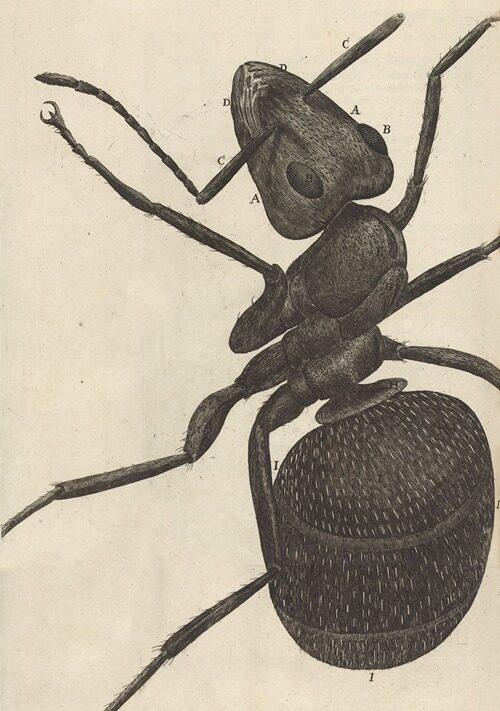
Title image: Microscopic view of an ant or pismire (1665), Robert Hooke
***
Ant
It’s nice living the way we do, so close together. We never feel abandoned to our own destinies or that we’re useless. After all, there’s no time to indulge in sad thoughts: in the morning, before we’re barely awake, we’ve already been assigned to a specific collective activity. Carrying grains of some sort, expanding the pantries, cleaning up among the supplies of crumbs, tidying the graveyard, taking care of the eggs: there is always something to do. When the evening comes around, we’re dead tired: there’s just enough time to say goodnight to the others, and then we’re in dreamland. Our true strength is that, while we work, we communicate, so we don’t even notice the fatigue. We ants never shut up. Certainly, compared to the ladybugs’ screams that shatter our ears or even just the thud of a rose petal when it crashes onto a blade of grass, our little voices are barely noticeable. We chat and chat incessantly. In the very rare occurrence that none of us feels like jabbering on, we chant one of our cheerful marches, there to lift the spirits of both those who sing them and those who listen.
From what I hear, most other creatures live very differently. Instead of helping each other, they think only of their own personal gain, however absurd that may seem. Every morning, instead of amassing supplies in the anthill, they set off in search of something to promptly stuff in their stomachs. They’ll go in any direction, come what may. And once they find that something, heaven help any friend who comes close and tries to take a piece: there will be growls, insults, threats. The outcome of this nice state of affairs is that little by little they end up calculating the best way to screw each other over, to appear stronger than they are while exerting as little effort as possible. Sooner or later, even the most helpful and generous become full-blown egoists, overbearing and insolent: society becomes a series of disputes and abuses. Needless to say, nine out of ten times, the most cunning, the most arrogant, wins. The law of the jungle.
We ants are a lucky species, there’s no doubt about it. Around here, we live by the sacrosanct principle that what’s mine is yours, and that the good of the anthill must come before everything else. We all have the same rights and duties, the same responsibilities. The days go by placidly and industriously. In fact, like my friend always says, it’s nonsense to rack your brain deciding if one day was better than another, because in the end, they’re all very similar except for trivial details. When I say “friend,” we need to be clear that we ants are all friends to a greater or lesser extent. Let’s just say she’s my closest friend.
And yet, I must confess: every now and then I get a strange craving. For example, a few days ago, we had to carry pieces of straw to the summer warehouses of the hill, who knows what for. They never explain anything to me; they say it’s useless, I’d forget anyway. Come on, I wouldn’t forget that quickly! I’m just a bit scatterbrained sometimes. In any case, that afternoon the topic of conversation in my sector was the following: is it more satisfying to toil away when it’s sunny or when it rains? As it always happens, there were some who praised the merits of good weather and others who defended the rain tooth and nail. My friend, true to form, insisted that it was all the same to her: what mattered was making herself useful. She’s one of those ants who always have categorical opinions pretty much about everything. In a way, one could consider her a political extremist, a Maoist, if only politics meant anything to us.
I listened but said something only every now and then. I’m not one of the chattiest: in fact, since I was a child, I have been considered an introvert. Or rather, if you listen to my friend, I either keep my mouth shut as if I’m at a funeral or I prattle away, nothing in between. That doesn’t seem right to me. It’s true, sometimes I’m lost in thought, and other times I feel it necessary to describe in detail whatever crosses my mind, but one certainly shouldn’t make a cherry out of a speck of dust. Whatever she says, I am perfectly normal.
So there I was transporting my sliver of straw, more or less like all the others, when suddenly I felt like setting off in a direction perpendicular to the marching line. I don’t know how to describe it better: a vague attraction, a daydream.
“Come here, you’re making a mistake!” the others would’ve immediately shouted, I thought to myself. “Come back, hey!” But as if I’d heard nothing, I would’ve continued on, further and further from the path. How far? Why? I really didn’t know. It was just an idea, a whim of the imagination.
And yet, the more time that passed, the more that urge took on the characteristics of an uncontrollable itch. It took a tremendous effort to follow the trajectory of the comrade ahead of me. One-two-three, one-two-three, I kept repeating to myself, hoping the feeling would go away. And if it really did happen, what excuse would I come up with, I started wondering, while feeling some ice-cold sweat trickling along my neck. Nah, don’t worry, it’s just one of those crazy things that pop into your mind when you nibble on a slightly fermented grape, I reassured myself. However, I might add, that afternoon I hadn’t been anywhere near a fermented grape. It had to be the day’s scorching sun on my head, I hypothesized while trying to contain the convulsive quivering of my antennae.
Anyway, long story short, at a certain point I realize there’s a thrilling silence around me. Something similar to when in the anthill there’s the danger of an external attack, and the order comes to hold our breath until further notice. But with the difference that I’m in a meadow, and there is no enemy here: a very different scenario. I place the straw on the ground and raise my head: I see clumps of dirt, pebbles, blades of grass, but not a single ant. Oh my God! I tell myself. I look behind me: same thing, nobody, a desert!
Where was I? What the hell had happened? Had my comrades disappeared into thin air like dewdrops in the sun? No, there was no other explanation: as hard as I’d been concentrating, I’d kept going straight instead of marching toward the entrance to our hill. And now? What could I say to justify myself? Who would have believed that while simply trying to do my best, I had committed such a serious breach of the rules? In fact, as far as I knew, the rules didn’t even account for anything this outrageous. The most disquieting thing was that the sun was setting, and soon it would be dark.
By really stretching my antennae, I pick up some noise: a buzz like that of silly girls, giddy as they plot some kind of prank. I place the straw in full view, vertical—I wouldn’t want to lose it on top of everything else—and head toward the source of that cackle. Emerging from behind an endless chestnut leaf, I see what it is: at the entrance to their den, two crickets with scratchy voices are speaking into each other’s ears. Tender words, it seems. They caress and hug each other. They don’t realize how close I am; they don’t care at all about my presence. One can understand why they are so relaxed—I think—these two just got up! For those who live at night, it’s wake-up time, of course. I’d like that too—to be pampered by a friend upon waking. Seriously, who wouldn’t? In our species, we all tend to be a bit hasty and don’t leave much time for affection.
As I stand there thinking, I start to feel some discomfort observing these two crickets who, instead of working, are doing their things. I feel I should turn on my heels that very instant. And yet, at the same time, I’m overwhelmed by a very intense sensation—a violent inner turmoil I have never before experienced: a whirlpool of delicious nectar that keeps me rooted to the spot. No, it isn’t simply a sense of tenderness: it’s some sort of inebriating dizziness, a heartbreaking sense of emptiness. The sky is gorgeous; it looks like an immense fire struggling not to die.
At one point, the two big creatures do something even stranger: they lock into each other. In some ways, one could say that they are suffering because they gasp and moan, but at the same time, they smile, and it looks like they are having a good time. And so, who knows why, my uneasiness turns into a sort of anxious longing. A desire to merge with another body: a being just like me, but at the same time, a little different. A true folly, I am aware of that! Perhaps it’s the consequence of loneliness: it’s the first time that I’ve ever found myself truly at my own mercy. Or maybe it’s that sky, as red as fire, that air so sweet, so fragrant with jasmine flowers. When I finally make it back to the anthill, I get called all sorts of things: the usual scatterbrain, the dunce, the poetess, the village idiot. The young ants hold their bellies from laughing; the elderly look at me with reproach. Also because, I’ve just realized, I’ve left behind the straw. I would die from shame if I could. My friend, on her behalf, is so upset that she circles around me at full speed, unable to say anything. If I’m capable of such monstrosities, then it’s truly serious! She starts shouting at me. I’m a public menace! A lunatic! She really lays it on thick. In her opinion, the only remedy is to toil twice as much for a while: it’s still the most effective cure for whims and neuroses.
“You are right, that’s exactly what I will do,” I tell her, my head down, when she is done venting.
“You’d better, if you don’t want things to end badly,” she admonishes me with her crow-like voice. But her eyes appear saddened because ultimately she isn’t as grouchy as she seems, and she loves me, in her own way.
For a few days, everything went well, I worked, and that was it. Without daydreaming, without crickets—literally!—in my head. But then, yesterday, there was another unpleasant episode. Nothing tragic, mind you, so much so that I might not even mention it. And yet, sometimes I wonder if it isn’t a red flag for something very serious, like my friend claims. We were gathering all the seeds into a big pile in order to transfer them to the anthill in a well-disciplined line. We had made good progress, probably three quarters of the work done. Well, every time I dumped a seed in the pile, I would stare at a poppy petal that had somehow ended up near there. And I’d think that I’d like to sneak underneath it in secret. The others wouldn’t know, but I’d be there, very close; I’d see all that they were doing, hear all that they were saying. Maybe they would even talk about me. Where on earth could that anarchist have gone? Doesn’t she know there are things you just don’t do? Who does she think she is? And if everyone acted like her, where would we end up? Could she have slipped under the pile? Maybe she marched straight ahead like she did the other day? Or perhaps she’s tucked away with someone else? How exciting that would’ve been! But would I really have managed to keep a straight face, not to laugh? Or would I have burst out giggling uncontrollably, like I sometimes do?
“Now you are even laughing by yourself?” my friend’s self-assured voice cut me off.
“Nothing, nothing, I was just thinking,” I answered, struggling—but without much success—to push back the series of tsunamis of an irrepressible laugh. The most embarrassing thing was that I didn’t have the slightest idea how long I had been there with my head leaning against the pile of seeds, as if under a spell. I immediately resumed a brisk pace, coughing to keep my composure.
“And may I ask what you were thinking about?” she asked me, with a tone that implied that I am truly incorrigible.
“Of the crickets’ sighs.” I replied. I have no idea how the heck I came up with something like that.
***

Photo by Massimo Sussini
Born in 1958, in Trento (Italy), Giacomo Sartori lives and works between France and Italy. He is an agronomist and soil scientist. He has published eight novels, four collections of short stories, and four picture books as well as a collection of poems. In 2023, he published a book of essays on agriculture and related environmental issues, followed in 2025 by a collection of writings on soil, some of which had been translated on the Massachusetts Review blog. His novel Baco [Bug] was a finalist for the 2020 Premio Procida Award and for the Gelmi di Caporiacco Award. His novel Fisica delle separazioni [Physics of the separations] was a finalist for the 2024 Premio Chianti. The English translation of his novel I am God (2018) was a Financial Times Best Book of 2019 and won the 2019 Foreword INDIE Gold Award for Literary Fiction and the 2020 Italian Prose in Translation Award. The translation of the novel (2018) was a finalist for the 2022 Philip K. Dick Award. He won the Premio Frontiere Grenzen Award (2011) and the Premio Cesare Guasti (2025), was a finalist for the Premio Settembrini Award (in 2012 and in 2013), and was runner-up for the Premio per voce sola 2013 Award. He’s an editor of the online literary collective Nazione Indiana: nazioneindiana.com.
***
Michela Martini and Elizabeth McKenzie were awarded a 2023 NEA Translation grant for the novel Anatomy of the Battle by Giacomo Sartori, to be published in 2027 by McNally Editions.
***

Photo by Drew Todd
Michela Martini has taught Italian language and culture at Suffolk University, Indiana University, Cabrillo College, and the University of California, Santa Cruz. She cofounded and directed the Dante Alighieri Society of Santa Cruz. Her translations and cotranslations from Italian into English and from English into Italian include the work of poets and novelists such as Edoardo Sanguineti, Giorgio Caproni, Gabriella Leto, Patrizia Valduga, Rossana Campo, Emanuele Trevi, Giacomo Sartori, Elizabeth McKenzie, Ellen Bass, Jewelle Gomez, and Scott Hutchins. They have appeared in numerous journals and volumes, including The Literary Review, Poetry International, Gradiva, Catamaran Literary Reader, Chicago Quarterly Review, Journal of Italian Translation, Italian Poetry Review, Nazione Indiana, Poesia, Alfabeta 2, and The FSG Book of 20th-Century Italian Poetry. In 2025, she was selected as a juror for the Premio Strega, Italy’s most prestigious literary prize, awarded annually for excellence in contemporary fiction.
***

Photo by Linda Ozaki
Elizabeth McKenzie’s novel The Dog of the North was a New York Times Editors’ Choice and a finalist for the Los Angeles Times Book Prize in fiction. Her novel The Portable Veblen was longlisted for the National Book Award, shortlisted for the Women’s Prize, and received the California Book Award. It was named a Best Book of the Year by NPR, The Guardian, The San Francisco Chronicle, Kirkus, and many others. She is the author of the novel MacGregor Tells The World, a San Francisco Chronicle and Chicago Tribune Best Book of the Year, and Stop That Girl, shortlisted for The Story Prize. Her work has appeared in The New Yorker, The Atlantic, Best American Nonrequired Reading, and others.
SEE THE ISSUE
SUGGESTED CONTENT
Blast
Nov 05 2026
“Talking with My Mother at Midlife” by Andrew Cohen
A meditation on the crossroad that occurs at the cusp of middle and old age, “Talking with My Mother at Midlife” by Andrew Cohen approaches the grounding effect familial love… read more

Blast
Oct 22 2026
“Buckle Up” by Tyler Ayres
“Buckle Up,” is a story about two relationships of well-intentioned dysfunction and how they compare in a spontaneous moment. TMR’s online-only biweekly series, BLAST features prose too vibrant to be… read more

Blast
Oct 08 2026
“Starting Over” by Joseph Hamaker
In Joseph Hamaker’s short story, set in the busy years after World War II, the young son of a father who can do anything witnesses sudden devastation. Something can be… read more