
Blast | November 05, 2026
“Talking with My Mother at Midlife” by Andrew Cohen
A meditation on the crossroad that occurs at the cusp of middle and old age, “Talking with My Mother at Midlife” by Andrew Cohen approaches the grounding effect familial love and connection has on life: in the past, present, and future.
TMR’s online-only prose anthology, BLAST features prose too vibrant to be confined between the covers of a print journal.
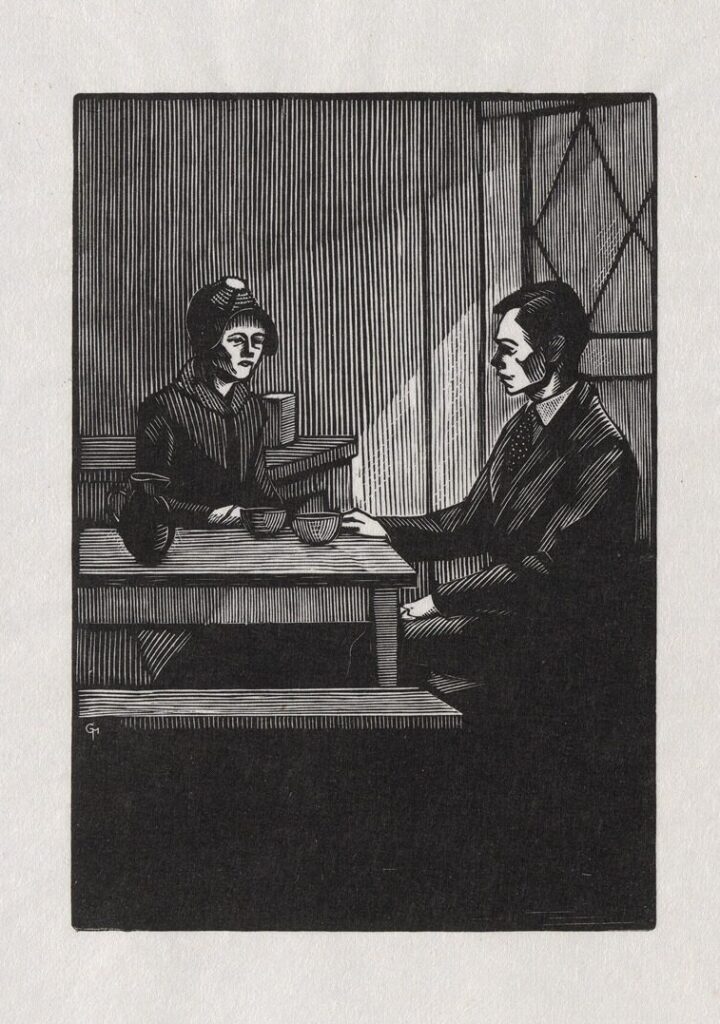
Artwork: La mère et le fils (1952), Marc Gonthier (Swiss, 1895–1954), Artvee.
* * *
Talking with My Mother at Midlife
“What, are you sleeping again?” I say over the phone to my eighty-seven-year-old mother, undoubtedly lying, all ninety-two-and-a-half pounds of her, feet up on the couch in the dark living room of the New York City apartment where she’s been living alone since my father died almost two years ago. “Where are you? What time is it anyway?” she says, and I tell her that it’s almost 10 p.m. by her—that I’m driving to my weekly Hebrew class here in Portland. “I must have dozed off,” she says, her words gummy from sleep. “I had such an awful day, Andrew,” she says, and I laugh as I drive through the quiet, twilit streets near our home, where my younger son and wife are watching after-dinner television: “Another one?” But my mother is already talking about the repairman who was supposed to come fix the stove and how she was ten blocks away buying groceries when he called to say he was there, thirty minutes early, and how she had to rush home in a taxi because he didn’t have insurance papers to get into the building, and then, while she was negotiating that, the electrician who was supposed to come on Monday showed up unannounced to fix the light box in the kitchen, which he did, though when he told her it would be a hundred dollars and she asked for an invoice, he said, “If we do it that way, it will be $240,” at which I laugh again. “Extorting a little old Jewish lady,” I say. “Some nerve! So, what did you do?” and she says, “What should I? I went and got him a hundred-dollar bill and he left,” at which I say, “That was the whole, awful day, Ma?” to which she says, “Do you know at one point I felt so overwhelmed I began to cry?”
In fact, my mother is doing pretty well for eighty-seven. She lives independently. She does her own shopping. She takes buses and cabs around the city to her appointments. She walks out to Central Park and gets herself chocolate muffins at Le Pan Quotidien. She visits weekly via Zoom with her Yiddish book group and her trainer. She (reluctantly) serves on the board of a small Jewish arts nonprofit. To be sure, she has help: a housekeeper, who comes once a week and tries to find enough to keep busy for seven hours; a man who comes occasionally to cook a few meals. My brother lives across town and can run over to help change a lightbulb or take her to dinner, and I help with her finances. Still, if you saw her pushing a grocery cart through Pioneer Supermarket, you’d think, “Could be worse.”
Not that you’d know it from talking to her. On the contrary, to listen to my mother is to listen to someone who experiences life as an agonizing series of trials—nerve-racking journeys, harrowing decisions, unbearable conundrums—that she is almost certain to screw up and even if she doesn’t will leave her feeling badly all the same. “I don’t know, Ma,” I say, stopping at a red light. “It sounds like you handled it all pretty well,” to which she says with defeat, “I don’t know what I’m handling, I’m so tumeldik.” As I sit at the intersection, watching the evening traffic swirl around me, I am distracted by the weight in my chest that seems to have taken up permanent residence over the past couple of years, the sense that my life isn’t working out the way it’s supposed to and, too, that there’s little to be done about it. “Well,” I say, startling as a car honks behind me, “whatever you’re doing, keep at it. As far as I’m concerned, you’re doing great,” to which she says doubtfully, “You just like to talk me up,” and I say, “Not at all. Think how much you’ve learned to deal with since Dad died: repair people, bank accounts, computers. It’s impressive,” to which she says, “I should become optimistic?” and I laugh heartily as I pull into the synagogue lot. “God no, Ma! If you become optimistic after all these years, you’re liable to drop dead from the shock,” I say, at which she lets out an old, wheezy laugh, and I think how much I love to make my mother laugh. “You hold on to that despair and pessimism till your final breath,” at which she pauses with a new concern: “Is that what you’re going to say about me?” she says, to which I say, “At your funeral? Absolutely. I’m going to stand up and say, ‘My mother was an extremely neurotic woman who always looked at the dark side of things.’” In the silence to follow, I imagine the alarm coursing through her frail, osteoporosis-riddled little body that will surely crack in half if, God forbid, she ever falls and feel a surge of delight—I am a twelve-year-old boy again, provoking the mother he loves so dearly—until I can’t bear it any longer and burst out laughing. “Don’t worry, Ma,” I say. “It’s our little secret. I gotta go. Just remember: stay on your feet. And don’t become optimistic.”
* * *
I’ve spoken to my mother every day, often twice, since my father died, not because I feel obligated or because I am worried about her, or (merely) because of the amount of logistical coordination required for me, along with my brother and sister, to help her navigate life in my father’s absence, but because I love to talk to her, to hear her voice—because I feel such an abiding sense of comfort, holding, and connection when we speak. There’s something so deeply reassuring to me as I listen to her worries and regrets and overwhelm, her stories about her daily adventures and misadventures, and help her navigate her anxiety and frustrations and dilemmas, reassuring her, cajoling her, encouraging her, talking her down from the proverbial ledge she often finds herself standing on.
In her presence, I feel completely and utterly at home.
It wasn’t always this way. For much of my adulthood, I ducked and dodged around my mother; often I stayed away. But something changed after my father died. Partly it’s just his absence, the enormity of the space he left behind, that has softened her, made her more pliable, easier if no less anxious, given her—and us—more room to maneuver, as well as the rash of other deaths in the family, an entire generation vanishing before our eyes, that has left us feeling exposed, huddling closer as though for warmth. Then too there have been the unsettling changes in the Jewish world these past couple of years, the myriad worries and concerns suddenly hanging over us. And there have been other, more mundane changes in my life: with one son having left for college, and the other soon to follow; the inevitable shifts and curves in a long marriage and a teaching job that seems after twenty-five years to belong to another lifetime; weird and worrying physical ailments—tingling in my toes, an occasional tremor in my hand—that have made my body feel like a stranger to me, all of which have left me feeling disoriented, afraid, alone, heartbroken, too, lost in a sprawling and unfamiliar wilderness whose landscape I can’t fathom and boundaries I can’t discern.
Yet here, in the midst of this wilderness, I have found my mother again.
To be sure, I still grow frustrated with her, though it’s a passing frustration, a loving frustration, a knowing-it’s-all-going-to-be-over-soon frustration. I mean, she can be incredibly self-absorbed, my mother, nearly swallowed by her anxieties. The moment she answers the phone, she immediately and in excruciating detail begins reporting about her day, how—this, one night last week—she spent nearly an hour on the phone getting the air–conditioning people scheduled, after which she tried to pay some bills, only she realized she was out of checks, which found her heading over to the bank, where a nice woman helped her order more, after which she went over to Lenwich to get a sandwich because it was already two o’clock and she hadn’t eaten a thing, but when she got the sandwich home she found the avocado was spoiled, which found her calling up the store and talking with the manager who, after a lot of back and forth, offered to send a new sandwich with a delivery boy, but said that it would take a half hour, by which point it would have been almost three o’clock, so she just threw out the avocado and ate the sandwich, and then— “OK, Ma,” I say. “Glad you got it resolved. That’s enough reporting now,” to which she says, “I know you’re right: too much reporting,” before continuing about how she got a message from her hairdresser who called to say that he’s moving to a new location in midtown because of a disagreement with his business partner, which will make it very inconvenient to get to— “Alright, Ma,” I say. “That’s enough. I’m sure it will be OK. Now it’s time to ask about me,” to which she says with alarm, “Why? Is something the matter?” at which I laugh and say, “No, Ma. Nothing’s the matter. It’s called a conversation,” which might have insulted her in the past, but now finds her apologizing. “I’m sorry,” she says. “I shouldn’t complain so much. Everyone has tsuris,” to which I say, “You don’t need to apologize to me. I told you: our ledger is clean,” and I mean it: try as I might, I can’t muster any resentment toward her these days. “In fact,” I continue, “I was recently thinking that the only thing I hold against you is my name.” “Really?” she says, to which I say, “Yes, really. We’re Jewish for god’s sakes. What were you thinking?” to which she says, “You know, I really don’t remember,” sounding typically puzzled by how her life has unfolded—as though all of it happened without her doing—a manner I used to find maddening, though now, as I take stock of my life, I wonder if she isn’t onto something: who, after all, can adequately account for life on this earth? “I guess I thought it was a nice name,” she says, explaining how they wanted to name me after my father’s grandmother, Anna. “Ascher, Abraham, Avery, Adam—there are a million Jewish names beginning with A besides Aron,” I say, referring to her father who was still living at the time. “Or find a different relative. God knows there were a lot of dead ones to choose from by then.” “Well, I’m sorry to disappoint,” she says with resignation, at which, so as to avoid making her feel more guilt than she already feels, I change course. “I guess it could have been worse: you could have named me . . . Peter,” I say, referring to my older brother, which pries a laugh from her.
* * *
I almost always call my mother: on my way to teach. On my way home from tap dance class. When I’m on a bike ride. (My mother is one of the few people who doesn’t mind the noise of blowing wind on the microphone). She always answers, too, even when she can’t talk and will invariably feel put out because she’s on another call or a crowded bus or paying for groceries. “Andrew, I can’t talk right now,” she’ll say tautly, never considering the possibility that she might not have answered in the first place. On those occasions when she calls me, it is rarely to say “hi” but because she needs help. “Hello, Ma,” I say breezily. “Calling to see how my day is?” “Actually, I have some questions,” she will say, all business, and proceed to ask me what to do with a bill or a suspicious text.
I don’t begrudge her these calls. On the contrary, my mother’s concerns seem so manageable, her worries so modest in the context of my own worries, and my ability to address them makes me feel capable, purposeful, accomplished in ways I don’t often feel. When she’s worried about how to cancel a lunch date without causing offense, I quickly recite her a script. When she despairs because she forgot her potato in the oven and finds it oozing and ruined, I tell her she can make another potato. “Better yet, order yourself a pizza.” And when she feels overwhelmed about her endless to-do list, I help her plan her day. Often I feel as though I’m coaching a small, anxious child, and I dispense advice with a generosity and creativity and humor that I seem incapable of extending to myself. A self-proclaimed hypochondriac, she gets especially worried about medical concerns, quickly falling prey to catastrophic possibilities. One night she calls because she can’t remember if she’d already taken her blood pressure medication. “It won’t hurt to skip a night,” I assure her. Another night she calls because she sees a bump on her arm where blood was drawn and fears deep-vein thrombosis. “Say that three times fast,” I quip. In fact, I spent much of my childhood trying to talk my mother into a happier, easier place. But though I once felt burdened by this and for decades opted out of the job, now I’m happy to do it even as I know it won’t change a thing. “I don’t know what to get nervous about first,” she says one afternoon. “I was reading about how water in plastic bottles has so many toxins.” She laughs mirthlessly. “I mean, why bother getting out of bed in the morning?” she says, to which I say, “Well, you’ve made it this far. Now you’re playing with house money,” though she of course remains unconvinced.
Even when her overwhelm and agitation result in outbursts of anger, I remain surprisingly impassive, happily engaged, dexterously responsive, as for instance, when I tell her one evening that she needs to go sign a document at the bank in the morning, which finds her screaming, “I need to do a lot of things, Andrew! I could barely get my dinner together tonight, I almost killed myself!” at which I laugh and say, “OK, Ma. Don’t get excited. Do it another day.” Or when she calls one afternoon in an uproar about the paperwork she needs to fill out for her new doctor: “I’ve never seen anything like it,” she rails, saying she is going to call the office and tell them they can “fill out the fucking paperwork themselves,” to which I say gently, “Listen, Ma: you can’t call up and start yelling at some secretary. You just say you are confused about the paperwork and would like help.” Or consider our interaction late one night when I press her for details to help me with the family tree I’m working on and she yells, “I can’t do this now, Andrew!” to which I say, “What are you getting so upset for, Ma? We were having fun,” to which she says, “Because you disrupt me,” at which I laugh and say, “It’s my nature: I’m a disruptive presence,” to which she says, “Well, I don’t want to be disrupted. I just want to go to bed,” to which I say soothingly, “OK, Ma. Just don’t lose your sense of humor,” to which she says, “I don’t feel very humorous, Andrew. I just feel old and tired,” to which I say, “Well, you are old and tired. But I told you: you got thirteen more years till you turn a hundred and can keel over and die. In the meantime, focus on the good things—your grandchildren, your wonderful son,” at which she concedes a laugh, and I say, “You know, I was just talking about you in my Hebrew class the other night.” I explain how we had to talk about a hobby, and I talked about how I tap dance, and how my mother was once a pretty good dancer. “Not anymore,” she says, but I push past her defeat. “And that got me thinking: you’ve really had a massive influence on me,” and she says, “You don’t say,” and I say, “Think about it: Tap dance, semitic languages, piano, writing, worrying, despairing, agonizing—all my greatest occupations and preoccupations come from you,” at which she bursts out laughing. “Well at least I was good for something,” she says, to which I say, “More than something, Ma.”
* * *
Conversations with my mother are meandering, circular affairs, punctuated by abrupt leaps in time and space, moved here and there by stray worries and associations, rather than any kind of organizing principle or linear progression. A statement of how farchadat she feels reminds her of a conversation in her Yiddish group about I. B. Singer’s sister, which reminds her of a PBS show she watched about an Egyptian Jewish woman she knew who died recently of cancer, which reminds her that she has to get scheduled with her dermatologist, which reminds her of her honeymoon with my father in Bermuda where she got wickedly sunburned, which gets her thinking about my mother-in-law in Los Angeles who survived Stage 4 melanoma and about my sister who lives nearby and whether she should move out of the fire zone. In this regard, our conversations can be disorienting, dizzying experiences, as she, we, return to the same subjects again and again, often within the span of twenty minutes. “We’ve been through this, Ma,” I remind her when she tells me about a conversation she had with an old colleague. “We did? I don’t remember who I told what anymore.” It’s not that she’s losing her mind, though she admits that memories swirl in her mind in ways that sometimes make them difficult to locate in time and space, and this, combined with long days and nights alone, a jagged sleep schedule, worries that are so persistent, so difficult to leave behind, finds us making unexpected lurches and left turns as we talk. Occasionally I will try to inject some order into our conversations: “Let’s talk about your grandchildren, Ma.” But my efforts invariably collapse beneath the steady current of her preoccupations and associations, and the truth is I’m generally happy to ride along.
If there is a through line to our conversations, a paste holding them together, it is our Jewishness, not simply because so much of what we talk about—Israel, her parents from Poland, her trips around the Upper West Side, Shabbat dinners and the weekly Torah portion and the daily minyans I attend to say kaddish for my uncle who has no children to do so—or because my mother and I share a dark, nearly primal obsession with Jewish history and, too, profound worries about Jewish life—but because of how we speak, the tone, the expressions, the words, the syntax and rhythm of her language, littered as it is with the Yiddish of her childhood home. “I potchked around the apartment,” she says one rainy day. “He was farbissen,” she says of my father’s wayward uncle. “Gai in drerd arein!” she hisses one evening when I mention the Haredi draft-dodgers in Israel. Often I feel as though I could be talking to her small, pigeon-toed Polish mother rather than a woman who twice won arguments in the United States Supreme Court, and I wonder what, if anything, our public lives finally have to do with who we are. Even the worries themselves—whether she should risk using the nose drops the doctor recommended for her sinuses; what to do about her housekeeper who allegedly “manipulates” her by talking on the phone while she cleans—seem Jewish. Which is to say nothing of our shared sense of humor: the grim, absurd hilarity that often overcomes us, as, for example, when she relates one evening how she watched a wonderful Ken Burns documentary about Holocaust survivors that made her think about her heroic Uncle Berisch, her father’s oldest brother, who got most of the family out of Poland in the thirties, and I say suddenly, “That’s what you should have named me, Ma! Berisch!” to which she says, disbelieving, “Berisch? Life isn’t already difficult enough?” at which I nearly fall over laughing.
Invariably, we get lost in the past, her past, our past, tumbling back and forth in time from the shtetls of Poland in the 1920s to the boardwalk of the Jersey Shore in the 1940s to the Upper East Side in the 1970s. We talk about our old, rent-controlled apartment with its leaking windows, the doorman who walked inside whenever he saw my mother coming up the block with groceries, not simply because he was lazy, but because, she insists, he was an antisemite; her commutes—the crosstown bus and the Lexington Avenue subway downtown—all those years she worked for the State Attorney General, how she waited too long to start wearing sneakers like other women, which is why her feet bother her so; her trips as a child to Steinbach’s, where she would sit on the floor reading books while her mother shopped, and her summers working as a waitress at Sid’s in her white dress, after which she would go cha-cha at the hotel next door where famous bands played—all of it melting together into a sumptuous feast of vanished worlds, times and places and ways of living that anchor me, orient me, comfort me in a world where I have increasingly lost my bearings. Often as I listen to her, I am reminded of the anxious young boy I once was who took such deep comfort holding her hand, tracing her veins, rotating the rings on her fingers.
* * *
“You know, you have impeccable timing,” my mother says to me one evening. “I’m just sitting down to eat my dinner.” In the past she would have gotten irritated by such an interruption, insisting on calling me back, leaving me feeling resentful for having called in the first place. Now she chews in my ear and talks: about how she watched the News Hour, which was depressing, and then started a show about Liza Minnelli but had to turn it off because “it was disgusting” the way it focused on all the men she’d slept with, and how she wished there was a Knicks game on to watch instead. “They’ve been so exciting lately,” she says.
She’s animated for a change, chatty, and I wonder what accounts for this—and other times when she seems, if not exactly lighthearted, then relatively unburdened, happy in her own way, as though the worries and preoccupations that ordinarily hang over her have temporarily receded. “Did you walk today?” I say, and she says, “Let’s see, did I walk? Why yes, I walked quite a lot. In fact, I practically ran,” and she tells me how she went down to Sixty-Fifth Street to Le Pan Quotidien to get herself three chocolate brownie muffins and then went over to deposit checks at the bank, where she had a very nice conversation with the banker, who evidently didn’t know how successful my father was. “I’m sure you filled him in,” I say, at which she starts filling me in about all my father’s accomplishments, to which I say, “Yes, though maybe he could have yelled a bit less?” and she says, “I don’t disagree. He could be very stern, your father,” at which I laugh. “Stern?” I say. “That’s like me saying, “My mother can get a little worried from time to time,” at which she laughs and says, “Yes, I suppose that was a little understated.” She tells me how afterward she went over to Citarella to get some salmon for dinner and ran into a woman she knows on the board of the Yiddish Book Center who was also buying salmon for dinner. “We had a good laugh about that,” she says, explaining how there were two other people waiting outside for taxis, so she just walked home, where she practically collapsed onto the couch and slept for two straight hours. “You earned it,” I say, to which she says, “Did I ever! I haven’t walked that much in ages!” to which I say, “It’s good for you, Ma. Gives you energy. I hear it in your voice: your jois de vivre has returned,” I say, and she laughs. “Well, I don’t know about my jois de vivre, but I do feel accomplished,” she says, and I wonder how much of who we are and how we feel about our lives comes down to relatively simple matters—eating well, exercising, socializing—rather than profound insights or satisfying resolutions to life’s big questions and conundrums. “Anyway, I’m trying, Andrew,” she says, and the way she says it makes me think she has a point. “I think that’s all you can do, Ma,” I say. “I think that’s all any of us can do.”
* * *
For all the heaviness of our conversations, for all the tedium, intensity, hopelessness, worry, I never feel weighed down talking with my mother. On the contrary, our conversations always console me, lift my spirits, soften the edges of the gloom I can’t seem to shake.
I find myself oddly captivated, invigorated, inspired, even, by her capacity to struggle and strain, to forge ahead in her own neurotic way, as, for instance, when she talks about how, coached over the phone by a lovely woman in Georgia of all places, she managed to climb up on the counter and get the serial number on her broken stove to see if they could get her a replacement part; or, after running errands all afternoon, how she went back and forth with some cab driver who shut off the meter before she could see the price and overcharged her by four dollars on a ride that she’s taken hundreds of times and knows is eleven dollars before giving him what he asked for because she had to go to the bathroom and couldn’t spend any more time arguing over four dollars; or how, after she spent the morning searching through her piles of papers and files to gather the documents I told her she needed to get her REAL ID, during which she found and read through a stack of emails I’d sent to her when I was traveling decades earlier, she walked over in the pouring rain to AAA for her appointment. “Your life is like one of the great epics,” I say to her one day, and I’m only partly kidding: there’s a kind of existential enormity to her days that makes me think that while lLife may be unbearable, heartbreaking, vexing, absurd, it ultimately has meaning and is entirely worthwhile.
Moreover, the emotional space we share invariably makes me feel less lonely, even as I am often reluctant to talk with her about what is ailing me. In reflecting on her own fears, regrets, failures, and disorientation, my mother speaks poignantly to my own inner landscape, my sense of feeling old, stuck, bewildered, as though life has passed me by. Often as I listen to her, I feel as though she is speaking for me rather than to me, as, for instance, when she tells me about what a moving conversation she had with her trainer. “It just felt like she really cared,” she says with an aching sadness that could be my own. Another day she tells me how she attended Yizkor during Passover, how touching it was to have so many people she hadn’t seen in years come say hello, and how, while reading the prayerbook filled with prayers for the dead, she teared up over and over again—“It was just so moving.”—and I feel suddenly as though I might tear up for all the grief I feel. On those occasions when I do speak about concerns—my sadness at the prospect of an empty nest, my worries (despite reassurance from the neurologist) about my tingling feet, my dislocation at work, my apprehensions about the future—I feel as though she understands me implicitly. Though so much of our conversations are devoted to her concerns and needs, I never doubt her deep love for me and the life I live, nor her hopes for and concerns about my wellbeing. “Are you teaching today?” she asks one afternoon, and I say, “No, I’m on my way to tap dance,” at which she laughs and says, “You don’t stop for a moment, do you?” and I feel myself basking in her affection. “I love you, boychik,” she will say at the end of a conversation, and I feel for a moment that all is right in the world. “You should go to the gym, have a schvitz,” she will say to me. “Do something nice for yourself for a change.”
What she doesn’t understand is that talking to her is one of the nicest things I have going.
Sometimes when I’m reaching for the phone to call her again, I think that there must something the matter with me, a fifty-four-year-old man, so deeply attached to his mother. I think that if my marriage were different or that if I had more friends or that if I were more mature, self-possessed, evolved, this wouldn’t be the case. In this light, our conversations can seem like an emblem of pathology, a symptom of all that is and always has been amiss in my life.
But no less often I think that the connection we share is as pure and life–affirming and true as anything on this earth.
* * *
“You don’t look so bad, Ma,” I say, when she opens the apartment door. She smiles doubtfully. “You don’t think so?” she says, and I give her a kiss: “Not a day over . . . eighty-seven,” and she laughs.
It’s spring and I am visiting her for a week. Though this isn’t my childhood apartment—my parents moved in here twenty years ago, long after I left—being back here, with her, in the city, feels orienting, ordinary, sensible, right, and I couldn’t be happier.
We spend our days running around the city—to the Met, for Chinese food, for walks through Central Park. My mother frets at every turn, but she doesn’t say “No.” She’s entirely at my disposal, and I revel in it as though I were a young boy again. One morning, she takes me shopping for clothes and sits outside the dressing room while I try on pants. (“Those fit you very nicely,” she says.) In between her naps, we putter around the kitchen, sifting through stacks of neatly piled mail with her handwritten notes on the front of each envelope. (“I think I must be a hoarder,” she says. “Oh, you’re definitely a hoarder,” I say. “A fastidious one. But a hoarder nonetheless.”) At night, we stay up working on the family tree. (“Abe used to leave notes for his wife in the kitchen,” she says, referring to my father’s cousin. “‘I love you so,’ ‘My sweetheart,’” to which I say, “Like Dad,” and we laugh heartily.) Occasionally, she gets irritated with me for “strong–arming” her when she just wants to rest; at one point, discombobulated after a nap, she even threatens not to invite me back, at which I lean over and kiss her. “Empty threats,” I say. “Besides, you didn’t invite me in the first place.” On Friday night, I take her to a nearby shul with nice music and a welcoming congregation. As we sit holding hands and singing, I roll the rings on her fingers as I did long ago. I wonder, as I often do, if anything can feel like home again after childhood.
The following morning, we ride the subway down to the Lower East Side. She hasn’t been on the subway in years and worries that someone will grab her necklace or push us onto the tracks. (“At least we’d go out with a bang,” I say. “I don’t want any more bangs,” she says, clutching her neck.) We walk through streets that have been transformed in recent years, trying to get oriented. “My father loved to get his suits around here,” she says, talking about what a handsome man he was and his butcher shop and how he once took her to see Abba Eban at a fundraiser for the future State of Israel in Asbury Park. At Russ and Daughters, she tests the patience of a kind waitress, but after a harrowing moment when her pumpernickel arrives with seeds, which she’s not supposed to eat, we have a nice lunch. Afterward, while she is in the restroom, I wait in the sunshine, feeling so thankful to have had all these days with her to myself, knowing as I do that time is not on our side in this regard. I think it unavoidable but nonetheless cruel that only now at this late hour do I wish that she, we, will go on forever.
That’s when the waitress approaches and says my mother fell on the way to the bathroom. “I think I’m OK,” my mother says, rubbing her hip, when I find her inside. Predictably, she blames herself. “I was complimenting a woman on her glasses,” she says. “I should have been paying attention.” But I feel as though it were my doing, that I should have walked with her, that I pushed her too hard; my fears for what could have been overwhelm me. “I’m sorry, Ma,” I say, to which she says, “Don’t be silly: it’s not your fault.” By the time we arrive home in a taxi, we’ve recovered somewhat; my mother even does a little dance in the elevator to show me that she’s OK. Still, between the fall and my imminent departure, a pall hangs over the evening.
In the morning, she hovers over me as I pack. I feel dismay at the prospect of returning home, going back to work, my tingling feet, the myriad uncertainties awaiting me. “Well, you can’t say we didn’t do a lot,” I say, trying to put on a brave face. I laugh. “Even a near–death experience.” But the sadness is palpable: this goodbye, like all our goodbyes now, feels like a dress rehearsal for the Big One. “It really was a fun trip,” she says, as I stand waiting for the elevator. I lean over to hug her again. “For me too, Ma,” I say, knowing that if I start crying now, I won’t stop anytime soon. “Goodbye, boychik,” she says with her best attempt at a smile, and I wave as the elevator door closes.
* * *
 Andrew Cohen’s essays have appeared as part of the Jewish Book Council’s Witnessing series, and in journals such as the Alaska Quarterly Review, Judith Magazine, Boulevard, OfTheBook, Michigan Quarterly Review, Zyzzyva, and The Missouri Review, where he received the Editor’s Prize.
SEE THE ISSUE
SUGGESTED CONTENT
Blast
Nov 05 2026
“Talking with My Mother at Midlife” by Andrew Cohen
A meditation on the crossroad that occurs at the cusp of middle and old age, “Talking with My Mother at Midlife” by Andrew Cohen approaches the grounding effect familial love… read more

Blast
Oct 22 2026
“Buckle Up” by Tyler Ayres
“Buckle Up,” is a story about two relationships of well-intentioned dysfunction and how they compare in a spontaneous moment. TMR’s online-only biweekly series, BLAST features prose too vibrant to be… read more

Blast
Oct 08 2026
“Starting Over” by Joseph Hamaker
In Joseph Hamaker’s short story, set in the busy years after World War II, the young son of a father who can do anything witnesses sudden devastation. Something can be… read more