
Blast | July 30, 2026
“Butterfly Jeans” by Ben Austin
Ben Austin’s “Butterfly Jeans” is a story of adolescent love that sees a boy out of a borrowed identity back to himself, and then sustains him throughout his life. “It’s sweet but has a bite,” said one editor.
TMR’s online-only prose anthology, BLAST features prose too vibrant to be confined between the covers of a print journal.
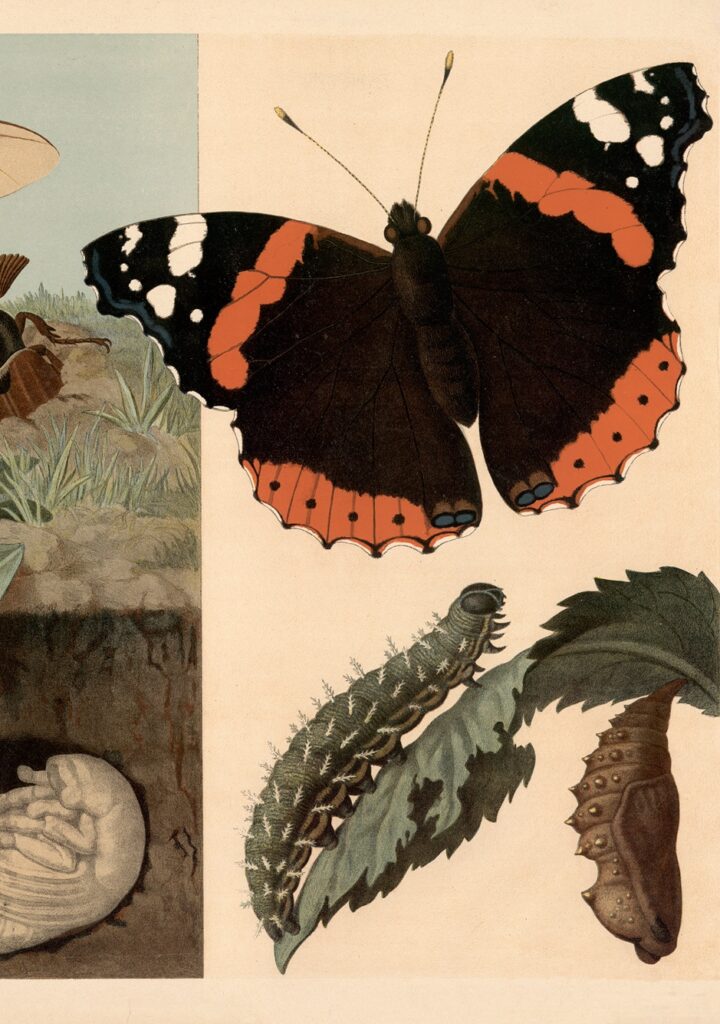
Artwork: Cockchafer and butterfly. Emil Schmidt (German, 1839–1909), Artvee.
***
Butterfly Jeans
It was 2006 in Rennes, France, and I was cooler than I would be for the rest of my life. Kids dropped their eyes when they passed me in the hall, my shoulders opened up, I stopped lending out fountain pen cartridges, I stopped caring about getting hurt. I changed the way I dressed to remind everyone of the person I had become. I had earned my camo Eastpack and my purple joggers with socks pulled over the cuffs. I had earned my neon yellow Nike Shox.
I had stolen the Shox from an overweight kid at the swimming pool, but my friends and I used different language, for both the stealing and the person we stole from. When Briac handed me the lock cutter, what he really said was: Mac Doe (short for McDonald’s), you should carrot those Shox from the fat. I wore them to school in the morning and fell in love in the afternoon.
I looked up from my worksheet—we were learning about right triangles—and I saw her, I saw her move and breathe, and I loved her. The girls sitting next to her looked mealy in comparison. Her black hair clinging to her temples, the wink of her elbow, her chewed up pen, her ink-stained fingertips, her dark eyes, her skin—I did not know her parents’ names, I did not know how she cried, but I knew that every last piece of her would speak of the same magic I saw in that geometry class. I needed to know all of her.
I watched her for weeks. She and her friends wore no makeup and carried Hello Kitty backpacks to school. During recess, they sat under the oak tree at the edge of the courtyard and laughed together in the dirt. They wanted people to think they had no interest in growing up or being popular. She, Natalie, smiled as herself, she smiled without hiding the front tooth the others had boxed out of their huddle, and she spoke kindly to the Runescape kids my friends and I table-topped in gym class, and she mouthed off to our teachers without looking around the room to gauge her classmates’ reactions. I started getting up earlier because I needed more time to think about her while listening to Justin Timberlake on my clock radio. I bookmarked her blog on my parents’ computer and before long I had my favorites downloaded on the iPod Nano. I looked at the pictures under the covers every night.
Did I speak to her? Not for a long time. I told myself story after story to justify my inaction. It would have been easier to make her love me back if she cared about being popular—or so I told myself. It would have been easier to make her love me back if she respected the girls I thought about in the shower, but she did not, her face was a cold serving when they approached her in the hall, which of course they did because they needed to gather information. They could not abide her beauty without knowing her.
One day she did join us in the park after school, but only because her friend Charlotte wanted to join us. We played truth or dare by the children’s playground. I thought we did this for the girls, so they could let their curiosities breathe within reach of the swing sets and monkey bars. Briac and I had spoken about this at length, when I slept over at his house and we watched dubbed American Pie movies. “These girls,” he said, indicating the topless girls on the screen, “they’ve gotten over it. It’s not the same for me and you—there’s nothing to get over. That’s why me and Rémi”—his old best friend from his old middle school—“would kiss girls on the mouth every morning to greet them, to get them over it, you know?”
I said that I knew.
“That’s what you need to do with Natalie.”
It was safe to say that the girls in our class had not gotten over it yet, but I looked over at Briac that afternoon in the playground and I could see by the quiet determination in his face that things were in order—I imagined he had been here before, at this same stage, with the girls at his old school.
We started slow: girls were asked to kiss one another, which they did with no trouble. They even lingered on each other. When the girls asked us boys to do the same, we complied, but we shook hands through the act to make it less uncomfortable.
I started feeling closer to Natalie when Jeremi asked his crush, Zelda, if she would ever “make out in some bushes.” Zelda buried her head in Maude’s lap and began to shake, maybe from laughter, but she was silent. Jeremi turned bright red. “In general!” he said. “Not with anyone specific. In general!” and he kept saying “in general” until Briac reached around me and gripped his shoulder in gentle admonition.
Before long it was Charlotte’s turn, Charlotte who had only been invited because the Eastpack girls knew that Natalie would come with her.
“Is it true,” Maude asked her, “that you want to make Mac Doe your boyfriend?”
The cruelty was just subtle enough to be unindictable. Charlotte looked small and naked; there was a story unfolding behind her eyes that she tried to mask with a weak smile.
“No.”
Maude said nothing; she only stared at Charlotte as if the question had not yet been answered. Natalie put her hand on Charlotte’s leg and whispered something in her ear, and Charlotte shook her head urgently. I wondered if Natalie’s position in relation to me had made it more difficult for her to stand up for her friend. I needed to know, and I could feel the moment slipping away from us and so decided to prolong it in the only way I knew how. “It’s okay, Charlotte. You can say it.”
Briac made a moaning sound and put his forehead against my temple and whispered, “No, not that, not that way!” and all of the girls, including Natalie, made their faces opaque and avoided my eyes. I said nothing. I wanted to hide in my own skin. Charlotte was quiet, and Natalie, her fingers passing through her friend’s hair with the tenderness and poise of a much older sister, was watching the children on the playset behind me.
“Your turn, Charlotte,” said Zelda.
Charlotte tilted her head back and put her tired eyes on Natalie. “Mac Doe.”
Natalie’s fingers stopped working but she did not take them from her friend’s hair.
“Dare,” I said.
“Ask Natalie if she wants to go out with you.”
I stood up and looked at Natalie. “Can I talk to you in private?” I heard giggling but I stood tall. I felt my face trying to move around but I held my breath to keep it fixed.
Natalie came towards me like a ship captain walking the plank. We walked for a bit and stood under a tree, the gravel pressing into our heels, among the browning leaves and fallen chestnuts. My hands were shaking and the back of my neck was heavy. I looked at her; the swirl of hair over and around her ear, her dark eyes, the curve of her lips—even the jutting bones in her wrist made me want to cry. There was no world in which I deserved any part of her. “I think you know what I’m going to ask you.” I sounded terrified and bitter. My Nike Shox had never looked more stupid.
“I’ll think about it,” she said, her eyes elsewhere. She gave me her back and returned to the group.
Her answer was closer to a no than a yes, I knew, and while I spent the rest of the week in a depressive haze, I held out hope. I woke up early every morning and listened to Justin Timberlake singing what goes around comes around—they played nothing else on Skyrock that year—and sipped my hot chocolate and imagined our life together, then hurried to school in hopes to run into her by the locker. Sometimes I ran, confusing my classmates, because her bus, the 7, arrived a few minutes before the bell. I stood next to her by the locker and said hello and she said hello back, and I made a show of fiddling with my books until she walked away, and every day I cursed myself for letting her leave me yet again, without having at least tried to make her love me back. Some days, she told me to have a good day, and though she was calculated and formal, she was not cold, either. Some days she even smiled.
I tried rehearsing lines that would make her love me back, but I could never get them quite right. They sounded too desperate, too solemn, too juvenile, too baroque. “What kind of butterfly is the butterfly on your jeans?” I imagined asking. “Is it a monarch butterfly? I used to catch those as a child.” I sat in my bedroom hunched over my cahier du jour, writing and scratching out and writing again. It looked like this:
That butterfly on your jeans: I’ve seen it before. Did I ever tell you I wanted to be an entomologist when I was little? Check this out: I was that kid who went up to random people at the grocery store and said hi. I wanted to live in the clouds. The butterfly on your bottom The butterfly on your derriere reminds me of my childhood
and so on for several pages until finally I scrapped the whole thing and went to bed with the iPod Nano.
My friends and I got more serious about carroting. Briac and I spent an afternoon all the way out in St. Jacques carroting bayblades from the bureaux de tabacs: these we just grabbed and ran with. One of the marchands chased us through the subway tunnels. We made our exit up the escalator and hid in the lobby of an apartment building. Some of the mailbox drawers were unlocked and Briac was making a game of switching them around. Briac had recently been seated next to Natalie in technology class. I watched them from across the room as they completed the soldering iron and HTML projects together. Over the course of those few weeks, Natalie softened to his proximity. She even laughed at his jokes. Now Briac was opening one of the letters.
“You should get Natalie something.” He eased himself into a nook under the lobby payphone and kicked a leg out, digging through the envelope. “She likes H&M. Or you could get her a backpack.”
“A backpack?”
“Her Hello Kitty was a gift from her dead aunt. She wants a new one.”
I felt something in my throat, like my blood changing direction. “I don’t like her anymore.”
“Oh.” His eyes lit up. “So can I go out with her?”
I went blank, the way I did when things moved too fast. I stared at him through my ugly thoughts and said nothing.
“I’m kidding,” he said. “You and your gueule de villain—but be careful with that. I don’t like that.”
J’aime pas ça was one of Briac’s refrains, and he always said it in the same voice, with the same drawn out vowels. He never stopped being astonished that people could displease him.
I brought the backpacks to school on Monday. I stuffed them in my dad’s tennis bag and hurried to my usual spot by the locker. She was there when I arrived. It was November; my breath came out of me in clouds. Her Hello Kitty was slung over her left shoulder.
“Bonjour,” she said, the rose of her cheek under the first light of the day.
“I brought a backpack for you today.”
“Comment?”
“I brought backpacks today.”
I put Dad’s gym bag on the wet ground. My hands were shaking as I worked the zipper.
“Are you cold?” she wanted to know.
“No.”
“Are you sure you want to put that there? It’s going to get wet.”
I found myself getting irritated with her. Why did girls always do this? They distracted from the matter at hand to fuss about your collar or the hole in your umbrella.
“I carroted these backpacks.”
She looked at the bag full of bags, and her suspicion seemed concentrated in her lips. “Is this because of my Hello Kitty?”
“No.”
“Briac told you to do this, didn’t he. I’m going to kill him,” she said, and the smile that took shape on her lips as she imagined “killing him” made my heart drop.
“No. Just take one. I’m giving them to people who want a new backpack. You just happened to be the first person I ran into. It really doesn’t matter.”
“It doesn’t matter!” she said, and now she was all games.
“Will you please just take one?”
“Maybe.” She reached into the bag and grabbed a dark red one. She stuffed it in her locker.
“Don’t tell anyone,” I said, “that I gave it to you for free.”
“I paid you sixty euros for it.”
“That’s it.”
“You owe me ten euros change.”
“Okay,” I said, unable to build on her banter. My skin was on fire.
She laughed in her low gurgle, the way she did when the absurd sent her into an unaffected, almost androgynous trance. I had heard other boys make fun of her for this, they made quacking sounds to imitate her, and I had not stopped them because I did not want to correct their vision. I loved her laugh the way I loved the exposed quick of her nails and the runt of her front teeth. She came towards me and gave me la bise. One kiss on each cheek, and she even gripped the crook of my arm, and on the second kiss I swore I felt lips.
“You should bring me next time.”
“Comment?”
“Stealing.”
I spent the rest of the day hiding. I hid in the bathroom at recess and went home sick because I did not want to interact with anybody, especially not Briac. I wanted to replay the events of the morning and plot in my cahier. I did not want to waste a second anywhere else.
I know you wanted to carrot with us but did you want Briac there too? I think he’s busy this week Would you still want to go out just us or would you need Briac I’ve noticed you guys have become friends because you sit next to each other in technology class. Because you sit in front of me. And you said you would kill him about the Hello Kitty backpack. Are you in love with him? I’m cool either way
We met by the winding stairs the next day after school. I had spent the day in my cahier and I had decided things were different now—now was time for the real test. I had made her interested: now I would have to make her love me. She was wearing her new backpack and her pink sweater under her winter coat. When she came towards me, her dark eyes on mine, I could not speak. What was there to say besides I want to be close to you.
I said we would miss the bus if we did not hurry.
She said the buses arrived four minutes apart.
We spoke about logistics on our way into town. She did not want to grab and dash, so we agreed to carrot from the department store. She would change in the waiting room and wear her winter coat over the H&M sweater she wanted. I kept pace a few steps ahead of her. I was full of fear.
“We don’t have to go carroting,” I said, “if you don’t want to.”
“Okay.”
“Do you want to?”
“I don’t know, Julien.”
But we kept walking and then we were in the store.
She called me over to show me a sweater. It was a light blue sweater with embroidery around the collar. I stood next to her and I felt her breath in my heart but I knew she was mourning what today could have been.
“Try it on,” I said.
She took the sweater into the changing room, and I stepped outside for fresh air. I hated the smell of department stores. It was a fuzzy smell that reminded me of hitting my funny bone. I massaged the arcs of my feet against the cobblestones, and I looked up the road at the Place des Lices where I saw my friend Briac sitting backwards on a bench by the fountain. He was staring at me. He was alone and I knew he had followed us. The city sounds—the sirens and the chatter and the perfume advertisement over the loudspeaker at Virgin Records—seemed trapped in the space between us. I knew Briac had been to war—I knew where he lived, and with whom—but I was ready to kill him. I could see his bright green lying eyes from across the place, and the heat in my veins made me feel big and right.
She came running out of the store, laughing in her gurgle, and the alarm was going and she said hurry and now we were running towards the heart of the city, away from Briac. We ran down Rue Pere LeSage past the Boulangerie Hoche my mother patroned for fresh bread, and we ran across the quais, through the Centre Colombier, towards the Gare du Nord. She was in front of me and I watched her butterfly while she ran, and then I was in front of her. My backpack was full and heavy; the straps dug into my shoulder blades each time my feet hit the ground. The sun was out and you did not need to look at the sun or the puddles to know it: you could see it in the faces around us. I turned around and smiled and told her to hurry and she smiled back, her cheeks pink from the running. Her eyes were in the sun and they were on me, too. I spun around and heard a tear, and my backpack was becoming lighter now, my books were falling through the bottom and clapping against the cobblestones behind me.
“Wait!” she said, a smile in her voice.
“I can buy more.”
But she was picking them up, one by one, and stacking them in the street. “Books are expensive,” she said.
I went to her. I kneeled in the street to help. I was happy. When our hands touched, or when she lifted her eyes at me, I thought the moment would never end, and when she finally stood up with my cahiers and books against her chest, I must have shown the fear in my heart, because she laughed—a more feminine, knowing laugh than her gurgle—and said: “we can sit next to each other on the bus.”
We found a seat in the back. She seemed to be leaning into me, but I did not dare turn my head to check. My breath was getting short again. I would betray myself, show her an ugly and imperious truth I could not identify. I thought of the person I was before: the child in his Tintin sweater who waited outside the school gates until the bell to avoid the demons on the playground. I stole candy—carambars—from Mom’s pantry and brought them to school as a peace offering, as if I had been complicit in my own abuse. The demons took the candy and stopped forming spit circles around me. Now, sitting next to Natalie, sharing this moment under the weight of its inevitable end, my capitulation on the elementary school playground felt truer to me than my later encounters with courage that propelled me into adolescence, when I lost myself to my rage and stopped caring about getting hurt.
I heard a page turn and I looked over; she was flipping through my notebooks.
“What are you doing,” I said, but I knew.
“You need to use your margins,” she said. “When you cross something out like this”—she tapped her finger on a nihilistic blotch of ink—“you need to rewrite it in the margin. Not on top of it like this.”
“Since when do you care about school?”
“I don’t. But my cahiers belong to me.”
She flipped through a few more notebooks until she found my cahier du jour. “I thought I was a bad student.” She brushed some mud off the spine and opened it, and I let her. She began turning the pages and reading the words inside them. They were about her—how she made me feel when she smiled at me, how our meetings by the locker were my favorite thing about being alive, how I hated weekends now because I could not stand to face two full days without her. The words were about the first moment I saw her in geometry class, the jolt of recognition in my sternum when I first saw her move, the harmony and power in her interactions with the air, and the sunlight, and other people. Much of it was addressed to her, and when she read about the butterfly jeans, my earliest, scripted attempt at making her love me back, she put her hand in my lap. “Give me your hand now,” she said, and I did.
My fear expanded as she read, for I needed her to react to the words on the page, to praise or condemn them, but she said nothing. I tried quieting my breath. She was turning page after page. I took my hand away to wipe the sweat on my jeans.
“Come back,” she said, without taking her eyes off the notebook. She said this calmly, in the same voice she had told me to use my margins. Her conviction seemed to come from somewhere outside of her.
“I like you more than him,” she said, “but we can’t do this again.” I knew what she meant, but I pretended I did not.
“We don’t have to steal anymore. I don’t care about stealing.”
“I know you don’t.” She closed the notebook and pulled my hand into her lap. She made a cage around it with both of her hands and stroked it with a hidden finger. “You don’t want to steal, you want to be someone who steals.”
“That’s not true. And anyway, I want you—tell me what you need.”
“My friend likes you, and she’s been through too much.”
“Charlotte?”
I could feel her retreating into herself. Asking her to confirm Charlotte’s identity, with undisguised bitterness, had given her an easier job of it.
“Do you even like me at all?” Then: “We don’t have to tell her.”
“I want to be a good friend more than I want to date you.”
“Why did you come with me,” I said, my voice bursting with hurt, “if you knew we could never?”
“I wanted to make sure I was right about you.” She kissed the top of my cahier du jour and handed it back to me.
I was expelled the next day. The dean and two police officers showed up to my history class and asked for a Julian Beat-Shell. I looked around the room to confirm their words in the faces of my classmates. There was no oo-ing or ah-ing: my classmates were too busy wondering about my crimes, and the person who had committed them, to make senseless noise. I looked at Natalie and she looked away. She knew someone had been betrayed, and she would not be seen outside of herself until she knew whom. I felt Briac’s green eyes on the back of my head before I turned around to read them, and when I did, I saw the same look he had given in the playground weeks before, a look that said he knew what he wanted, and he had already fashioned the world into a shape that would bring it to him. Now was time to sit back and watch.
I had been seen running from H&M the day before, and someone had picked up my history notebook and brought it to the police station.
We moved back to the US a few months later, and my parents sent me to Kennedy Oaks, a school for troubled kids in Utah, where I became exposed to drugs and borderline personality disorder. I kept contact with Natalie through middle school, and we finally got together in high school, but we were only able to see each other on vacation. Our time together was fleeting and ethereal. She never called me her boyfriend.
I watched her grow into a woman on social media. She was outspoken about gender inequality on Twitter and she volunteered at an orphanage and she appeared in my inbox every few years with a regret or a question about me—this she continued to do long after she and Briac were married with children. After a while, I stopped responding—there was no future in any of it—and a little while after that she stopped reaching. But she never left my dreams. Would you believe I met the love of my life at thirteen? No one ever does, so I keep her to myself. I lost the iPod Nano years ago, but I have newer pictures now, and I look at them on my smartphone before bed. I remember everything. I begin with our afternoon on the bus, when she took my hand and told me to grow up.
***
 Ben Austin is a writer with roots in New Jersey, Texas, and Bretagne, France. His fiction appears in Cleaver, Beloit Fiction Journal, J Journal, and elsewhere. His work has been nominated for the Pushcart Prize and Best of the Net. He holds an MFA in fiction from Texas State University in San Marcos, where he currently teaches in the English department.
SEE THE ISSUE
SUGGESTED CONTENT
Blast
Nov 05 2026
“Talking with My Mother at Midlife” by Andrew Cohen
A meditation on the crossroad that occurs at the cusp of middle and old age, “Talking with My Mother at Midlife” by Andrew Cohen approaches the grounding effect familial love… read more
Blast
Oct 22 2026
“Buckle Up” by Tyler Ayres
“Buckle Up,” is a story about two relationships of well-intentioned dysfunction and how they compare in a spontaneous moment. TMR’s online-only biweekly series, BLAST features prose too vibrant to be… read more

Blast
Oct 08 2026
“Starting Over” by Joseph Hamaker
In Joseph Hamaker’s short story, set in the busy years after World War II, the young son of a father who can do anything witnesses sudden devastation. Something can be… read more