
Blast | March 26, 2026
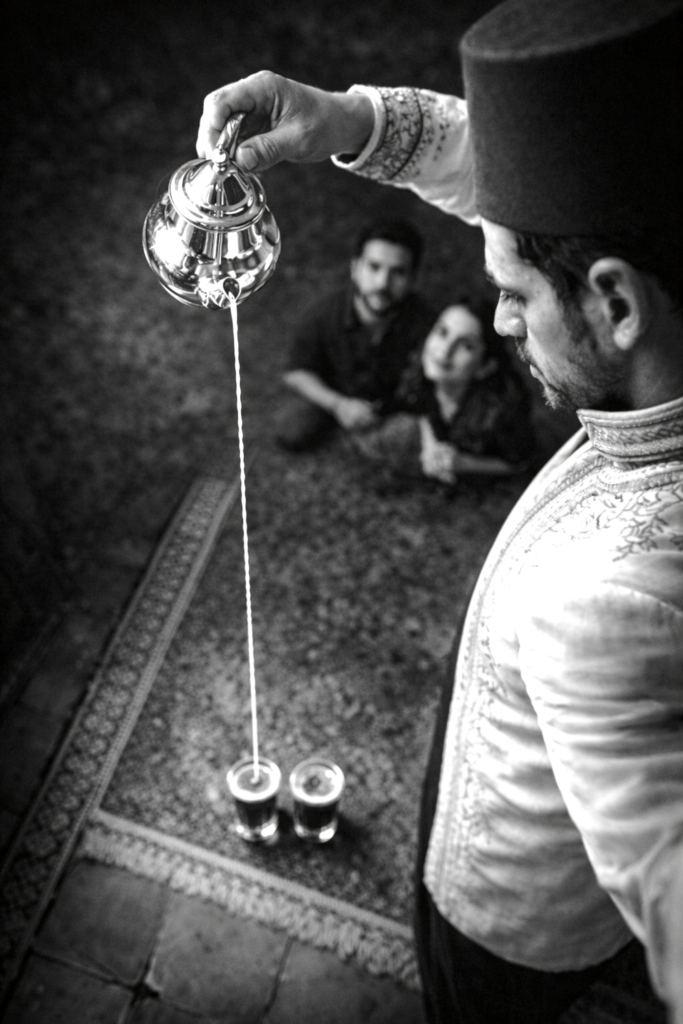
“The Art of Falling Water” by Darryl J. Benjamin
Darryl J. Benjamin’s “The Art of Falling Water” is a short story about a man who applies for a challenging new job to support his daughter’s future. Learning the traditional Moroccan tea-pouring service at the historic Dar Maghreb in Los Angeles turns out to be more challenging than anything he’s faced in his aerospace engineering career.
TMR’s online-only prose anthology, BLAST features prose too vibrant to be confined between the covers of a print journal.
* * *
The Art of Falling Water
Omar Farid discovered the position at Dar Maghreb the way desperate men discover most things—by accident, late at night, while the rest of the world slept. The restaurant’s website showed candlelit tables draped in jewel-toned fabrics, geometric lanterns casting amber patterns across white walls, and a promise: “Servers earn competitive wages plus gratuities averaging $400 per night.”
He’d been an aerospace engineer for twenty years. Now he was forty-five, unemployed for eight months, and his daughter Leila’s college fund had evaporated like morning dew. She started at UCLA in six weeks. The math was simple and devastating.
* * *
That night, he made ramen at 11 p.m. while Leila hunched over her laptop at the kitchen table, toggling between UCLA housing forums and Reddit threads about Westwood parking.
“So apparently,” she said, not looking up, “parking’s basically impossible near campus. Like, people literally camp overnight for permits.”
Omar stirred the pot, watching steam rise. “We’ll figure it out.”
“There’s this off-campus lot that’s cheaper, but you have to walk through this sketchy underpass—” She caught herself. “Not that I need a car. The dorms are fine. I could bike.”
“You’re not biking at night in LA,” he said, more sharply than he meant.
She glanced at him then, and he busied himself with the noodles, hoping she couldn’t see the way his hand trembled against the pot handle. His phone sat face-down on the counter, hiding the bank’s automated message: Second mortgage payment 67 days past due. Foreclosure notice: 23 days.
“Dad.” Her voice softened. “It’s gonna be okay. I could defer a year, work, save—”
“No.” He divided the ramen between two bowls, concentrating on keeping his hands steady. “You’re going. You got into UCLA. That doesn’t just happen.”
She came around the table and squeezed his arm, and he felt how much steadier she’d become this year, how easily she could see through him. “Too much coffee today?” she asked, looking at his shaking hand.
“Yeah,” he lied. “Too much coffee.”
After she went to bed, he sat in the dark living room of their Glendale bungalow—the one with the cracked driveway and the lemon tree his wife had planted before the cancer—and opened his laptop again. The Dar Maghreb posting glowed in the blue light. Immediate hire for experienced servers. He wasn’t experienced. But twenty-three days was a deadline he understood.
* * *
At nine the next morning, he stood outside Dar Maghreb’s carved wooden door on a side street near Little Armenia, rehearsing his pitch. The door itself was a work of art—geometric patterns in dark cedar, the kind of door that belonged in a medina, not a Los Angeles strip mall wedged between a tax preparer and a wholesale rug dealer. I’m a quick learner. Excellent with details. Twenty years managing complex systems. He left out the part about his hands shaking every time he thought about the mortgage.
The woman who answered his knock was perhaps sixty, elegant in a charcoal suit, her silver hair pulled into a severe bun. She looked him up and down with eyes that missed nothing.
“Madame Zara?” he ventured.
“You’re here about the server position.” Not a question. She stepped aside. “Come.”
The dining room was even more beautiful in daylight—all those lanterns dark now, waiting. Silk cushions in burgundy and saffron lined low banquettes. The walls held framed photographs: black-and-white images of Casablanca’s port, a Jewish quarter in Fez, what looked like Zara herself as a young woman standing before a different restaurant in another lifetime. Madame Zara led him past empty tables to the kitchen, where copper pots hung from ceiling hooks and the air smelled of cumin and preserved lemons. A young woman in a headscarf was prepping vegetables, singing softly in Darija.
“You have restaurant experience?” Zara asked.
“No, but I—”
“You’re Omar Farid. Aerospace engineer. Worked on satellite guidance systems for Northrop Grumman.” She said this while examining a bunch of fresh mint, not looking at him. “You think precision transfers across industries.”
He blinked. “How did you—”
“I google everyone who applies. I also see you’re a widower. One daughter. House in Glendale with a second mortgage.” Now she looked at him, and her expression wasn’t unkind, just unbearably direct. “I don’t hire people who need jobs, Mr. Farid. I hire people who want this job. Do you know the difference?”
Omar’s throat tightened. “No, madame.”
“Good. Honesty is better than cleverness.” She set down the mint. “There is one requirement. In Morocco, tea service is an art form. My servers must master l’atai—pouring mint tea from shoulder height into a glass on the floor. You will stand. The glass will be at your feet. You will pour without spilling a single drop.”
She demonstrated with an empty teapot, her arm extending in a graceful arc, miming the motion. “You have one week to learn. On the seventh day, you will perform for me and for the Board of Health inspector who has concerns about my hiring practices.” Her jaw tightened almost imperceptibly. “Concerns about who I hire and how I treat my staff. They think I exploit immigrants. They don’t understand that some of us are just trying to keep a piece of home alive in this city.”
“One week?”
“Is that a problem?”
Omar thought about Leila. About the letter from the bank. About the tremor.
“No problem,” he said.
Madame Zara smiled slightly. “We’ll see. Come back at three p.m. We practice before dinner service.”
* * *
That afternoon, he met the other applicant.
Jules was twenty-four, beautiful in that careless way young people are, with perfect stubble and expensive sneakers that probably cost what Omar’s mortgage payment used to be. He’d graduated from the Culinary Institute and spent a summer backpacking through Morocco. “Picked up the tea thing in Fez,” he said, loud enough for everyone to hear. “It’s all about wrist angle and confidence.”
The senior server, a man in his sixties named Hassan, distributed the equipment: heavy brass teapots with curved spouts, small glasses with gold filigree, and prayer rugs to mark where they’d stand. Hassan moved with deliberate care, and Omar noticed how he used his forearms more than his hands when lifting anything heavy.
“The glass goes here,” Hassan said, placing it on the floor at Omar’s feet. “You pour from here.” He lifted Omar’s arm to shoulder height. “The distance creates the foam. Moroccans call it the crown. No crown, no respect. Spilled tea, no job.”
Omar lifted the teapot. It was heavier than he expected—maybe four pounds of brass, the weight distributed wrong, already throwing off his calculations. Water sloshed. He aimed carefully, compensated for arc and distance, calculated trajectory and velocity, began to pour—
The stream hit the rim, splashed everywhere, and the glass tipped over.
Behind him, Jules executed a perfect pour on his first try. The sound of water hitting glass was like music.
“Show-off,” Omar muttered.
“Muscle memory,” Jules said, grinning.
* * *
Day two was worse. Omar broke a glass. Day three, he drenched his shoes so thoroughly that he left wet footprints across the kitchen floor. Hassan watched these disasters with an unreadable expression, occasionally offering cryptic advice: “Don’t fight the water” or “The pot is not your enemy.”
But it was the cryptic advice that haunted Omar that night, lying awake in his too-quiet house. Don’t fight the water. In his old life, he’d spent twenty years fighting everything—friction coefficients, orbital decay, the inexorable mathematics of entropy. He’d fought and calculated and solved, and he’d been brilliant at it.
Then cancer came, and no equation could save his wife.
Now he couldn’t even pour water in a straight line.
Day four: another soaking. Day five: he knocked the glass over before he even started pouring. That afternoon, Jules leaned against the prep counter and said, loud enough for everyone to hear: “Maybe engineering’s just about computers doing the thinking for you. This requires actual skill.”
Hassan, who’d been silent until then, looked up from the mint he was sorting.
“Jules.” Just the one word but spoken with enough weight that the younger man went quiet. “Come here.”
Jules approached warily. Hassan held out his hands, palms up.
“You see these?”
The hands were gnarled, knuckles swollen, fingers bent at odd angles. Arthritis, Omar realized. Severe arthritis in a man whose livelihood depended on those hands.
“Thirty years I’ve been pouring tea,” Hassan said. “Started when I was younger than you. Now some mornings I can barely hold the pot.” He closed his hands into loose fists, wincing. “But I’m still here. You know why?”
Jules said nothing.
“Because this work—this real, authentic Moroccan restaurant—it’s what pays for my daughter’s nursing school. It’s what keeps food on my table and a roof over my family’s head.” Hassan’s voice was calm, almost gentle, but his eyes were hard. “So when you talk about ‘actual skill,’ maybe consider that some of us would give anything to have young, healthy hands. Even if they belonged to a guidance systems engineer.”
Jules looked down. Actually looked down. “I didn’t mean—”
“I know what you meant.” Hassan turned to Omar. “You’re too tense. Like you’re still calculating orbital velocities. Water doesn’t need equations. It just needs permission to fall.”
* * *
That night, after everyone had left, Omar stayed late to practice. Hassan stayed too, though Omar hadn’t asked him to. The old man sat on a stool near the wall, hands cradled in his lap, and watched without comment as Omar missed. And missed. And missed again.
Finally, around midnight, Hassan stood.
“You know what your problem is?” he said. “You’re still thinking like an engineer. You want control. But l’atai isn’t about control. It’s about trust.”
“I don’t understand.”
“In Morocco, tea service is about community. About hospitality. About showing respect.” Hassan picked up a teapot—carefully, Omar noticed, favoring his right hand. “When I pour, I’m not pouring for myself. I’m pouring for my guests. For their comfort, their dignity. You? You’re pouring for some abstract idea of success. Of not failing.”
“I’m pouring for Leila,” Omar said quietly.
“Are you?” Hassan studied him. “Or are you pouring because you’re terrified of disappointing her?”
Omar’s hands tightened around the pot handle.
Hassan continued, his voice taking on an edge that Omar hadn’t heard before—not anger exactly, but something raw and honest. “You think you’re special because you’re desperate? Jules dropped sixty thousand on culinary school and can’t make rent. Amara left her family in Rabat and sleeps in a studio apartment with three other women so she can send money home. I work here with hands that feel like broken glass because if I stop, I starve.”
He gestured at the restaurant around them.
“This place—this ‘authentic Moroccan experience’—it’s beautiful, yes. But it’s also survival. Madame Zara isn’t preserving culture out of nostalgia. She’s preserving it because she has no other choice. None of us do.” Hassan’s voice softened. “So don’t stand there feeling sorry for yourself, calculating angles like this is some kind of physics problem. Just pour the damn tea.”
* * *
On day six, something shifted. Not dramatically—there was no sudden revelation, no moment of perfect clarity. Omar just got marginally less terrible.
He poured a glass that only splashed a little. Then he poured one that created a decent crown. Then—impossibly—he poured three in a row that would have satisfied Hassan.
Jules noticed. His jaw tightened, and that easy confidence flickered. “Guidance systems guy finally getting it. Only took him five days to do what I did in five minutes.”
But that evening, as they were packing up, Omar heard Jules in the back hallway, phone pressed to his ear: “I know the payment’s late, Mom. I’m working on it—no, not like last time, this is a real job . . . . Tell Dad I don’t need his lecture about being twenty-four and still asking for money. Tell him—”
He saw Omar and hung up abruptly, the smooth confidence sliding back into place like a mask. But Omar had heard it: the fear underneath. The shame.
Later that night, Omar lay awake thinking about Jules. About Hassan’s arthritic hands. About Amara sleeping in a crowded apartment, about Madame Zara looking at photographs of another lifetime. About how this whole beautiful restaurant was built on people with no safety net, no backup plan, no choice but to keep pouring.
The paralegal who washed dishes. The line cook with two jobs. The busboy putting himself through community college. All of them balancing on the knife’s edge between making it and not making it, between dignity and desperation.
Omar had spent eight months feeling uniquely cursed. Now he saw the bitter truth: his desperation was the least remarkable thing about him.
* * *
Day seven. Test day.
Rain hammered the restaurant’s windows—the same kind of cold February rain that made Los Angeles drivers forget how roads worked, that flooded the streets in Glendale because nobody built proper drainage in a desert.
Madame Zara had arranged the test in the dining room. The Board of Health inspector—a severe woman with a clipboard and reading glasses on a chain—sat at a front table. The entire kitchen staff lined the walls. Amara whispered encouragement in Arabic. Hassan stood near the back, his face carefully neutral, his hands hidden in his pockets.
Jules stretched his wrists like an athlete.
“Mr. Jules will demonstrate first,” Madame Zara announced.
Jules stepped onto his prayer rug, lifted the pot, and poured. Perfect arc. Perfect crown. The inspector made a note. Jules bowed slightly, shooting Omar a smile that didn’t quite reach his eyes.
“Mr. Farid.”
Omar’s turn. He positioned himself over the glass, feeling forty eyes on his back. The teapot felt like it weighed fifty pounds. His hands began their familiar tremor. Through the window, rain turned the street into a river of gray light.
Don’t look at the glass. Look at your daughter.
He closed his eyes for just a moment. Saw Leila at eighteen, brilliant and terrified, standing in her dorm room at UCLA—wherever that would be, whatever it would cost. Saw the future he was fighting for—not just college, but the message it sent: Your father doesn’t give up. Your father finds a way. Even when his hands shake. Even when the math says it’s impossible. Even when everyone’s watching him fail.
When he opened his eyes, he looked at the glass on the floor and saw her face reflected in its curved surface.
His hands stilled.
The pour was instinct—his arm extending, the pot tilting, water becoming tea, becoming foam, that perfect crown rising in the glass like a blessing. The sound it made was like rain on copper, like his daughter’s laugh, like every good thing he’d almost lost.
Not a drop spilled.
The dining room was silent.
Then the Board of Health inspector stood and clapped, just once. “That is what I needed to see.”
Madame Zara nodded and something eased in her face—relief, maybe, or vindication. “Welcome to Dar Maghreb, gentlemen.”
* * *
Omar’s first shift was Sunday night.
He wore the traditional server’s vest, dark blue with gold embroidery. His section included a table of four elderly Moroccan women who’d made reservations weeks in advance, who spoke in rapid Darija and laughed at private jokes and adjusted their headscarves with hands that showed decades of work.
When the time came for tea service, he felt that familiar flutter of nerves. Then he remembered: You’re not pouring for yourself.
He positioned the glass on the floor beside their table, lifted the pot to shoulder height, and let the tea fall.
Perfect arc. Perfect crown.
One of the women—she must have been eighty—pressed her hand to her heart. “Ya Allah,” she whispered. “Just like my father used to do in Marrakech. I haven’t seen that done properly in forty years.”
She insisted on tipping him an extra hundred dollars, folding the bills into his palm with shaking hands. “For keeping the tradition alive,” she said. “For remembering.”
Across the dining room, Hassan caught Omar’s eye and gave the smallest nod of approval.
* * *
Three weeks later, Omar found himself in the kitchen after closing, teaching a new applicant—a nervous woman in her fifties who’d been a paralegal until the firm downsized.
“The glass goes here,” he said gently, placing it at her feet. “You pour from here.” He lifted her arm to shoulder height. “The distance creates the foam. No crown, no respect.”
Her first attempt missed by a foot. The second shattered the glass.
“It’s okay,” Omar said. “I broke three on my first day.”
“How did you learn?” she asked.
Omar thought about Hassan’s arthritic hands—hands that still moved through the dining room each night, pouring shorter distances, relying on Amara’s strategic positioning, holding on for however long his body would let him. About Jules, who’d started leaving his expensive sneakers in his locker and wearing a scuffed pair similar to Omar’s, who’d stopped making jokes the day his first paycheck went straight to rent. About Leila’s acceptance letter to UCLA, now framed on his bedroom wall, the thing he looked at every morning while his coffee brewed and his hands found their daily steadiness.
“Someone taught me that the water knows where it wants to go,” he said. “Your job is just to agree with it. And to remember who you’re pouring for.”
She tried again. Missed again. But something in her posture shifted—a small becoming, barely visible.
Omar glanced toward the hooks where Hassan’s vest still hung, though the old man had finally scheduled his surgery for next month. They’d thrown him a party last week—the kind where everyone pretended it was a celebration and nobody mentioned that he might not come back, that his hands might never hold a tray again, that this restaurant and these people were all he had left of a country he hadn’t seen in forty years.
Outside, rain fell on the city, same as always. Inside, the prep cooks were singing in Darija while they broke down the line. The copper pots gleamed on their hooks. Madame Zara was in her office, probably looking at photographs of another restaurant in another lifetime, probably wondering if keeping a piece of home alive was the same as going home.
The paralegal tried again. This time the water fell in a clean line, missed the glass by only an inch.
“Better,” Omar said.
His hands were steady now. Not because the fear was gone. Because he poured anyway.
“Let’s try it again,” he said.
* * *
 Darryl J. Benjamin lives in Port St. Lucie, Florida. He is the author of Farm to Table: The Essential Guide to Sustainable Food Systems (Chelsea Green, 2016) and has spent years teaching writing and sustainable food systems at the college level. He holds an MFA from Vermont College of Fine Arts and a BA from McGill University. His work explores the friction between natural ecosystems and the domestic ones we struggle—and usually fail—to manage with grace. He is currently revising his first coauthored novel, Seedland.
SEE THE ISSUE
SUGGESTED CONTENT

Blast
Jun 04 2026
“Was Home Always This Bad?” by L.F. Khouri
L.F. Khouri’s heart-wrenching microfiction details a father’s reflection on the hardships of war, the weight of survivor’s guilt, and the deep desire for safety and normalcy. “Was Home Always This… read more

Blast
May 21 2026
“The Yellow Suitcase” by Aizhan Yesbolatova
This essay by Aizhan Yesbolatova explores the complicated relationship between a mother and her father as she watches him be a different sort of grandfather to her child. “The Yellow… read more
Blast
May 07 2026
“Handsome Crying Boy” by Lee Conell
In this black comedy by Lee Conell, the emotionally repressed pay for group crying sessions administered by attractive men. “Handsome Crying Boy” asks what it means to be vulnerable with… read more