
Blast | June 18, 2026
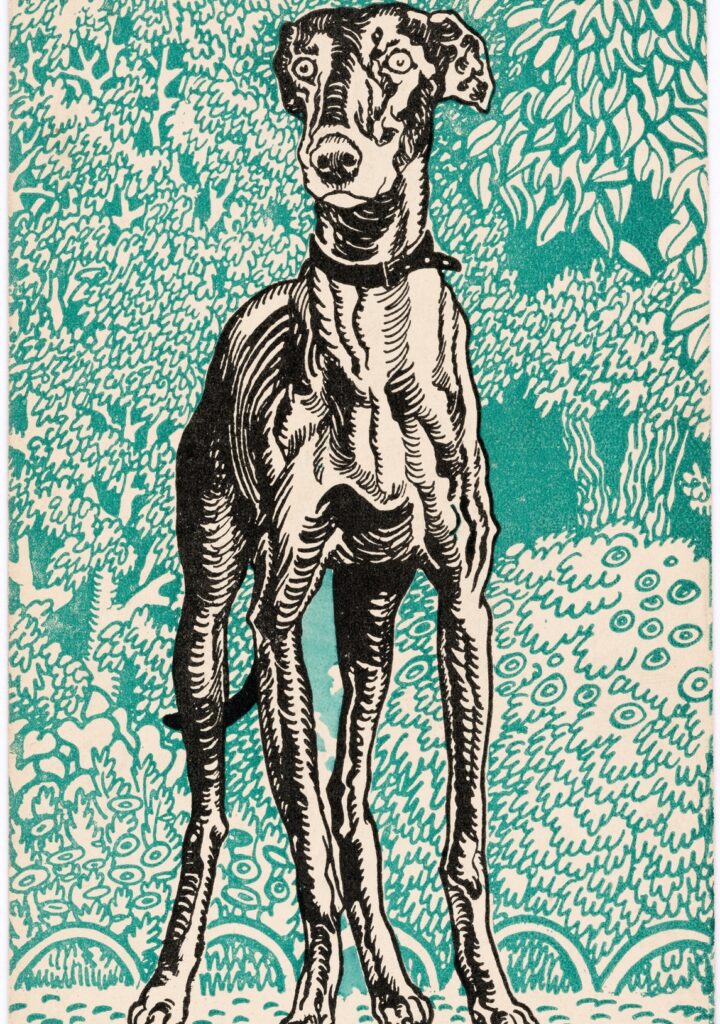
“Mad Dogs and Scotsmen” by Megan Ritchie
Megan Ritchie’s short story “Mad Dogs and Scotsmen” opens a window on the mind of a boy whose psyche is shaped and hardened a little more each moment by the crowd of voices that clatters around him.
TMR’s online-only prose anthology, BLAST features prose too vibrant to be confined between the covers of a print journal.
***
Mad Dogs and Scotsmen
Angus had to look out for the dogs. They weren’t wild, but when the residents of Govan turned them out for the day, they would join up into large roving packs, gnashing their drooly jaws and showing passersby the white rounds of their eyes as they maundered from butcher to woods to the bins put out on Fridays and since forgotten. Sometimes Angus’s mother let out their own dog too, shooing her—stiff-eared, low-tailed—from their terraced house, and Angus was fearful of what would happen to her in the throng. Sometimes he had dreams of their dog gnashing her teeth and rolling her eyes at him, too. That’s what a crowd did. It could make you mean.
On the walk to his granny’s house, he kept his head on a swivel. He took the long way, skirting the woods where the traveler children rollicked. There was a drizzle. The gray of his jacket became a darker gray. Outside his granny’s, he wiped his Wellies hard on the mat. Before he could let himself in, his uncle opened the door.
“Heya,” said Campbell. “Where you been? Been waiting on you.”
“Rain,” said Angus, rather than saying: Dogs.
“It’s Scotland, aye, when’s there not rain?”
His uncle Campbell was more agitated than usual. In the entryway, he yanked at the collar of Angus’s jacket, then patted his shoulders, then finally told him to take it off. “Don’t get mud all over the house now,” he said. “And say hello to Mam.”
His granny was wiping her hands off on a towel by the kitchen sink.
“Hi, Granny,” he said.
His granny said, without looking up, “How’s your mother doing?”
“Just fine.”
“Is that right? Even with all the weans?”
“Even so,” said Angus. He could see Wendy peeping up at him from the wobbly stool in the corner. He pretended not to notice her, put his hands in his pockets all nonchalant. Touched each of the eight sides of the coins, worn smooth, he kept in there for betting. Wendy was small for her age, ten years old to his twelve, and had a hunchback that was unnerving to see in someone who wasn’t old. He was a little afraid of her, mostly because he had begun feeling funny about his sister living in a different house than him. He had been too young to remember himself but knew his granny had kept Wendy warm in her oven when she came early, then never gave her back, never gave Wendy up at all, even to school. She didn’t know how to read or write.
“Well she’s a bit thick, isn’t she,” his granny had said when Angus had asked.
“I thought it was just a hunchback,” Angus had said.
His granny shrugged. “A weak body is a weak mind.”
It had sounded very smart to Angus, the kind of thing adults would understand. He’d nodded sagely.
Wendy smiled up at him toothlessly. On her lap she had the family dog, who was only kept inside on race days. He was a little spaniel with fur Angus liked to pet because it was very soft and a nice shade of red. Campbell snatched up the spaniel in one arm, where it squirmed like a caught fish, and marched out to the garden, where the greyhounds were lying dogpiled under the eave. Their heads rose and ears triangulated as Campbell slammed the door shut behind him. Angus had seen this many times before, so he didn’t flinch when Campbell tossed the spaniel into the dogpile and the pile turned swarmy, nipping and snarling until they seemed like one writhing, smooth-skinned body from which the spaniel surfaced only briefly. Campbell turned to him and said, “Count for me, Angus.”
“One. Two.”
“Don’t count fast on purpose, what’ve I told you?”
“Three. Four. Five. Six.”
“Better.”
“Seven. Eight. Nine. Ten.”
“There we go.”
Campbell reached into the melee and pulled out the little spaniel, who was crying softly. He held her in his arms and rocked her back and forth and spoke softly into her neck. To Angus he said, “Just startled, is all. That’ll get them nice and frenzied. We’ve got a winner here today.” Campbell pointed, but to Angus the hounds looked all the same. They were already placid again, blinking slow and yawning. Strings of saliva hung between their teeth like clotheslines.
Angus fetched the box they’d carry the greyhound in, avoiding eye contact with his granny and Wendy inside. “Which one today?” he said once back out.
“Top of the pile. Hold him up for me.”
The greyhound was warm in Angus’s arms. He had Irish patterning, with a white chest and ribs Angus could feel through short fur. The insides of his ears were pink like they’d been sunburnt. Angus was always a little awed by how muscular the hounds were. Their waists were narrow and their legs rippled. Even their tails, when they were wagging, were solid. This one’s thwapped against Angus’s chest. Angus held him carefully while Campbell wrestled on its jersey.
“Number one, aye,” he said. “Because it’ll be number one. I’ve given it something special. In the box now.”
Angus deposited the greyhound and closed up the box.
“He’s shaking,” he said, looking through the holes in the cardboard. The greyhound looked back, quivering, with eyes like black marbles.
“That’s a good thing. Lots of energy.”
Angus carried the box on their way back through the house. “Good luck, lads,” said his granny, and Wendy looked at him with something sad in her eyes.
***
The sky was still stucco at the track. Before they entered, Campbell scraped back his hair, which was thinning and blond.
“How do I look, Angus?”
“Okay,” he said.
“Just okay, eh? Man of few words? That’s a good way to be, you know. Play it close to the chest. Be a big man like me.”
Angus didn’t know if he wanted to be like Campbell at all, but he also wasn’t sure exactly how much say he got in the matter. He understood that family was what kept your life moving on its track. They made the decisions so you didn’t have to—like his granny taking Wendy from his mother, or Campbell asking him to help out with the greyhound racing.
He and Campbell dropped their greyhound off at the cage where the racing dogs were all kept, and then they made their way to the track. There men stood on orange crates and held up chalkboards. Occasionally they’d erase them frantically and rewrite the numbers on them. More men drifted between them, shouting up their bets. Angus’s job was to convince men to put money on their greyhound. Somehow this would end up in Campbell taking home more cash; Angus wasn’t totally sure of the exacts. Mostly he liked having a job and that sometimes Campbell would slip him a couple pounds after a good day. Already Campbell was going around jostling people and clapping them on the back, telling them, “Put some money on mine, aye? For the sprint. I’ve got reason to think he’ll be a winner, if you ken what I mean.” He made gestures like squeezing a syringe. Angus began circulating between the little flocks of men standing here and there, too.
“Money on the railer to show,” he said. The men put their hands on his shoulder and called him son, making him feel warm. “Number one. That’s number one to bet on.” The men were solemn listening to him. A big man, so he was. He thought about Wendy. He could give her his winnings. He had no idea what she’d do with them, but it would help him feel better about ignoring her earlier. He felt for the coins in his pockets, and then he headed up to one of the men standing on the orange crates. “Fifty pence on number one to show,” he said.
The man took his money. “You’ve got it, mate.” He scribbled again on his chalkboard.
The sprint was starting soon. The crowd of men began moseying closer to the track. Angus found a spot against the railing and hooked his arms over the side. He could hear Campbell’s voice somewhere, saying over and over, “This is the one.” The greyhounds were rattling behind the gates, wearing their blue jerseys like players on a football team. Between the rails he could see flashes off their hides: brindle and fawn and blue and liver. “That’s the winner!” Campbell was saying. “Number one!”
The gates split open.
The hare, the mechanical lure, zipped forward on the rail.
The greyhounds burst after it.
For a second, Angus felt like he was the spaniel, thrown into the dogpile. The track was suddenly very loud, and everything was moving fast. And then he felt like he was in a movie. The crowd of men, the whole pack of them, were shouting and pumping their fists, crumpling the white slips of paper where their bets were written. Angus could be one of them. Angus was one of them, shouting alongside them, with them, yelling, screaming, “Go, go, go!” The greyhounds were all bounding, their eyes dark with focus. They all wanted the hare, badly. They were such simple creatures. Put something in front of them and they wanted it. And Campbell’s dog, their dog, wanted it most of all. He hugged the inside, his legs flashing like a zoetrope, his white chest broad and sinewy. He was, incredibly, keeping up with the hare, was closing the distance between him and his prey, all his nervous energy drawn toward that one point. Angus’s hope rose and beat hard against his ribs. He and his uncle had done it. He thought about his fifty pence, imagined it becoming four, five pounds. The look on Wendy’s face when he would hand it to her.
Half a lap from the finish, the greyhound stuttered in his steps. His eyes rolled like the black marbles they had been when Angus had closed him up in the box.
Angus blinked. He was imagining it.
And it was true the greyhound’s jaws were not gnashing or drooly. His paws smacked at the dirt again and again, like Angus’s pulse knocking in his ears. He was still in the lead. He would win. But there was a white foam around his black lips.
The greyhound’s eyes rolled again, and this time, its long fibrous neck twisted too, so that it looked, or seemed to look, right at Angus.
For a second, Angus could hear Campbell yelling, and then he couldn’t. Could not hear anything at all even though he was in this pack of men. He felt his hope become something hard and mean. In the greyhound’s eyes he saw—nothing.
He thought, So.
And then the greyhound dropped, stone dead.
***
 Megan Ritchie has been published in Pinch, Southern Indiana, Denver Quarterly, and elsewhere. She earned her MFA from the University of Miami, where she now teaches writing. She is currently at work on her first novel.
SEE THE ISSUE
SUGGESTED CONTENT
Blast
Nov 05 2026
“Talking with My Mother at Midlife” by Andrew Cohen
A meditation on the crossroad that occurs at the cusp of middle and old age, “Talking with My Mother at Midlife” by Andrew Cohen approaches the grounding effect familial love… read more
Blast
Oct 22 2026
“Buckle Up” by Tyler Ayres
“Buckle Up,” is a story about two relationships of well-intentioned dysfunction and how they compare in a spontaneous moment. TMR’s online-only biweekly series, BLAST features prose too vibrant to be… read more
Blast
Oct 08 2026
“Starting Over” by Joseph Hamaker
In Joseph Hamaker’s short story, set in the busy years after World War II, the young son of a father who can do anything witnesses sudden devastation. Something can be… read more