
Featured Prose | October 13, 2023
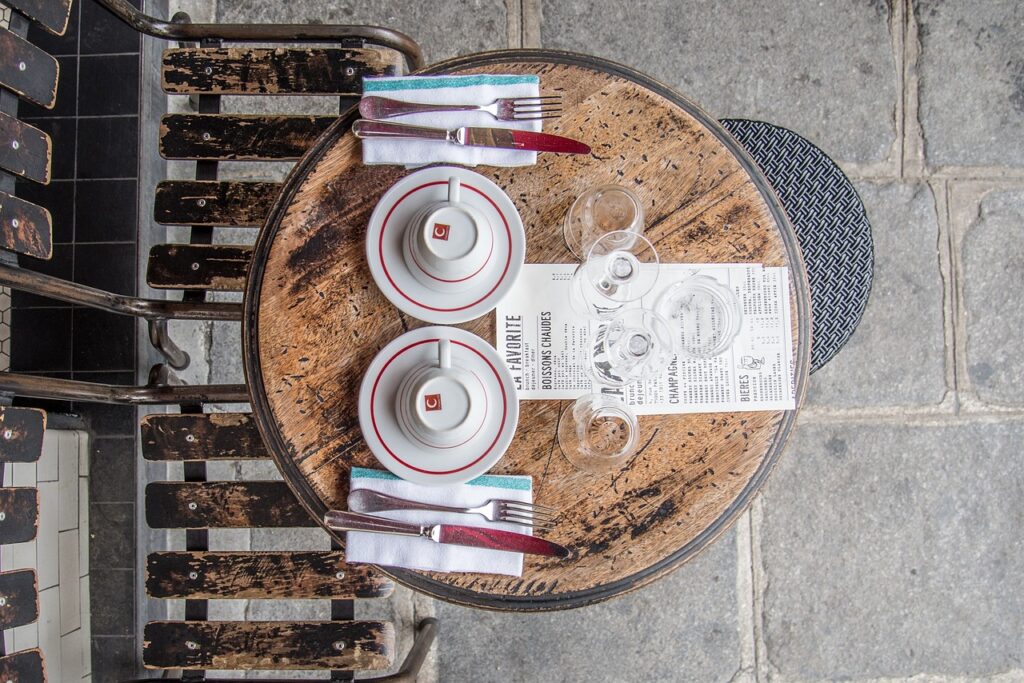
“Naff: A Rumination on Taste and Tastelessness” by Grace Plowden
Taste has long been used to reinforce hierarchies of power and class—a fact that Grace Plowden interrogates in this personal essay on the conscious cultivation of bad taste. A runner-up for the 2022 Jeffrey E. Smith Editors’ Prize, “Naff: A Rumination on Taste and Tastelessness” follows the author as she scrutinizes the significance of “naff”—a British/Polari word for a specific form of tackiness. In the process, Plowden reflects on the balancing act involved in writing critically about money and class from a position of privilege. “Naff” originally appeared in the Summer 2023 issue of TMR (46.2).
Naff: A Rumination on Taste and Tastelessness
Grace Plowden
Last summer I went on a Hinge date with a guy from New Jersey. We sat outside a Williamsburg restaurant that called itself an “eatery” and tried to suss each other out over frozen margaritas (mine) and fish tacos (his). At some point, he asked me what kind of music I listened to. I told him I loved shitty music: corny country and sappy pop. He was surprised. Apparently I didn’t give off that kind of vibe.
The kind of vibe I did give off likely had something to do with how he received my cut-glass British accent. I have been told that in America, my accent lends me a cool aura of authority. I have also been told that it sounds clunkily polite, in a way that suggests I want everyone to like me.
My date asked whether I liked these genres ironically. I told him I didn’t think I would have been committed enough to a project of irony to maintain an ungenuine taste for them for the best part of the last decade. I said I did enjoy listening to them, but I was always aware of their shittiness; thus, my pleasure wasn’t pure or unfettered but laced with a distance that I guessed I could call guilt or irony or even postirony. There was something taboo about listening to them, yet also something permissive. Some kind of pleasure born precisely from their shittiness. He wondered whether I would have felt the same had I been raised in the States, where lots of people liked these genres in earnest and said so publicly without qualifiers. I thought it likely I wouldn’t. The corny and the sappy would be much less fun if they were respected.
I’d call these genres “naff”—a subcategory of bad taste that the OED defines generically as “unfashionable, vulgar, lacking in style.” When I tried, clumsily, to describe its valences to my date, it became clear that there is no obvious American equivalent.
________
Nowadays, in the UK, allegations of naffness are ubiquitous. The word is so mainstream that I hear it every week, sometimes every few days, depending on where I am, whom I’m seeing, and whom I’m able to eavesdrop on. However, while it is generally acknowledged that “naff” means bad taste, there is little consensus about how naff’s bad differs from tacky’s and what exactly warrants this particular label.
One Urban Dictionary user, jessikuhh, defines the naff as something that is “unbearably out of fashion and nerdy,” citing parents trying to dance to ‘modern music,’ blue eyeshadow, blokes who wear socks with sandals[,] and pigtails. Their fellow forum users were on the fence: the post, when I viewed it, had seventy likes and sixty-one dislikes. Another, Shaowfax2020, leans into the way the term defies articulation, proclaiming it the word for “when you don’t like something or someone, but can’t really describe why.” Their example: Robbie Williams is just a bit naff (six likes, seventeen dislikes).
In his essay “Notes on Naff” (2021), Sean Wyer, a Welsh PhD candidate at Berkeley, presents naff in relation to “camp” to describe it to his American readers. He doesn’t discuss this, but it’s an interesting tack given that both words came into popular use via Polari, an underground slang prevalent in London in the 1950s. Polari is informed by Italian—”Polari” (aka Palare, Palary, Palyaree) comes from the Italian parlare, v. to talk—and was likely influenced by the significant number of Italians who migrated to London in the nineteenth century. Michael Quinion, the reputed etymologist and founder of worldwidewords.org, argues on his site that “naff” comes from the Italian gnaffa, n. a despicable person, and “camp,” from the Italian campare, v. to exaggerate.
Wyer’s comparison centres on the idea that naff, like camp, is not an idea but a sensibility—one that also hinges on imagined in-groups and out-groups. The comparison is fruitful up to that point, but thereafter, he strains for conclusions. For example, he opines that while camp implies a “too-muchness,” naff implies a “not-enoughness,” which is not a facet of the naff as much as the manky, adj. rotten, worthless (another Polari word, likely from the Italian mancare, v. to be lacking).
Wyer tries to convey a sense of the naff to his readers by composing his own “canon of naffness”:
garden gnomes
corporate team-building exercises
plastic souvenir snow globes
the vast majority of new and minor political parties
wax sculptures
vegetarian meat substitutes (until very, very recently)
“Keep Calm and Carry On” signs and their derivatives themed bars
monuments named after people who are still alive
monogrammed shirts
stadium marriage proposals
The Sunday Times‘s Rich List
I see that some of the examples cited above are kitschy, tacky, and a little bit cringe, but with the exception of “Keep Calm and Carry On” signs, for my money, most of them aren’t naff in the slightest.
My mum’s conception of the naff is similar to Nicky Haslam’s conception of the “common.” Haslam is an interior designer who is friends with the royals, and, as the Daily Mail alleges, he became the “arbiter of everything that should be avoided by those wishing to mix in polite society” after making a series of tea towels printed with lists of things he finds common.
His canon of common includes:
swimming with dolphins
gilded country gates
confidence
coloured bath towels
loving your parents
Caribbean at Christmas
Scottish accents
glass fruit in a bowl
tours of the house
having guests remove their shoes
knighthoods
comments in visitors’ books
exclamation marks
This is closer to my own sense of the naff, though several things on his list—a Caribbean Christmas for example—sound glorious and wouldn’t be on mine.
The lack of consensus is surprising. British society is one in which ideas of good and bad taste can feel so deeply coded and congealed within certain things that they seem inherent to them, as I imagine the genders of nouns might seem to the French and Spanish. This likely has something to do with the fact that sometimes judgements about a thing are latent in the language we use to describe it. Take crabby, adj. bitter, sour. The word itself makes it seem like my aversion to crab is not a personal preference but the natural, logical, objective conclusion because crabs themselves are crabby.
The same is true of metaphors. As the eighteenth-century philosopher Edmund Burke points out in the introduction to the second edition of A Philosophical Enquiry into the Origin of Our Ideas of the Sublime and Beautiful (1759), cultural taste takes its name from sensory taste. Cultural products are often talked about as foodstuffs, and judgements about their quality are baked into the chosen metaphors. Most present quality as something that correlates with the nutritional content of said foodstuffs. Daniel, a former classmate at university, used to say that books were his vegetables: “I don’t like them, but I know they’re good for me.” On the other hand, in his afterword to Different Seasons (1982), Stephen King poked fun at critics who deemed his books bad for the public by declaring his own work “the literary equivalent of a Big Mac and a large fries from McDonald’s.” Another brand of such metaphors presents quality as something that correlates inversely with the ease with which one can enjoy the food. As in one journalist’s observation that Matthew Arnold’s longer poems are “an acquired taste, but once the nut has been cracked their power is extraordinary.”
________
One of the things I find naff is quite literally tasteless. Viennetta is a British ice-cream cake that was popular in the early noughties. It comes in a cardboard box on a brown plastic tray and is a rectangular log of vanilla ice cream, cut through with rolling curls of tempered chocolate. At least, the ice cream is billed as vanilla. My friend Dom says it’s “vanilla ice cream that only tastes of white.”
Do I think Viennetta naff because of its literal tastelessness? Is my judgement a response to the fact that this tastelessness means it can be easily consumed by anyone and everyone—including those with “uncultured” or “unseasoned” palates? If this were the case, I would presumably find other tasteless foodstuffs—La Croix fruit-flavoured fizzy water, say—naff for the same reason. As it stands, I’m impartial to La Croix. I’ve had it three times or so, and my only real feeling about it is a fondness for the way it was described to me by a classmate in Chicago: “It’s like drinking sparkling water whilst a neighbour, three doors down, shouts the name of its namesake fruit—just once, staccato, each time you take a sip.” Other tasteless foods—tofu, quinoa, oats—likewise aren’t naff, which makes me think that I consider Viennetta naff for other reasons.
We had it at home once, for pudding after Sunday lunch. We were at our old house in Scotland, so I must have been no older than seven. We were allowed puddings most weekends (my parents were not monsters), but these puddings were of a certain type. They tended to be cake-based—either homemade lemon drizzles or farm-shop sticky toffees—and when we were allowed ice cream, it was always the type with ingredients we could read and labels that advertised the farm that supplied the dairy.
Viennetta was such a novelty for us that naturally I asked to have it at my birthday party. My mum was reluctant. She told me it wasn’t quite the done thing and insisted that she make something herself. Her birthday cakes were elaborate constructions which tended to be themed according to whatever two-week-long obsession my siblings and I were passing through at the time. They were always delicious, but that year, mine was ungratefully received. I didn’t understand why she had to make a real cake. A proper cake. A cake baked with sugar, love, and intention. I couldn’t understand her reluctance to serve a cake she’d bought in Tesco for £1.29.
________
I must have been nine or ten when I first came across massage chairs. We were Christmas shopping at a department store in Edinburgh, and I sat on one of the sunken pleather La-Z-Boy-esque contraptions while waiting for Mum to come back from the loo. The roller balls edged up my spine once, and that was it: I was sold. I petitioned her for one on her return. She laughed, agreeing that they felt nice, but said she wasn’t going to buy one “because they’re naff.”
Years later, we were having supper at home when she announced that she thought it would be kind of funny to have a naff room in the basement—a communal bachelor pad of sorts, chock-full of tasteless objects and décor. I imagined this room to be something like Elvis’s Jungle Room without the tropical bent (the rock waterfall, coloured lights, and ruched curtains could stay, but that Astroturf carpet would have to go). It would be filled with all the things we’d wanted over the years but had been denied. My brother suggested that we hang personalised numberplates on the walls. Mum floated a hot tub or a jacuzzi—”Why not both?” I lobbied for massage chairs.
The following night, I brought the naff room up again and asked if anyone had had any bright ideas. Mum was much less keen. “It’s funny in the abstract,” she said lightly, “but it’s impractical.” Meaning: we couldn’t put guests in the bedroom next door.
________
We keep a copy of an AQA General Studies exam paper—”Power” from May 2003—in one of the loos at home, the one closest to the front door. It’s mounted in glass but has been left, casually, beside the sink, a position that embodies the way we conceive of it: as an amusing little artifact that we’re keen to have seen but one we don’t want to look like we’re drawing attention to. The exam contains an excerpt from Jeremy Paxman’s book The English: A Portrait of the People (2001). The excerpt is about my dad’s family and their lives at Plowden Hall, in the village of Plowden, at which Plowdens have been “seated” since 1200, when one of our ancestors fought in the Crusades at the Siege of Acre. (This means they were there when Chaucer wrote The Canterbury Tales, when the fact that it was written in English rather than French made it vulgar and lowbrow, still there when it was deemed canonical by English departments around the country).
The exam question is as follows:
It could be argued either that the real power in Britain still lies with such families; or that they have lost hold of the power they once had.
Argue one way or the other, as if you were a member of such a family. You might consider in your account:
-
-
-
- the source, and present basis, of your wealth
- whether this wealth gives you power and influence
- where the power that you once had might have gone
-
-
My dad’s family is posh. Black-Labradors-and-tweed posh. Where they sit on the class scale, however, is up for debate. If you consider “upper class” a synonym for “posh,” “old,” or “landed gentry,” then they are as upper class as they come. But if you reserve the term exclusively for those with titles, then they would be middle class. They, however, consider the latter view a little shortsighted. Within the family, it’s understood that they would have been titled had they renounced their Catholicism and converted to Protestantism during the Reformation. Their lack of title is a point of pride: evidence of their unwavering faith—a faith that led them to squirrel high Catholic officials into priest holes to keep them safe from those who wished them harm. They thus view their lack of title as something that distinguishes them, honourably, from others.
Where my mum’s family sits on the class scale is up for debate for different reasons. They do not feature in books by renowned historians, nor are there strangers on the Internet keeping tabs on their peerage. Their history is buried, accessible only through the scant stories my grandparents have chosen to pass down. Grandpa’s family were bakers from Newcastle and his mum a performer of sorts who operated under the stage name “Dorinda Long.” Granny was born in Liverpool, and all I really know is that her dad died young, after which things got hard. Later, she became one of the first female designers to go to the Royal College of Art.
Mum describes them as “not posh,” “middle class,” or “lower middle class.” What is implied by the “lower,” though, isn’t quite clear. It could be a relative term, used to suggest that they are of a lower middle class than the Plowdens. Or it could mean that historically they were “lower class” and that their middle-class status, expressed as it is via tastes for Boden clothing and the children’s show Blue Peter, is relatively recent. This “relatively” also begs elaboration. Relatively recent compared to my dad’s family’s conception of history? Or relatively recent compared to my mum’s? Even when I am trying to describe class straight-up, to name its nuances without euphemism, it feels nebulous. The words themselves are self-conscious—too schooled in English social norms to make this line of enquiry comfortable.
My own immediate family thus hovers somewhere in the middle of Britain’s class system: middle class, but with access to and understanding of both those “above” and “below” them. My dad is the youngest son, so he didn’t inherit anything and moved to Scotland to work in the city. We could be called “old money” because of the number of branches on my dad’s family tree or “nouveau,” “nouveau riche,” “parvenu,” or “arriviste” because all our money comes from his job.
________
In “Notes on Naff,” Sean Wyer argues that although the naff hinges on ideas of imagined in-groups and out-groups, it’s “not an inherently elitist phenomenon, because derision can punch up as well as down.” His argument that naff can punch up centres around the fact that he thinks it naff to be on the Sunday Times’s Rich List. However, I would argue that naffness is foremost a class judgement rather than a pecuniary one and that it is pecuniary only insofar as money relates to class.
In feudal Britain, the king owned all the land, but he would allocate it to noblemen in return for their loyalty. The noblemen lent some of this land to knights in return for their protection should they or the king require fighters. They also let the serfs live on this land as subsistence farmers, so long as they provided enough food for everyone on their fief. This structure, which was in place from about 300-1400 AD, was pretty rigid. Unless you somehow became chummy with the king, there was little chance for upward social mobility. But after enclosure, when the king closed the commons and “freed” the serfs, former serfs were forced to flock to the cities to try to earn their living via wage labour. In theory, this shift from feudalism to capitalism made upward social mobility easier.
As the country industrialised and trade networks expanded with the British Empire, it became easier for working Brits to get rich quick. They became a class of their own: an entrepreneurial, mercantile, aspiring class of means. Anxious about maintaining their own class position, the noblemen of yore wanted to find a way to distinguish themselves from the newly prosperous. And thus: taste.
Though Thorstein Veblen writes of the middle class in nineteenth-century America, much of what he discusses in The Theory of the Leisure Class (1899) can be applied to Britain. He states that initially, class was determined by wealth and expressed via either “conspicuous consumption” or conspicuous leisure. However, as more and more people acquired significant amounts of wealth, class became determined not just by how much money one had but by how exactly one expressed its surplus.
According to Veblen, taste first served as a means of broadcasting conspicuous leisure. “This cultivation of the aesthetic faculty requires time and application, and the demands made upon the gentleman in this direction therefore tend to change his life of leisure into a more or less arduous application to the business of learning how to live a life of ostensible leisure in a becoming way.” It took such a long time to become educated in this arbitrary system that the mere fact of connoisseurship signified extreme wealth; it showed that you could afford to spend hours acquainting yourself with this system and more still acquiring a taste for the things considered tasteful so you could converse at length with dinner companions about the “extraooooooordinary power” of Matthew Arnold’s longer poems.
Today, in Britain, class continues to grow ever more distant from the fact of money and ever more intertwined with proving that you are learned in the arbitrary intricacies of taste. To parrot the Financial Times, it’s all about showing you know “How to Spend It”—and, more importantly, how not to. Spending lots of money on the wrong things is in fact the fastest way to betray a lack of class. As one of the (posh) people I spoke to declared, naffness is the result of “people trying too hard to look a certain way.” By which he meant nouveau people trying to look posh by flashing their cash. His canon of naffness included caviar and Rolex watches.
This is also the case with many things on Nicky Haslam’s tea towels, including gilded country gates and tours of the house. His inclusion of knighthoods, however, betrays another related, more modern anxiety about the shift to a meritocratic social hierarchy from one determined by hereditary aristocracy.
Taste then, serves two primary functions:
- it’s an expression of class that receives social confirmation or social dismissal depending on audience
- it’s a barrier to social mobility, a means through which the historically elite cling to feudal hierarchies of power
Here’s my dilemma: I have a taste for bad taste. A compulsion for it and the feelings of permission it grants. I regularly serve guests Viennetta at dinner parties, partly because I’m a terrible cook and partly because it feels frowned upon, which makes its tastelessness even more delightful. I like to rest my forehead wistfully against rain-streaked windows of cars, buses, trains, and planes while listening to Taylor Swift or Catherine McGrath sing some mopey ballad or another. I hold my knife and fork in the wrong hands. And I feel compelled to write essays about class and money.
I am, however, suspicious of these compulsions. On the one hand, given that deeming something in bad taste is a means through which the historically elite try to maintain superiority over those who have historically been lower class, I worry that my attraction to naffness is a form of snobbery. Regardless of the fact that I purport to love rather than loathe naff things, my canon of naffness takes shape in opposition to received notions of good taste—a fact evident in the wealth of comments about how naff things aren’t “done” or “proper” for “certain kinds of people.” When I call something naff, I implicitly assert my superiority over the kinds of people who like it in earnest.
On the other hand, my attraction to naffness could be a way in which I rebel against this snobbery. When I serve dinner-party guests Viennetta, I bring a nonposh thing into a traditionally posh space and, in so doing, rebel against its conventions from within. I acknowledge the rules in place whilst I break them.
Historically, both “naff” and the Polari slang through which it came into popular use have been used as forms of resistance to mainstream culture. Polari uses English grammar and syntax, but its vocab is informed by other languages: Italian most heavily, but also French, Irish, Shelta (the cant of the Irish tinkers), Yiddish, Turkish, Cockney rhyming slang, Molly slang, and criminal cant. As the linguist Paul Barker notes, many people who spoke these languages were seen as criminals and lived on the fringes of society. It thus isn’t surprising that soon after it appeared, Polari was adopted by queers. Male homosexuality was illegal in Britain until 1967, and thus Polari came in handy as a code to disguise the culture from homophobes and charpering omi, n. the police. (Synonyms: Hilda Handcuffs, Lily Law, Betty Bracelets, Beryl with a Badge.)
The slang remained underground until the late ’60s, when it was featured in “Julian and Sandy,” a comedy sketch about two gay men, on the radio show Round the Horne. The show was pretty raunchy, but the fact that it was raunchy in Polari helped it evade censorship.
SANDY:
Roll up yer trouser legs . . . we want to vada [v. look, see] your calves.
JULIAN:
Hmmm . . . his skotches [n. pl. legs (from cockney rhyming slang, scotch egg = leg)] may be a bit naph [unique spelling of naff, adj. bad] but his plates [n. pl. feet (from cockney rhythming slang, plates of meat = feet)] are bona [adj. good (from Italian)].
This was likewise the case with Porridge, a 1970s comedy show set in a British prison. Before writing the pilot, the writers spoke to a former prisoner who told them about the importance of “little victories” when serving time. They decided to structure each episode around a little way in which Fletcher, the show’s criminal protagonist, beat the system. The way the writers used “naff” was their own little victory. They used it as part of a euphemism, “naff off,” to allow Fletch to say “fuck off” whilst circumventing the strict national censorship laws in place at the time. “Naff” helped them break the rules in plain sight and say what they wanted to say without biting the hand that fed them.
“Naff” and its derivates would remain peripheral until 1982, when Princess Anne used it while competing at the Badminton Horse Trials. The royal equestrian didn’t make it over one of the obstacles and fell off her horse. The paps had a field day and descended upon her to capture the moment. She told them to “naff off” [/’naff-orf/].
While the fact that Princess Anne used a Polari word shows the extent to which the slang was then known, after she used it, uses of both “naff” and “naff off” spiked.
This can be seen in Figure 1 and Figure 2: screenshots from Google Ngram Viewer that show their appearance in books between 1950 and 2019. Even allowing for the fact that initially the slang was rarely written, let alone published, the increase is clear.

Figure 1.
“naff off,” Google Books Ngram Viewer, http://books.google.com/ngrams.

Figure 2.
“naff,” Google Books Ngram Viewer, http://books.google.com/ngrams.
On his blog, however, Michael Quinion offers an alternative account of Badminton. He states that years after the fact, he interviewed one of the reporters who broke the story. The reporter told him that Princess Anne had said, “fuck,” and it was the reporters who had replaced “fuck” with “naff” to circumvent censorship. This begs the question: Would “naff” have become so commonplace had its use here been attributed to the reporters from the off? The cynic in me suspects not and that to really catch on, it needed that royal stamp of approval.
________
There is a sense in which only certain kinds of people are able to embrace the naff. In Let’s Talk about Love (2007), his book about Celine Dion, Carl Wilson claims that those of us who have a taste for bad taste think ourselves beyond cultural reproach; he proposes that our love for it is symptomatic of our social arrogance: “It suggests that you are so cool that you can afford to risk it on something goofy, ungainly[,] and awkward.” I’m not sure my love for the naff is arrogant, but it could be said to highlight the relative stability of my class position, bolstered as it is by the dominance of my posh parts. “Plowden” acts like a dominant gene, subsuming my mum’s family name and associations; thus, my taste for bad taste is likely to be considered a personal preference rather than something that automatically marks me as different from the upper classes.
This might explain why I’m comfortable broadcasting my love for the naff and why Mum, although likewise drawn to it, is usually reluctant to go whole hog in her appreciation. She also bears my dad’s surname, but she wasn’t born with it. Not to suggest that she feels unstable in her class position: she’s not ashamed not to be posh and is anything but ashamed of her family. But taste-wise, in Britain, she tends to present herself as more steady, more conservative (small c) than I know her to be.
She does, however, publicly embrace the naff on one occasion. Every year we go to the Dalrymples’ drinks party on the twenty-third of December. Every year we stand around making polite small talk over large platters of smoked salmon, sour cream, and dill blinis. Everyone is smart or smart-casual. Men and boys are expected to wear chinos and shirts, but the choice between a shmere jumper, tweed jacket, or Schoeffel is a matter of personal (read: their wives’) preference. For women and girls, the emphasis is on tidiness. Hair must be brushed, makeup worn, and shoes clean. Most wear dresses or skirts in dark colours, though trousers are allowed, as long as they aren’t jeans. Mum always opts for a silk dress (some dark, tidy, tasteful number), but she’ll dress it down with her Christmas earrings: two Brussels sprouts, just a little too green, that dangle conspicuously from her lobes. She bought them years ago for £5 from Claire’s Accessories. She’s allergic to cheapy jewellery. These earrings itch so much that she has to take them off the moment we peel out of the Dalrymples’ driveway and head homewards, and yet she continues to wear them regardless.
I’m inclined to consider the mild discomfort of her public display of bad taste symbolic, to see it as her senses advising her against this public embrace—senses she chooses to ignore, refusing to take herself so seriously as to deny herself this toying with transgression.
I can picture her standing by the Dalrymples’ Christmas-card-lined mantelpiece, a blini in one hand, a glass of champagne in the other. A dozy smile plays on her lips as she gazes into the throng of shmere and tweed and well-brushed hair. Her face is flushed. Her earlobes red. It’s as if she were alight with the thrill of her little victory.
________
Though I embrace naff things more often and more conspicuously than my mum, I also get off on naff’s potential for low-stakes transgressions that are always watered down, rendered palatable, digestible, by that ambiguous note of guilt, irony, and/or postirony that make my tone and sincerity hard to locate and thus hard to condemn. Embracing the naff allows me to say what I want to say without biting the hand that feeds me. It allows me to have my Viennetta and eat it, too.
Writing about class and money, however, feels different. The more explicit I am, the more I risk having my own posh privileges revoked and the more I risk offending or upsetting both sides of my extended family for similar but contradictory reasons. The potential downsides far outweigh the benefits, yet I feel compelled to write about these things regardless. I have always felt like an outsider: marginally other, marginally different to whomever I’m with: “too posh” for people who aren’t posh and “not posh enough” for posh people. In naff’s liminality, though, I feel at ease. I feel compelled to tell you—as corny as it may be—that in naffness, I feel at home.
________
Meet the Author
 My parents’ house in Scotland has roofed turrets with spires, battlements, and the odd crest etched into its brick walls. It seems the sort of house one inherits, but they bought it when I was five. Built in 1623, it was a private family house until 1986, when the owners were forced to sell it to a corporation that opened it as a hotel. My parents bought it around the millennium and spent several years doing it up, much of which involved removing all the features that signified its former, mercenary function.
In the corner of what’s now the inner hall there used to be a bar: a chunky wooden thing that served as the hotel’s reception. The first time my siblings and I looked around, we met the manager there and he took us on a tour, showing us each room as if we were prospective guests. My siblings and I loved this bar. We imagined growing up behind it, using it to make our own guests cocktails when we were old enough to drink. Mum, however, insisted on taking it out. She wanted the house to look like a home rather than a hotel.
The feudal system may be a thing of the past, but its hierarchies continue to structure and stratify British society, influencing everything from choice of school to choice of supermarket. Although class can often be deduced from someone’s accent or from the way they refer to the bathroom, for the most part, it’s a silent presence, expressed by subtle social cues, or else their lack. This silence makes class particularly tricksy and is, I think, one of the reasons why feudal hierarchies have endured for so long. Classist ideologies are concealed by cognates, baked into metaphors, loaded into innocent-sounding language that is then acculturated, inherited, by one generation after another.
___
Grace Plowden was born and raised in the UK. She now lives in New York, where she’s pursuing an MFA in nonfiction at Columbia University. She received a first-class degree in English literature from Trinity College Dublin, where she was awarded Trinity’s Gold Medal. This essay, a runner-up for the Jeffrey E. Smith Editors’ Prize, is her first published personal essay.
SEE THE ISSUE

SUGGESTED CONTENT

Featured Prose
Oct 15 2026
A Conversation with Mitch Wieland
Mitch Wieland’s short story “Snow Angels” debuted in the summer 2015 edition of The Missouri Review. In the years since, Wieland adapted the story into his forthcoming novel, The Ghosts… read more

Featured Prose
Aug 27 2026
“Snow Angels” by Mitch Wieland
“Snow Angels” by Mitch Wieland first appeared in TMR 38.2 and later in the TMR anthology Hello, I Love You: Stories of Romance. Wieland turned the story into a novel, The… read more

Featured Prose
Jul 09 2026
A Conversation With Rufi Thorpe
Rufi Thorpe is the author of the Clark Fiction Prize-winning novel Margo’s Got Money Troubles, as well as The Girls from Corona Del Mar, Dear Fang, With Love and The Knockout Queen, which was a… read more