
Poem of the Week | September 07, 2026
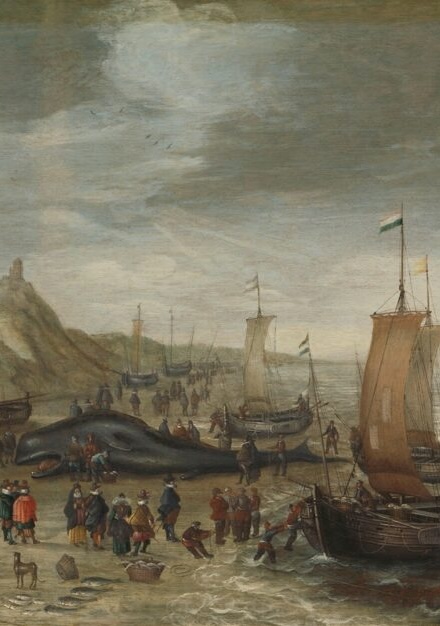
“How to Move the Dead” by Gretchen Williams
Gretchen Williams is a poet and writer working in global health equity. She holds a Master of Science from the Harvard T.H. Chan School of Public Health and is a certified guide with the Association of Nature and Forest Therapy. Her writing has appeared in the Mississippi Review and elsewhere, and she was a poetry finalist for The Missouri Review 2026 Perkoff Prize. Her work has been supported by the Bread Loaf Writers’ Conference, Kenyon Review Writers Workshop, Virginia Center for the Creative Arts, and Massachusetts Audubon Society. Originally from central Virginia, she currently lives in western Massachusetts.
“How to Move the Dead” by Gretchen Williams is our Poem of the Week.
***
How to Move the Dead
A dead sperm whale washed up on a Nantucket beach
in November. Its leaden corpse arched limp in the raw,
frigid surf. More than one hundred thousand pounds,
authorities puzzled over how to move the beast inland,
where it could be pried apart to determine why it died. Its
lower jaw sawed off to stop prize hunters from stealing teeth
as relics, mouth agape in forever yawn against the wash—
cut off mid-call. Mourners and the merely curious came
to see the creature up close. Scattering flower petals and trilling
coastal hymns for this anointed mariner that crested two worlds
in life, now dispatched into another. But there’s no machinery
this side of creation powerful enough to transport a carcass that
heavy anywhere across land. And small excisions on the beach
uncovered gnarled scar tissue, but no lethal pathogen or injury.
Unsafe and unseemly to leave rotting in the open, it would be
dragged out to sea. A tether looped around its tail, the whale
shifted by excavator, then pulled behind a tugboat churning fifty
miles offshore. Jettisoned back down to the dark, where it spent
most of its life. A deep-dive feeder returning to ocean reliquary.
Ferried out just far enough to ensure it can’t return with the tide.
Like how you carry any dead thing: a broken housecat from the
middle of the road, the getaway plan long abandoned but tough
to shake off, a paper-thin marriage stock-still in its sickbed.
Hands slick with blood and marked by scars of mottled memory.
Cradling whatever remains to the curb, to the shoreline, to an
uncertain threshold—released into the next world. Searching
for words, a short prayer offered in eulogy. Eyes casting about,
trying to look anywhere but down, as you let go.
***
 Author’s Note
In November 2025, a whale was found dead on the north shore of Nantucket, an island about thirty miles off the coast of Massachusetts. The first sperm whale to wash up in more than twenty years, the creature was enormous: fifty feet long and weighing fifty-two tons—roughly equivalent to eight adult African elephants or twenty-nine midsize sedans. Frequent news updates chronicled the challenges posed by the massive body, deemed “too big to move” and defying all usual modes of human transport. Five days later, an excavator and tugboat offered a solution. At the time, there was no conclusive cause of death, though scientists have since determined that the endangered animal was likely killed by the long-term effects of a ship strike—a common occurrence and tragic anthropogenic epilogue to the story. This poem explores the ways we often try to address seemingly intractable problems or situations and how what seems like solely an issue of logistics at first glance may instead be a matter of will—a practice in the motions required to release just about anything.
SEE THE ISSUE
SUGGESTED CONTENT

Poem of the Week
Nov 02 2026
“Dreams of Birth” by Kathryn Kimball
Kathryn Kimball grew up in Montgomery, Alabama, has an MFA and a PhD, and taught writing and nineteenth-century British and American literature. Her translations and poems have appeared in various… read more

Poem of the Week
Oct 26 2026
“Observations meant to enlighten can also obscure” by Bob Hicok
“Observations meant to enlighten can also obscure” by Bob Hicok is our Poem of the Week. Title image: A Distant View of the Hudson River in the Fall (1873) by Jasper… read more
Poem of the Week
Oct 19 2026
“I Was Braver Than I Thought” by W. M. Lobko
W. M. Lobko’s poetry, interviews, and reviews have been published in journals such as Iowa Review, Kenyon Review, Washington Square, Boston Review, and Guernica. He has been nominated for a Pushcart Prize… read more