
Blast | January 15, 2026
“A Day at the Museum” by Michael J. Cannistraci
BLAST, TMR’s online-only prose anthology, features prose too vibrant to be confined between the covers of a print journal.
In this essay by Michael J. Cannistraci, a New York actor finds himself at the helm of a group of Jewish emigrants from the USSR as they navigate the American Museum of Natural History—and the challenges writ large of their new lives in America. Through sharing words, food, and histories, the English teacher and his students become the caretakers of one another and partake in the struggle to “do this life.”
***
A Day at the Museum
The security guards at the Museum of Natural History had pinned my student to the marble floor. Four overweight museum guards against one skinny guy from Uzbekistan—it didn’t seem fair. He was too drunk to start a fight, but then again, he shouldn’t have tried to dance with the dinosaur.
***
I wouldn’t have chosen to teach English as a second language. I never thought of myself as a teacher of anything. I never had a call to teach; I was just desperate for work. I hadn’t been able to find steady employment for four months. I’d been fired from my bartending job after giving away too many drinks to the regulars. I scraped together odd jobs as a dishwasher or day laborer to eat while being pounded by the fear of being homeless. My landlord was patient about my late rent payments, but the stinging humiliation of having to ask for more time each month made me feel worthless. I was skirting destitution. I dropped off resumes all over New York City, and no one was hiring.
It was April 1991 when I met with a social worker at the Actor’s Fund to see if I could get a grant or a loan, a kind of one-shot deal to help me pay my rent and utilities. She drafted me into a satellite teaching program for ESL. I completed a three-week training course. The program used a combination of aural/oral repetition of phrases and sentences, combined with an acting out of the sentence, a kind of linguistic pantomime, which is why they were hungry for actors. I was hired almost immediately.
Mikhail Gorbachev had offered visas to masses of Russian Jews to leave the USSR, and many of them took him up on his offer. Antisemitism was part of the day-to-day in Russia, and most of my students were glad to see the back of it. The passports they were given cited their nationality as Jewish, not Russian.
The school was housed in an imposing, modern building down in the financial district within walking distance of the stock exchange. The front of the building was all smoked glass and polished silver metal, more like an investment bank than a safe haven for the huddled masses. I walked in and was welcomed by the director of the school, a warm and energetic woman named Liz, who gave us a pep talk and welcome speech and then shuffled us off to our classrooms.
Despite years of performing, I had stage fright on my first day of teaching. My face and upper chest were flushed, and I felt sweat pooling at the nape of my neck. There were about twenty students in the classroom, mostly in their thirties and forties. Their clothing was clean but worn. I would be their teacher for the next four months, and then they would transition to a work-readiness program.
They were chattering away in Russian when I walked in the room, then suddenly became silent and shyly deferential.
I decided a frontal attack was best. During my teacher’s training, I was told I had to manage the class, show them my confidence.
“Hello,” I said.
“Hello,” came back a few whispered responses.
“Hello,” I said, writing hello on the board. “My name is Michael. Say: Hello Michael.”
I stared at a room with blank faces.
Then one man stood up and said loudly, grinning broadly, “Hello Michael!”
I took him in. He was a tall, skinny man with olive skin and a good-natured expression. He was missing three fingers on his left hand.
His name was Ziyo, Ziyo from Samarkand.
My teaching career got off to a bumpy start. The school wanted me to use a teaching method with a strict mode of repetition. I had trouble getting the hang of it. It didn’t help that I was assigned to Matt, a carping teaching mentor with a sadistic streak. He was tall, with flowing black hair that he would toss back like he was an orchestra conductor. He came twice a week and stood glowering in the corner, jumping on any student who missed a word in the repetition exercises, snapping at them like a seagull eating a clam. The students sensed the tension between us and sometimes became withdrawn. His day job was writing children’s musicals, but he had the personality of a prison guard. He loved coming in with his clipboard and tearing my teaching to shreds.
“Michael, we’re not here to make friends with these people. We are here to educate them and make them good Americans. Don’t be so easy on them. Make them repeat the sentences exactly,” he barked.
My students, having experienced the brutality of authoritarian types, would compliment me in front of him. “Misha, you are the best teacher. Thank you giving us words to speak.” Matt didn’t look convinced, scribbling on his clipboard and shaking his head.
The first six weeks of teaching were filled with hellish uncertainty. Despite spending five days together, week after week, with limited language it was difficult to know my students as people. I wrestled with a mix of compassion and resentment, not knowing if my students were really trying or lazy, intelligent or stupid. In class one day, most of them would understand the lesson, perfectly repeating each phrase, and the following day they would forget everything we had worked on. I seethed with frustration. I wasn’t sure if they weren’t able to learn or if I wasn’t able to teach.
The rigidity of the teaching program didn’t give them a chance to show their creativity or curiosity. However, around the fourth week, during class breaks some students would begin to ask about a word or expression they’d heard on a television show or on the street. I tried to explain in pantomime, like playing charades with the refugees. As they brought more words for me to decipher, I was able to get a glimmer of their intelligence.
Still, I was separated from my students by a gulf of language, never completely knowing them or their lives outside of class. What music did they like? What was it like to be a teenager in Kyiv, Murmansk, or Baku? When did they learn to swim? I had no language to ask these questions.
By the sixth week, I sensed a nimble canniness in them, some survival instinct that would help them learn English. At the same time, I began to think I couldn’t teach them. I didn’t really learn grammar in high school. I was too American to teach English.
So I kept drilling them and prayed they would learn by imitating me.
“Lyudmila, how are you today? Repeat.”
“Shtoh?”
“No shtoh. Shtoh that away. Repeat: How are you today?”
“How are you today?” Lyudmila said.
“Ask Grigor: How are you today?”
“Shtoh?”
I began to understand that, for most of them, I was the only American they had any contact with from day to day. All of them were living in subsidized housing, spread out over Brooklyn and Brighton Breach, living in enclaves with other Russians emigrated from all over the USSR. The staggering reality that I was the guide for these pilgrims, lighting the way in this strange new world, freaked me out. Sometimes it would become awkward. Svetlana, a refugee from Kyiv, thick waisted with calloused hands, asked me in the middle of class, “Misha, what is the lap dance? Is exercise for peoples?”
My students, despite leaving Mother Russia with little more than the clothes they were wearing, were so deeply generous and openhearted that I felt ashamed. I was often irritated in my private life about perceived slights and criticism, while they were humble and kind in the face of years of prejudice. Often, I would walk into the classroom and find that an offering had been arranged on my behalf: some delicacy from Murmansk, or a fish dish wrapped in sausage in some kind of gravy. I ate obediently as the women in my class stared at me expectantly. I always praised the food that was so foreign to my palate. I didn’t want to offend my students who had spent what little money they had to buy and cook food for me. They wanted to share their history, their life stories on a covered, chipped dinner plate.
It was true they needed money, and I needed money too, but there was an ocean of difference between an immigrant cast on the shores of New York, and a New York actor hustling for work. All of the teachers at the school were artists (a now-famous novelist had the class next to mine), so it was easy to get substitute teachers when I got cast on All My Children or some other well-paying gig.
My students became anxious if I was away for three days on a shoot. When I returned to class, they would bring me gifts: a beautiful carved jewelry box called a palekh, black lacquered with intricate hand-painted scenes from Russian folklore, or a matryoshka, a Russian nesting doll. I think they hoped I wouldn’t quit, leave the school, and abandon them.
I felt a worming shame when they handed me these gifts, their faces scanning mine for pleasure. Some of them told me terrible stories of persecution and struggle in Russia, of not being hired for work because they were Jewish or getting lower pay than non-Jews. They were giving some American actor a gift they had to scrounge to buy. I begged them to stop giving me gifts, but they stoically refused. At night in my apartment as I played with the doll, an existential question came up for me. What would be my identity if I weren’t acting? I opened each shell to reveal another doll and wondered if I was looking at myself.
The curriculum workbook I used in class focused on asking directions, how much things cost, and what each student did for a living in the Soviet Union.
“What was your job in Russia?” I asked each student to turn to their neighbor and ask.
“I work in factory,” one student said.
“I was farmer.”
“I am engineer in water plant.”
“I sell fish.”
My students rattled off descriptions of their past working lives with defeated sadness, and I stood there rooted like a tree in front of them, feeling chagrined. I was teaching these people with my stupid pantomime, asking them to repeat sentences like first graders. It didn’t seem enough to move them forward in this new world.
When we got to Ziyo, he said, “I work in cotton factory. That’s where I hurt hand.” He waved his two-fingered hand in a lighthearted wave, like he was saying hello.
“Uzbekistan has much cotton,” he said.
“Uzbekistan has a lot of cotton.”
“Yes, lot of cotton.”
After class one day, Ziyo lagged behind and slipped me a folded paper. It smelled like cigarette smoke and onions. He looked at me for a moment, then nodded his head and left.
I waited until I was in the teacher’s lounge to read it.
Mischa, thank you for reading letter. I have question but is difficult.
How do I live as me in America?
I read these few sentences, broken like Morse code, repeatedly. Every time, I tried to find something between the lines.
***
For most of them, their years in the Soviet Union had dimmed any connection to the Torah, or any spirituality for that matter. The experience of being Jewish had gone underground decades ago, generations of Russian Jews not participating in any religious life and never speaking or writing in Yiddish. Not all of my students were non-observant. Grigor, a tall, gentle man with stooped posture and a thick black beard, told me that he would sometimes attend clandestine Shabbos dinners. These dinners were cloaked in life-and-death secrecy because neighbors would report Jews for observing the Sabbath, and entire families would be arrested and disappear forever. Matzo was sold on the black market like guns or cocaine.
I would awkwardly teach lessons on Yom Kippur, Passover, and Chanukah. My Catholic catechism hadn’t prepared me for this new role, so I spent hours on the weekends cramming on Jewish religious traditions, trying to explain who the Maccabees were, and how a little oil could keep lamps lit for eight days. My students would become confused when the school was closed for an observance of a Jewish holiday like Sukkot, so I would try to explain why there was a straw hut in front of the school.
But no matter how hard I tried to bring them their heritage as Jews, I couldn’t bridge that gap. It was like I was telling them stories of strangers they had never met.
***
Around eight weeks in, the refugee organization paid for each class to take an educational field trip, either to the main branch of the New York Public Library on Fifth Ave. or the Museum of Natural History. All of my students voted for the museum.
“Misha, can we bring vodka?” Grigor asked.
“No vodka. None. Nyet vodka,” I said.
The class grumbled glumly.
The thought of herding twenty Russians around the museum was terrifying to me. I told my friend Doris about my anxiety. She was a book editor who had just finished doing back-to-back all-nighters editing a For Dummies book. She looked fresh as spring; the cocaine and espresso might have helped.
“If you’re so scared, I’ll go with you. I’ll be your Armenian chaperone. I’ve manhandled a couple of Russians back in the day,” she said. Doris spoke a little Russian as well.
I wasn’t sure this was a good idea. Doris liked to drink vodka too.
“Don’t be such a worrier,” she chided me. “I’ll behave myself.”
I reluctantly agreed to have her tag along.
The field trip was scheduled for Friday. I waited tensely at the subway station exit. In a rush, all of my students arrived en masse, and I scrambled to get them organized for the walk up to the museum. Suddenly, they all stopped to stare across the street, and I saw Doris waving at us. She was dressed in stylish black silk pants with a beaded vest, white ruffled shirt, and a black fedora. She looked like some silent movie star. She walked up laughing, saying a few sentences in Russian to my students, who were charmed immediately. Her entrance annoyed the hell out of me.
She led the men giggling up the street to the museum, while I somberly walked behind with the Russian matriarchs.
Doris and I led the students up Central Park West to the front entrance of the museum. My students gazed in awe at the stone cupolas and stunning architecture of the front façade, and the statue of Teddy Roosevelt with a Native American and an African American man standing in obedient deference on either side of his horse.
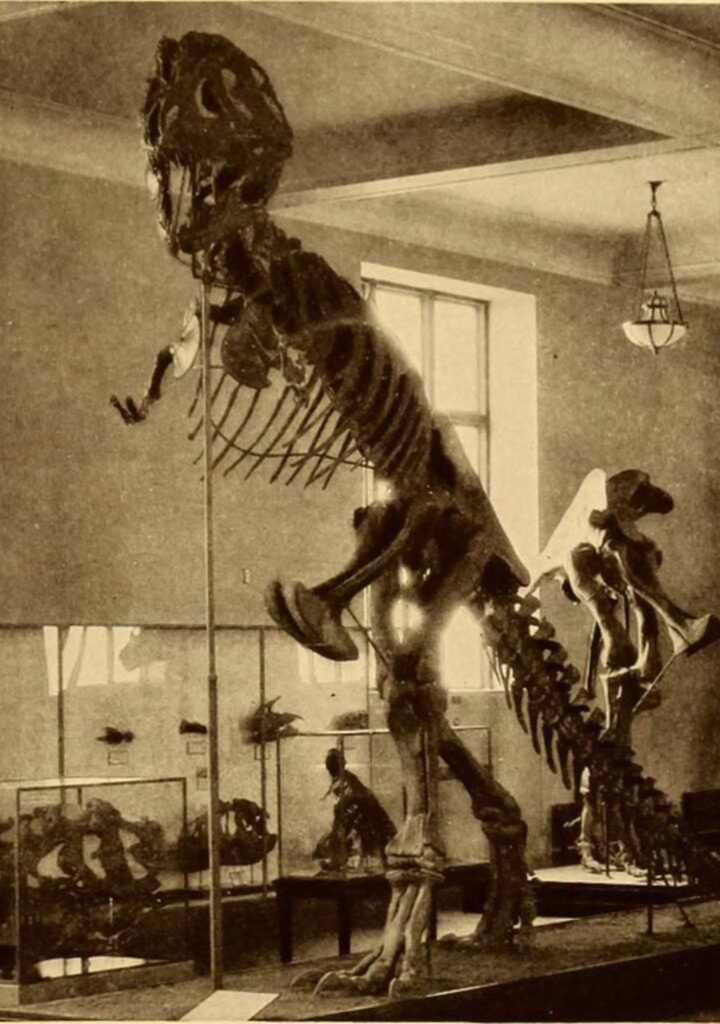
The students drifted off in the rotunda, ogling the gigantic fossil of the brontosaurus protecting its calf from a slightly less gigantic allosaurus. Two security guards were holding power drills while a machinist screwed in a brass-plated plaque about the scene.
Doris merrily led the students to the diorama of Peter Stuyvesant greeting a group of mostly naked Lenape Indians. She pointed out how realistic the male anatomy was in the Native American men. “Now ladies, tell me you wouldn’t want to spend the night in these boys’ tepees,” she crowed. All the women giggled and looked down at the floor.
“Okay, who wants to see the big blue whale?” I asked, trying to maintain some decorum.
I shepherded them through the museum, past the Hall of Asian Mammals, through the Hall of African Mammals, the lions, giraffes, and zebras staring out in glazed disinterest or fury, stuffed and painted to show the beauty of nature. The halls had a melancholy and macabre air, but my students seemed to revel in the wealth of the surroundings and the posing of each stuffed animal, trapped behind glass with a painted Serengeti in the background. Ziyo, Grigor, and a couple other male students giggled and posed, impersonating a lion attacking a gazelle and a bear roaring on its hind legs.
I was distracted with keeping my students together, afraid that one of them might wander off and get lost in the labyrinth of hallways. Doris was busy showing off her jewelry to some women and a couple of men. Her hands were festooned with rings made by her grandfather, a famous jeweler in Yerevan. All of the students were smitten by her carnelian and sapphire rings.
I was trying to describe how giraffes drink water with those long necks, in front of the watering hole diorama from Kenya, when I heard a loud crash. Ziyo had fallen to the ground, and two other students were helping him get up on his feet. I rushed over to him, panicked that he might have hurt himself, but he joked it off, saying he tripped looking at a stuffed tiger. He said he was okay. His eyes looked a little glassy, but I let it pass. I wanted to get this field trip over as quickly as possible.
We meandered past the big blue whale. My students stared in wonder at the size of it, then I began to wrangle them past a row of octopi and brightly colored Caribbean fish to the rotunda and the front doors of the museum. We got to the rotunda, and my students scattered like raindrops on a windshield. I tried to get them to huddle together but got distracted trying to help two of my women students put on their coats. Doris was giggling with Grigor and pointing at something on the ceiling. I thought too late that I should never have put her in a situation where her flirtatious nature could take over.
“Hey! Get your ass off there,” I heard someone shout.
I stared out and felt like I was falling down a dark hole. Four security guards were rushing to the brontosaurus platform, where Ziyo was doing some kind of swaying folk dance, inches in front of the huge fossil, his disfigured hand twisting in a gesture of seduction in front of its gaping mouth. I tried to shout out to him, but my voice came out in a strangled squeak. I was choked with fear, envisioning the huge fossil collapsing, the bones crashing on the marble floor like giant Lincoln Logs.
The security guards tackled Ziyo, and they all tumbled from the podium to the floor. Ziyo was carrying a dirty, ragged canvas bag with his belongings, and an old, dented plastic Mountain Dew liter bottle fell, spewing liquid all over the marble. The air was suddenly filled with the smell of vodka so strong it reeked like rubbing alcohol.
Ziyo was pinned to the floor like a butterfly in a display case. Each security guard had an arm or a leg. All four of them were barking orders at each other and pelting Ziyo with questions. He had no idea what they were saying. He was moaning and muttering something.
“I’m sorry. He’s my student. We’re on a field trip,” I said.
A pockmarked guard with chest hair sticking out of his collar turned to me, his face twisted with rage. “A field trip? I’ll give you a field trip. This shitbird is going on a field trip to Riker’s Island!”
Doris appeared like a genie. “Hey, Action Jackson, get the fuck off him! These people are refugees from Russia. They attend a school funded by some very powerful, very wealthy Jewish New Yorkers. Think Bloomberg. Think Tisch. You want to explain to your bosses why they’re being sued? That’ll look good on your resume, asshole. Now let him go!”
Her voice echoed in the rotunda, which was now eerily silent. The guards looked at each other, and with a nod of agreement, they got up and let him go. I put my arm around Ziyo, and we lurched out the door. Doris and the rest of my students followed close behind. I half dragged him to a bench and dropped him in a heap. The other students surrounded him, giving him water and soothing him. He was hunched over, muttering to himself, his head in his hands.
I stared at Doris. “How am I going to get him home?”
“I have an idea. I’ll call Julio Bueno in my building, He has a couple of livery cabs, and he owes me a favor.”
There was a phone booth on the corner. Doris called Julio, and he said he was on his way. By dumb luck, one of the women in the class lived near Ziyo and gave me his address.
“Are you alright?” Doris asked.
I couldn’t even muster a whisper. It was as if I had lost control of my bladder and was standing in a wet puddle of my own mortification. I couldn’t collect my thoughts or think about what to do for the students. All I wanted to do was to find a rock and crawl under it.
I looked at my students, all of whom were staring at me expectantly, waiting for some instruction. I had none to give.
“Hey, you take him home, get him to bed, and Julio will drive you back. I’ll get your students back to the subway and on the right train,” Doris said.
Julio pulled up, and a couple of my male students helped load Ziyo in the back. He slumped against the front seat. I turned to my students and told them to follow Doris; she would walk them to the subway. They looked ashamed, as if they had disappointed me.
I got in the back seat, and Ziyo plopped his head on my shoulder. Julio nodded hello to me. I stared at the fuzzy dice balls and silver crucifix hanging from his rearview mirror. A small, plastic statue of the Virgin Mary on the dashboard peered at me.
“Borracho?” he asked.
“Sí, muy borracho.”
Julio pulled into traffic, and we made the slow drive across the park, heading downtown to the Battery Tunnel. The sun was setting behind the skyscrapers, spreading shadow and light in the interior of the car.
I shifted Ziyo off my shoulder, leaning him against the back seat, gently lifting his head to put my jacket under it. Just before he passed out, he mumbled something I couldn’t understand. He curled his hands into his chest like a cat on a windowsill.
We crept along in rush hour traffic, sitting in silence. We were on the Belt Parkway when Ziyo jerked awake. He stared wildly around, gripping the seat, and let out a little cry. Then he saw me and stared, bewildered, silent for about a minute. I could see his eyes taking in the car, trying to remember how he got here. Then he remembered.
He slumped in the back seat and looked out the window at the cars passing. “Sorry,” he said.
“It’s okay. The dinosaur survived,” I said.
We sat quietly, staring out the window. Julio Bueno was humming a tune while he drove.
Ziyo tapped his head against the front seat, staring at his shoes. “Misha, I can’t do this life,” he said.
“What do you mean?”
He let out a hiss of air and turned to look at me, his eyes dimmed with mistrust. “This life too heavy here. In Russia, you told where to stand, where to sit— eat this bread, wear these clothes.
“Here, your life only yours. If you fail, you die or beg for bread.”
He brought his mangled hand within a few inches of my face. “With this hand I beg for bread.”
We stared at each other. The inside of the car had no air and felt heavy with sour sweat.
“America give hope to people who don’t need it,” Ziyo said.
I turned away from him and gazed out the window. I started to speak, to defend the dream and the life in America and all the gifts these shores shower on those strong enough to swim the great water to come here, but I came up empty. I reached over and took his mangled hand. His two fingers curled around my palm.
Julio Bueno navigated the streets of Brighton Beach as if he had lived here all his life instead of Washington Heights. It was almost dark, and the streetlights showed their orange. The sky was graded blue and purple, and the air smelled of salt air and low tide.
We pulled in front of a gray apartment building with a battered metal entrance door. I helped Ziyo out of the cab. He was still shaky from the vodka and leaned on me, tripping slightly over a rise in the sidewalk. He rang the buzzer, and we waited, my arm around his shoulders. After about a minute, a pretty young woman with her head covered in a scarf came to the door with two small children. Their eyes were like dark moons staring at me in wonder. I was holding their father so he wouldn’t fall to the ground.
Ziyo’s wife turned her head away, as if looking at him was painful; her eyes said that this wasn’t his first time coming home drunk. She took him by the arm, and he shuffled into the building. I walked back and got into the front seat with Julio. We drove back to Manhattan in silence.
Saturday morning, I called Doris to thank her. She picked up on the first ring.
“Perfect timing! The last of your students just left,” she said.
“Just left? Don’t tell me you took them back to your apartment?”
“Hell yeah, I made shalebour and lahmajoon, gave them some excellent Armenian cuisine. Man, those boys can drink! No wonder they won the revolution,” she said.
I hung up the phone. I had the whole weekend to think about being fired on Monday.
***
I walked into the school on Monday morning, and Liz, the school director, pulled me aside.
“Michael, come into my office. We need to talk,” she said.
I looked at the floor and followed her. She shut the door firmly behind her.
“This is a real mess,” she said.
“I know, I know. I’m sorry,” I said.
“You know? How do you know? I only got the call this morning. Matt, your mentor, has quit so he can produce his children’s musical, Bluebelle, the Fluffy Bunny. No notice, nothing.”
She looked at me and pleaded, “Michael, can you take two of his classes? It would be such a favor. All the students love you and you’re doing such a good job.”
I let out a slow stream of air and my shoulders dropped. I said of course; I’d be happy to take his classes.
I walked into my usual classroom, filled with a symphony of Russian accents. My students smiled as I walked to my desk and put down my lesson plan. I looked over at the back corner and there Ziyo sat, smiling sheepishly. He gave me a little wave.
“Ok, let’s review our lesson from last week,” I said.
***
The end of term came for my first class, and we had a graduation party. It was as much a graduation for me as for the students—I had made it through my first term without anyone getting arrested. We had a party in the cafeteria; it was a long narrow place like a train car going nowhere. I bought a cake and sodas, and the students brought dishes from their home cuisines. Svetlana made me a hand-painted thank-you card, and other students brought me carnations and Hallmark thank-you cards. All of them would transfer to a work readiness program after today. Everyone was talking and laughing, but unease filled the room at moments. They were leaving their first sanctuary, a safe and familiar place in this new world.
I gazed at them and wondered if I had helped them find their way, even a little. Would Dimitri, the engineer, find that plum job with his limited English? Would Grigor find work with his past life as a wheat farmer? I wished I could help them, to talk them through the tough days of struggle, and give them the words that would open the door to America.
As the class ended, my students came up one by one to thank me. Some of the students wore a haunted expression; this wasn’t their first goodbye to someone who had been kind to them. Ziyo walked up, his eyes downcast, and held my hand with both of his, then walked away.
The room emptied, and I was alone with silence. The carnations were spread on my desk and the thank-you notes had fallen on the floor, like leaves in October.
***
Photo Credit: Michelle Lemay
Michael Cannistraci began his creative journey as an actor; he worked for thirty years acting in theater and television. In midlife he answered a new calling and completed a master’s degree at the Hunter College School of Social Work. He currently works as a clinical social worker and psychotherapist. His essays have been published in the Southern Indiana Review, the TriQuarterly Review, Entropy Magazine, Briar Cliff Review, RavensPerch, Clockhouse, Little Patuxent Review, Chicago Story Press, the Dillydoun Review, the Bryant Literary Review, and Glacial Hills Review. He was a finalist for the Anne C. Barnhill Prize for Creative Nonfiction and Pen 2 Paper Creative Writing Competition.
SEE THE ISSUE
SUGGESTED CONTENT
Blast
May 21 2026
“The Yellow Suitcase” by Aizhan Yesbolatova
This essay by Aizhan Yesbolatova explores the complicated relationship between a mother and her father as she watches him be a different sort of grandfather to her child. “The Yellow… read more
Blast
May 07 2026
“Handsome Crying Boy” by Lee Conell
In this black comedy by Lee Conell, the emotionally repressed pay for group crying sessions administered by attractive men. “Handsome Crying Boy” asks what it means to be vulnerable with… read more
Blast
Apr 23 2026
“Coyote Map” by Justin Taroli
Justin Taroli‘s atmospheric short story follows a photographer who returns to Albuquerque after their grandmother’s death. Intertwining themes of grief, spirituality, and collective memory, the mystery of “Coyote Map” takes… read more