
Blast | May 07, 2026
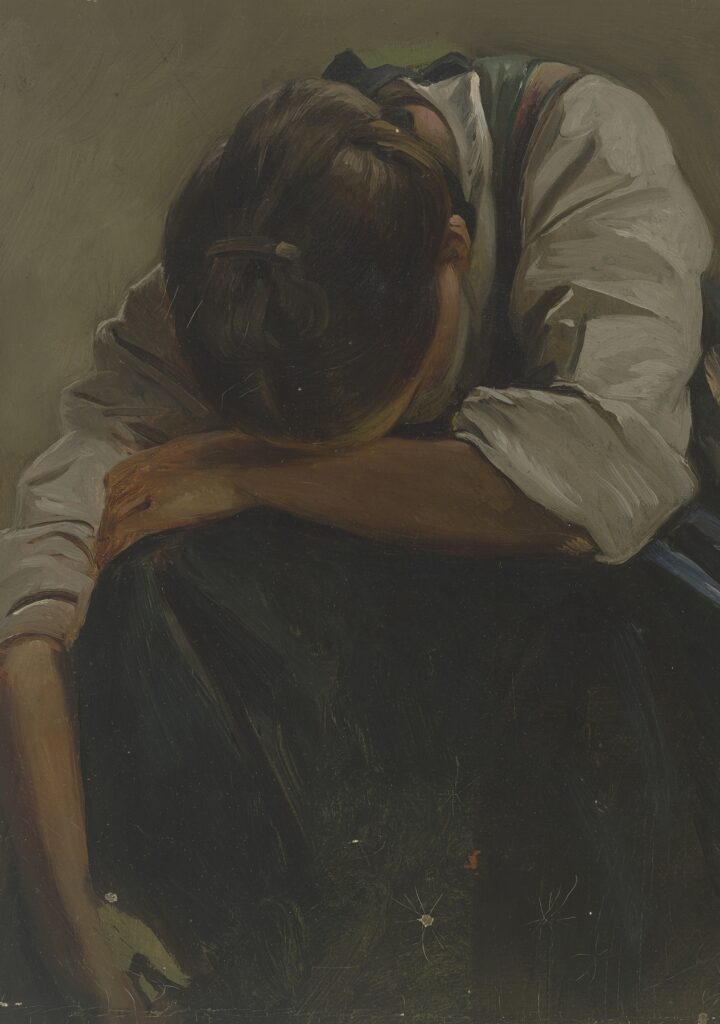
“Handsome Crying Boy” by Lee Conell
In this black comedy by Lee Conell, the emotionally repressed pay for group crying sessions administered by attractive men. “Handsome Crying Boy” asks what it means to be vulnerable with oneself and others, and how social bonds might resonate, or snap, across technological eras. Through the eyes of a professional crier named Kyle, we peer into a world where emotion itself is commodified and sold with a cooperate sheen.
TMR’s online-only prose anthology, BLAST features prose too vibrant to be confined between the covers of a print journal.
***
Handsome Crying Boy
When I first met Chelsea, my clavicles were covered in Vaseline. Greg had taught me the Vaseline trick during my training two years before, as we stood together in front of the Crying Center’s bathroom mirror. “You slather the stuff on just right, your tears stick and shine real nice in the morning light,” he’d said, and I’d tried not to be reminded of my dad teaching me how to shave, tried not to think of my dad at all until I went into our presentation room to try to help our clients weep. Our clients were corporate people. Legal advisors and UX writers, software engineers and financial managers. Chelsea’s group was part of was a team of seven digital marketers for a snack food company. According to the pre-session surveys, they had traveled all the way to Tennessee from California after recently losing the head of their team due to a sexual harassment case; they needed to re-bond. Someone in the HR department had seen a feature on Greg in a major glossy magazine, where he’d done this whole spiel on how the Cherokee people had been forced to travel through Nashville on the Trail of Tears, and the Crying Center was a way of honoring their legacy. Group crying, he added in the interview, not only reduced stress but to strengthen social bonds. Studies showed it was more effective than obstacle courses and escape rooms, with less chance of injury.
When Chelsea entered the conference room, I was already in the corner by the window, playing the role of silent brooder, staring out at downtown Nashville like I was fascinated by the pedal taverns full of day-drunk Bachelorette parties already on the street. Actually, I had a horrible headache. I would have stayed home but I was paid hourly, and I was already stressed about paying off a bill for a visit to an urgent care clinic. My throat had closed up with bronchitis at the start of December. I’d missed a full week of work and I knew I’d disappointed Greg, though he said my timing at least had been good: everyone wanted to cry in the lead-up to the holidays, so he’d been able to manage okay without me.
The snack food marketers took their seats around the large table and at last I turned to examine them: An older woman in a green silk blazer, three suited white-haired men, two younger men in button-up shirts and khakis, and a young woman in a dark dress with floaty sleeves, fiddling with her name tag. Chelsea. Chelsea looked right at me, then looked away. I tried to focus on the others in the room. One of the younger men, Ali, had a lean face, and the other, James, had a face so apple-cheeked and contorted, he reminded me of an angry cherub. There was a kind of tug on some stringy inner ligament thing around my solar plexus when I met Chelsea’s gaze for the second time.
Finally, Greg walked in.
When I’d first learned about the Crying Center, I assumed Greg would wear a robe to sessions, like a priest or at least a wizard. But he wore the same thing as me: dark jeans and a dark t-shirt. He told me once that he believed the outfits soothed the clients, made them feel like they were taking part in something less spiritual than start-uppy. Like the tears they were here to spill weren’t ancient and buried primordial griefs, but newly innovated by the usual techno-libertarian white-guy sprites. Algorithmic blubbering, bursting with health benefits.
Greg gave his introductory spiel, starting with how before the Crying Center was the Crying Center it had been a recording studio, and before that, a church. Which was deeply apropos, because, Greg said, singing and praying were nothing more than societally acceptable forms of group weeping. The perfect acoustics for crying matched the perfect acoustics for country music ballads and for talking straight to God. “Not that you have to like God or country music to be here.” Obligatory laughs from all. Then Greg said, “We’re going to begin now. You may feel uncomfortable as we proceed. You may feel nervous. You may feel giddy. That’s all okay. Lean into what you’re feeling and try to shut out what you think you should be feeling.”
He nodded to me, and I pulled down the projector screen.
I can’t tell you exactly what Greg said next. The silent videos and images, and the accompanying narration Greg provides, are proprietary information curated by Greg himself, and I signed about five million contracts and NDAs. But it doesn’t matter, anyway, because even if I could describe them to you, it wouldn’t work right. To get the effect you’d need Greg’s voice, which is slow and soothing and gravelly. He’d moved to Nashville to be a singer-songwriter, to make people cry with his voice and his words. “My band wasn’t very good,” he told me once. “We kept getting stuck in these historical wormholes. One of our albums was just songs about dead presidents.”
The drummer in his band had been this Japanese guy, who also worked as a higher-up at Nissan’s Smyrna plant, and he had told Greg about how his mother, who lived in Yokohama, became obsessed with crying clubs there. These clubs would often include male assistants, called Handsome Crying Boys, who would wipe the tears of weeping women while tearing up themselves at whatever movie played to goad the attendees to cry. Greg was sure there must be more cultural context to it, but the image had stuck with him. The power of a good-looking guy, there to wipe tears, to model manly crying. As far as he knew, he was the first one to try to translate the crying clubs for western audiences. (An act of translation, not appropriation, he always insisted to me, like I would have accused him of anything one way or the other.)
In front of the snack food team, in front of Chelsea, I held up a remote control and pressed “play.”
Let’s say, without veering into specific NDA-violating details, that Greg began with an image of a parent and a child in shadow beneath a tree. The two get separated. By what? Illness, accident, chronological time. The child is lost in something huge and vast. Maybe a desert, maybe a forest, maybe a labyrinthine hospital. The parent’s blinded, or wounded in the leg, or trapped in a sound-proof room. The details of what Greg showed don’t matter for my purposes here. What matters is this: the child’s ache and the way Greg’s voice, crescendoing, lent that ache some new acoustics. It’s something I can only gesture at with my words, not recreate.
The first fifteen minutes of the session, I stood against the wall while the clients listened to Greg narrate the images. Then, when they were warmed up, I waited for that feeling I got before a big cry. The clients seemed to sense the shift and looked to me expectantly. They saw the tears catching on my eyelashes, falling to the hollow of my throat. These tears were invitations telling them they could cry too. As the videos played, they fell. There went Ali. No sound, but cheeks wet, shoulders shaking. And there went the older woman, Boram, with an escalating series of sniffs. At the amusement park video (cotton candy, disappointed lover), Angry Cherub, all at once, lost his shit. His round face, mid-weep, seemed even puffier, rounder. His golden hair flopped against his cheek, and some strands stuck to the wetness there. I wondered if maybe I should grow my own hair long.
Chelsea, though? No tears. She cradled her chin in her hand, a slinky silver bracelet loose on her wrist. She watched the screen and then she watched me. I felt my tears drip-drop onto the jut of my clavicles. At last, Chelsea covered her face with her hands. On the video screen, a large and noble animal bounded forward while hunters lay in wait.
* * *
“We missed one,” Greg said after in his office. “The younger woman, Caitlin.”
“Chelsea. We didn’t miss her. She covered her face with her hands, is all.”
Greg took a book off the shelf behind his desk, opened it to a glossy reproduction of a painting. “President Zachary Taylor’s deathbed,” he said. “1850. We wrote a song about this painting in our dead president album. What do you notice?”
Greg had a ton of old books in his office, many of which had been the former source material for his dead president songs. President Taylor’s eyes were closed. Behind him stood distressed men in tailcoats. There was a woman next to President Taylor, but her face was covered be her hand and a large white handkerchief. Greg shoved his index finger at the face of the woman with the handkerchief. “That’s Zachary Taylor’s wife, Margaret. Throughout his entire presidency, she didn’t want to be seen. She wouldn’t sit for an official portrait. She wouldn’t attend the inaugural balls. Margaret didn’t even attend President Taylor’s funeral. What you see there, in her covered face, isn’t anguish at all. It’s a desire for privacy, knowing the artist is in the room with her.”
It was true that Margaret’s face was almost invisible in the painting. Only a little crescent of forehead. You couldn’t tell if she was crying. You could only imagine tears.
“I think that woman today didn’t want us to see she wasn’t crying,” Greg said. “Also? You were off today.”
“Me?”
“Your rhythm. Can you put in more preparatory time in the LC? Before the PM group?”
As I headed for the door, I must have looked sulky because Greg called out, “Eyeball sweat.”
I smiled and said, “Ocular ocean mist.”
“Human-harvested salt-soup.”
“Baby’s cheek cleanser.”
“Premature grief ejaculate.”
When we laughed together like this, it didn’t feel like weeping. I mean, it didn’t feel like work, or like Greg was my boss and I was a contract worker. It felt like we were family. And when I went to the LC, I didn’t feel like I’d been ordered there at all.
* * *
LC was short for “lamentation chamber.” It was a storage closet. During this space’s church days, I imagined it kept stacks of Bibles. During this space’s music studio days, I imagined it filled with guitars. Now its walls were covered with paintings and photographs of sad ladies. Roy Lichtenstein’s Crying Girl, its oversized dots, comic-book-grief. Man Ray’s Larmes, a close-up photograph of a woman’s eye with perfect spheres of artificial tears dotting her cheek. Picasso’s Weeping Woman, a jigsaw portrait of anguish. When I first saw the lamentation chamber during my interview, even if I didn’t know all the artists on the walls, I could tell what was conspicuously absent, what my presence was supposed to provide. “Most of the paintings I’ve found of full-on weeping men are medieval saints,” Greg told me once. “And then, modern-day, it’s all mocking memes. Michael Jordan, Dawson. It’s not a lot to work with.”
I sat on the closet’s floor pillow and tried to warm myself up. I thought about my mother, the way her shoulders shook after my father died. Almost immediately I felt a hot prickling behind my eyes.
It wasn’t always that way for me. I could only remember sobbing uncontrollably once as a kid, in fourth grade, after losing a library book about whales. At my own dad’s funeral, I couldn’t cry. I was home from college on winter break when he died. He was out hunting—I’d refused to go that day, told him I was trying vegetarianism—and he’d made fun of me. He’d been so proud of me for being the first in my family to go to college, but that day he said it was changing me, that maybe I was just taking out loans so some smug professors could cut me off from my own history. That day he fell climbing down from a tree stand to take a piss. All his friends talked about what happened only as “the hunting accident,” like it involved something with a gun, a wild animal, instead of an older man’s bladder.
After the funeral, I had trouble focusing in school. I met a woman at a bar and I told her my dad had just died and that I couldn’t cry about it. She took me home with her. I told that story a few more times, to a few different women, and then I began to feel sick in the morning, every morning, and I couldn’t get out of bed, the nausea was that bad. Anyway, one day I threw up for a while. And then I started crying. I just kept crying and I couldn’t stop. All of a sudden I was crying in the morning, before bed, in the grocery store. I couldn’t meet friends or be around people without feeling like maybe I would lose it. I looked up “can’t stop crying am man” and there was an article about a new innovative center just a twenty-minute drive away from me. There was a job posting for Handsome Crying Boys.
In my cover letter, I wrote about how I wanted to make people cry like babies in order to heal their inner child self, the same way I’d healed my inner child by crying after my dad’s death. A bunch of psychobabble I’d drawn from the wellness class I’d taken in school. My phone buzzed.
“Your letter was good and I like the headshot, but we’re not trying to make people cry like babies,” Greg said on the phone. “Crying all together, in unison, that’s for warriors. In The Iliad, the whole Greek army weeps in sync on multiple occasions. Normal back then. It’s only the industrial revolution, living in communities made up of total strangers instead of your kinfolk, that fabricated a need for emotional control.”
“Only” the industrial revolution. The fact is it’s a lot of work to undo the effects of the industrial revolution for a team of professionals whose very ability to pay exorbitant amounts to team-cry has something to do, if you insist on tracing things back, with a kid in a factory a couple centuries ago who can’t weep because if he gets tears in his eyes he’ll maybe lose his hand to a complex, spiky machine. My job wasn’t as simple as Greg made it sound, crying on command, getting other people to do the same. I knew that from the jump.
But I did it. For two years, I cried twice a day in front of Greg, at both AM and PM sessions. I listened to him narrate stories of loss, of grief, of hurt wild animals, to corporate teams. I stopped crying uncontrollably when I was off the clock, got my life back a little. On Tuesdays, Greg and I would get happy hour margaritas and gigantic burritos and sit out on the restaurant’s porch until it was dark. Once a month on a Sunday, we’d cycle together down the Cumberland River Greenway, raised up against flooding, the river on one side, tire factories and medical equipment shops on the other. I met Tracy, his bratty daughter—“So you’re my dad’s hired cry-baby?”—and cheered her on when her soccer team was in the league’s championship. I did Thanksgiving with them a couple times, was responsible for bringing the cranberry sauce his daughter liked, with the citrus zest. Greg’s wife had died in a car crash, part of why he had started the Crying Center to begin with. She had helped him learn how to open up, he told me. I never saw him cry about her. “It’s a private thing,” he told me.
On my second-year anniversary working at the Crying Center, a few months before Chelsea’s potato chips team came by, Greg handed me a gold watch after PM Session. I thought a client had left it behind, that he was asking me to find the owner. When I realized the watch was for me, I began to tear up. He laughed, pounded my back, and said, “Don’t do that. You’re not on the clock.”
“That’s right.” I rubbed my eyes, grinned. “I’m not even salaried, you fuck.”
“Someday, when this operation’s stable enough. Health benefits too.”
“Sea-salt jellybeans,” I said.
“Eyeball piss.”
* * *
The PM session—a team of anesthesiologists from Atlanta who wanted to be more open to their patients’ pain—was great. Everyone wept. When a session went well, it was like we were all connected, like there was a secret flash of prismatic light that only the group could see. Sometimes I thought it was like a magic trick, like I was getting one over on not just the clients, but somehow America. All these people got paid more than me, had insurance and benefits, and yet it was me and Greg who could unravel them in a moment. We had this power.
After the PM anesthesiologist session, Greg shook my hand. “Poetry. Vast improvement from this morning. We should celebrate after such an artful round. Drinks?”
We went to Robert’s Western World. There wasn’t much of a crowd when we got there and nobody was playing music yet. It was still early evening, and a Tuesday. Greg said he’d always found this place more tolerable than most bars downtown. We were already sitting at a table when I noticed Chelsea by herself at the bar.
“What is it?” Greg asked. He followed my gaze. Tilted his head. “Kyle!” he said. “You’re blushing!”
“No, I’m not.”
“You liked that one? She’s got nice hair. Go. Go talk to her.”
“It wouldn’t be professional.”
“You yourself said it. You’re not even salaried.” He knocked his beer against mine. “Go on. I won’t tell the boss.” He winked. I didn’t know how to tell him crying twice a day was all the emotional availability I could muster. Opening up to another stranger recreationally, without an hourly rate, seemed insane now.
Chelsea was eating what I recognized as “the recession special”: a fried bologna sandwich, chips, a PBR. When she saw me, she smiled, then turned away, examined the scalloped edges of the potato chips. She pushed her hair behind her ears and met my eyes again. “It’s funny,” she said. “I kind of wondered if you were even allowed to leave that place.”
“What? What do you mean?”
“It had cult vibes, you know. But not like the most evil cult. An innocuous cult. But still. Cult. Sit down?”
I sat next to her.
“Weirdly, I was just thinking of you,” she said. “About how I wanted to talk to you.”
There it was again. The too-much-Vaseline-on-the-clavicles feeling.
“You probably noticed, but I was staring at you in session. I mean, I’m sure women stare at you all the time, you’re good looking. Plus the arms. But I was staring at you because I want to know how you do it.”
“Do what?”
“Cry.” She nibbled the edge of a chip. “I just don’t cry. And my boyfriend thinks I’m too closed off.”
“Your boyfriend.”
“Well.” She glanced at the fried bologna. “Yeah.”
She ordered us two whiskey shots. The band had started playing, some rockabilly thing, and a few couples danced up front. There was a woman with white hair wearing a shaggy gray miniskirt and crop top dancing with a bald man in jeans and a shirt that said “BECKY’S BACHELORETTE.” A boy with braces who looked thirteen dancing with a woman in a dress made of feather boas. A young woman with a green streak in her hair dancing with an older woman with her hair in two pigtails.
Chelsea began to tell me about her boyfriend. He’d made a joke, or at least he said it was a joke, about how he didn’t think they could get engaged without his never once seeing her cry. “He keeps saying that relationships are an act of vulnerability,” Chelsea said. “My mother cries all the time, is the other thing. But she cries to manipulate things. Not to get too deep into the psychodynamics of my childhood or anything. Am I freaking you out?”
“It’s okay.”
“I know this is all a lot. We’ve just met. I’m maybe a little tipsy. I didn’t eat enough today.”
“Me neither.” The music had gotten louder. The lead singer hollered something rhyming “open road” with “heart load.” Chelsea ordered us two more shots of whiskey and then she said, “So. Tell me. How do you do it?”
The whiskey burned the back of my mouth. “Do what?”
“You know.” Chelsea’s eyes were so wide. “Cry! On command.”
I finished my sandwich. Then I cleared my throat. “I think about my mom crying about my dead dad, really, is what does it.”
“Oh,” Chelsea said. She paused. “But that won’t work for me. My parents are both still alive.”
“Sucks to be you.”
We laughed. And I felt a little lighter. “I couldn’t cry for a long while,” I said. “After my dad died, I couldn’t cry at his funeral.” And then something in my voice shifted. The tone got lower, gravelly. “And this is really embarrassing,” I went on, “but sometimes I’d tell about how he died to girls, like, hoping that would make them want me? And they’d cry about my dad, no problem. But I still couldn’t. I somehow couldn’t cry at my own sad story.”
She frowned. Scooted closer.
I looked at the crumbs on my plate. I was just recycling the story of my dad’s death again, only this time I was exploiting my own awareness of my exploitation of the story. There was something too artful in the way my voice had changed, taken on a new serious tone. Greg was watching us from afar, not approaching. I knew how we must look: Chelsea was sitting so close to me at the bar, I could feel the warmth from her legs.
“So how did you finally get unblocked and all weepy?” she asked.
I could tell her about the weeks and then months where I couldn’t get out of bed. About how something finally cracked. But when I opened my mouth, nothing came out. It was like my voice vanished. Her knee was still against mine. I went really, really still, because I felt like if I moved, she might run away. The band started to play, a steady twang. “I actually hate country music,” Chelsea said, her voice low and secretive, like she was the first person on earth to say those words. Then she leaned forward and kissed me. She tasted of fried bologna. She said, “Oh, shit,” and got up. “Fuck,” she said. “I have a boyfriend.”
“I know,” I said. “You told me.”
Then she was walking away. Out the door. Thinking about her boyfriend or whatever. It happened so quickly that for a minute I just sat there, dazed. I hadn’t kissed anyone in a while and I’d forgotten how wet a kiss could be. Not tears-wet. A fuller wet.
Greg’s hand on my shoulder. He said, “What the hell are you doing? Go get her, you idiot. Run after her.”
It didn’t feel like he was ordering me to do anything, but like he was narrating a romantic movie I was in. Go get her. Yes. I ran after Chelsea. It was dark, and the streets were crowded with taxis and noisy with people singing, with the distant woo-woos of multiple pedal taverns carrying multiple bachelorette parties, past the old Nashville toll bridge where a plaque about the Trail of Tears had recently gone up, alongside the Cumberland River brown with recent rain, all converging here, downtown, where there was bar after bar after bar. I had this confused feeling like I was chasing Chelsea but also running from something, from a hunter, sure, you could put it that way, and I thought about my dad in that tree watching out for movement while his bladder twinged. I was running and sort of crying and I couldn’t quite see and I needed to pee. I tried to clear my vision. I thought, “Sea-salt jelly beans,” and I thought, “Tear soup tear soup tear soup,” and then as I crossed the street I heard a woo-woo-woo.
A group of women pedaled in sync. “So tell me what you want, what you really really want!” they sang. And then, “Hey, hey, watch out, dude! Oh, he’s cute. Watch out!” I jumped back so the pedal tavern wouldn’t hit me, but then I slipped. A broken beer bottle, lightest green. I fell down hard. When I got up, my ankle wobbled and I fell again, my head hitting the corner of a parked car, then slamming to the ground.
* * *
I was extremely lucky.
If it hadn’t been a pedal tavern devoted to a bachelorette party, if it had been a car, say, or even a motorcycle, I probably wouldn’t have had the time to jump back. I’ve been told verbalizing gratitude helps with healing. So let me say: It could have been much worse. Still, I had a bad gash along my face and a concussion. I couldn’t go into work for a few days and even when I returned, I told Greg, I would still have this gash on my face for a while.
Greg said, “Don’t worry about it, bud. Just focus on getting better.” But then he asked me to send him a picture of myself, so he had a sense of the damage. And then he told me I couldn’t do sessions until I healed fully. He felt terrible about it, but the Crying Center was how he made money and supported his daughter. He couldn’t shut it down because of my face. He’d hire a temporary replacement and then we’d see where we were, how my healing progressed.
“You’re our human projection screen,” he told me over the phone, when he learned there might be scarring. “Right? People see their own sadness flickering on your face in session. If a projection screen has a huge gash in the middle of, or if it’s broken, you just notice the brokenness. But you’ll heal. Anyway, we found a temporary replacement. Temporary, okay? Do you remember James, that man from the AM-Potato Chip session? The one with the pink cheeks? The session wound up being life-changing for him. He reached out to me about a career shift. You know, his mom is sick, and he hadn’t been able to cry about it until he came to us. I tried him out yesterday and he did fine.”
It was Angry Cherub. He’d decided to quit the potato chip PR work and try to sob for a living. The work, Greg said, was something the new hire found meaningful. He’d given up a lot to do it. Health insurance, a real income. A powerful sacrifice, one that Greg would naturally feel compelled to reward. “I think it will help us with the PR piece going forward,” Greg said. “James’s story. The disillusioned Ivy League marketing kid gives up everything to cry. To help people heal. And what helps the center helps you, too. Right? Once your face looks less insane, there’d very likely be room for both of you.”
I walked to the bathroom and looked at myself in the mirror while cradling the phone to my ear. The purple bruising, the wound. The hospital bills waiting for me, adding to everything I already owed. Greg didn’t owe me anything, of course. The history between us wasn’t true familial history.
“I was thinking maybe I could write something for you,” Greg said. “One of those things where you ask for help with medical bills and put it online. A friend of mine did that after she had cancer. Really sad story. We don’t have to go into it.”
My eyes were cool and dry.
“Anyway, what I could do,” Greg said, “is I could write something about what happened to you and send it along to some of our clients. They’ve got deep pockets. They’ll want to help. They won’t forget you and how you helped them with your work.”
One innovation of the twenty-first century that they didn’t have during the industrial revolution: if you were financially decimated, you could ask for money online. If you told your story right, if enough strangers felt for you, you could earn something to undo the damage from the machine that mangled your hand.
“I don’t want you writing about me,” I told Greg. “Can you promise me I’ll have work when my face is better?”
“We have to see how your face heals. But look, I think it’s really likely. It’s not the right healing energy to worry about all that now, though.”
I took a deep breath and turned from the mirror.
Greg said, “Sad-flavored Gatorade.”
“What?” I said.
“Cheek-apple glaze.”
I hung up.
After our phone call, I sat down in front of my computer and tried to write my own plea for strangers to give me money to help with my hospital bills. By “tried” I mean I stared at my screen, waiting for someone to step in, to narrate for me. Outside, it got darker and darker. The screen became too bright. I couldn’t think of what to write. I took some painkillers. I looked up Chelsea’s social media accounts.
And there it was. A video of Chelsea’s engagement posted just that morning.
She and her guy were in a garden, surrounded by tulips. A friend must have been filming, because I heard the voice of someone invisible going, “Oh, oh, he’s getting ready. Oh, he’s doing it, Henry is doing it!” Henry, Chelsea’s boyfriend, got down on one knee. He was handsome, had a faux-bashful smile, the look of a man who hoped to post this online to share it with all his friends and family and strangers who couldn’t be there, a man who wanted it so that anyone who looked for his wife, who tried to hunt her down online, would see this video with her full name in it, this moment from Chelsea’s past forever marked, forever marking her as his. Oh, that was unfair. Probably he wasn’t so territorial. He was just excited. He wanted to share. He was crying a little.
“Chelsea,” he said to her in the video. “Will you make me the happiest—”
And Chelsea, she was ready. She’d thought this through. At the word “happiest,” she covered her face with both her hands.
***

Photo credit: Michelle Eggers
Lee Conell is the author of the novel The Party Upstairs (Penguin Press), which received the Wallant Award, and the story collection Subcortical (Johns Hopkins), which received the Story Prize’s Spotlight Award. She has received support from the National Endowment for the Arts, the Tennessee Arts Commission, the Japan-US Creative Artist Fellowship, Millay Arts, Yaddo, and Willapa Bay AiR. She is an assistant professor of creative writing at Purchase College. Her short fiction has most recently appeared or is forthcoming in Oxford American, Ecotone, and Kenyon Review.
SEE THE ISSUE
SUGGESTED CONTENT

Blast
Jun 18 2026
“Mad Dogs and Scotsmen” by Megan Ritchie
Megan Ritchie’s short story “Mad Dogs and Scotsmen” opens a window on the mind of a boy whose psyche is shaped and hardened a little more each moment by the… read more

Blast
Jun 04 2026
“Was Home Always This Bad?” by L.F. Khouri
L.F. Khouri’s heart-wrenching microfiction details a father’s reflection on the hardships of war, the weight of survivor’s guilt, and the deep desire for safety and normalcy. “Was Home Always This… read more

Blast
May 21 2026
“The Yellow Suitcase” by Aizhan Yesbolatova
This essay by Aizhan Yesbolatova explores the complicated relationship between a mother and her father as she watches him be a different sort of grandfather to her child. “The Yellow… read more