
From Our Authors | April 19, 2024
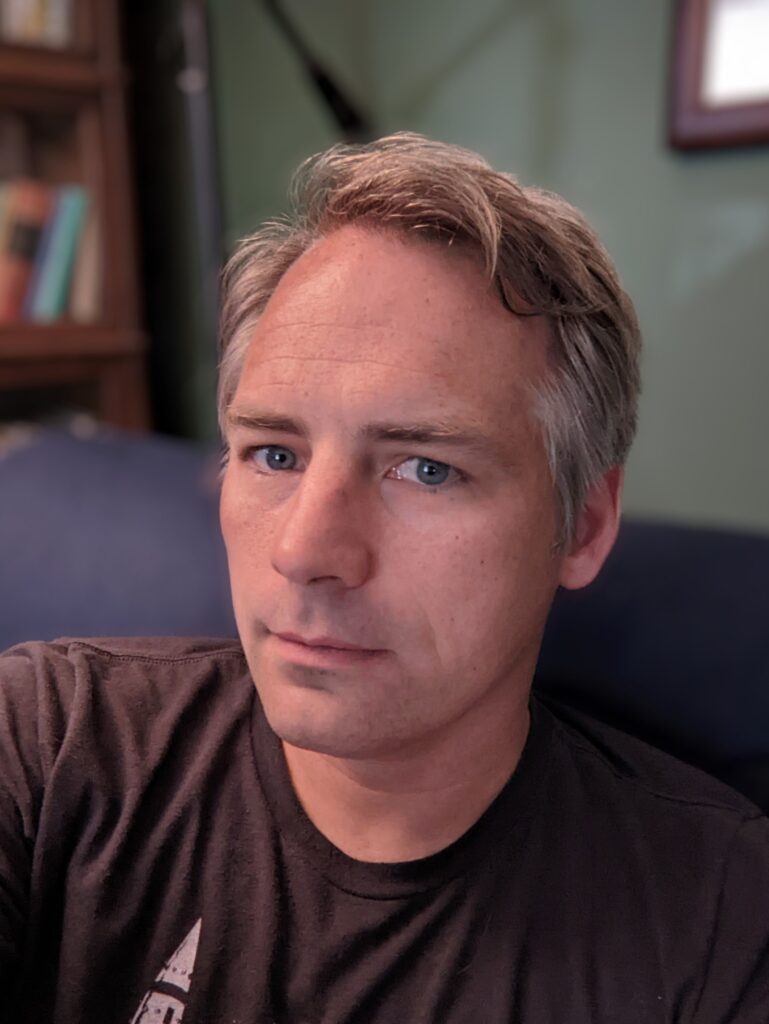
An Interview with Robert Long Foreman
Recently, TMR intern Shayla Malone interviewed Robert Long Foreman about “Song Night,” which tells the story of a pot-smoking father who has to adapt to the fact that his teenage daughter is following in his footsteps. First published in TMR issue 46.4 (Winter 2023), “Song Night” is a tender, funny account of what it looks like to grow—and grow closer together—in the midst of change. You can read it here.
Shayla Malone: In “Song Night,” marijuana is a catalyst for character bonding. What inspired you to write about weed?
Robert Long Foreman: This is the story’s most autobiographical dimension. Living in Missouri, where it’s legal, I have been using cannabis for about the last eight years, mostly as a sleep aid. I’m a lifelong insomniac, and since taking up smoking this stuff I have not had a sleepless night. And I sleep well! I also enjoy being high, and I grew up in the age of the DARE program; cops came to my elementary school all the time to tell us how bad drugs were and what it was like to have to wrestle guys to the ground when they resisted arrest. The policemen neglected to mention, every time they came to us, that drugs can do things like cure insomnia and show you a good time. I had to go out and learn that for myself, and I waited a long time to do it.
I have two daughters, and it’s a different world for them than it was for me when I was growing up. My dad smoked cigarettes, but no one in my house fooled with marijuana, as far as I know. It was illegal and frowned upon, and now it’s legal and still frowned upon, but not like it used to be. I don’t know how fast things are changing, but I gather that they are, and I don’t know how readily available cannabis will be, or how widely accepted its use will be, by the time my elder child is seventeen, eighteen, or fifteen or sixteen. I had friends at fourteen who were getting high all the time, if not earlier, while I never touched the stuff; I came to it very late, possibly in part because of DARE. Think of the sleep I could have gotten.
When I started writing “Song Night,” I wanted to depict someone in my position, with a kid who’s older than my kids are. She’s at the age when teenagers try stuff out, like marijuana. I wanted to render that classic scene from an anti-drug ad, which gets referenced in the story, in which a kid tells his dad that he is the reason he’s been doing drugs. “I learned it from watching you!” But I wanted it to be okay. I want that commercial to end with the dad shrugging and saying something like, “All right, just don’t smoke my stuff, and here’s some Narcan and fentanyl testing strips. Just be careful and not stupid.” I wanted to have that scenario play out and for it not to be the end of the world. In fact, in the story, the revelation of the daughter’s new habit marks a big transition for the daughter and her parents. Their relationship is sort of renegotiated in a way that they’re all okay with.
I never experienced anything quite like that in my youth, and I’d be glad if neither of my kids ever drank or smoked anything. But it’s something that lots of people do, sooner or later, for one reason or another, and I’d like to think it doesn’t have to be the end of the world if and when it happens.
SM: “Song Night” is often quite funny. What is the value of humor in fiction? Does humor in fiction work differently than it does in other media? Does your sense of humor on the page differ from your sense of humor in conversation?
RLF: I have often thought that being funny is more of a liability than anything else when it comes to writing literary fiction. I have heard editors and writers say that comedy doesn’t belong in the genre. And while I think the total prohibition against humor is weird and stupid, I can’t deny that comedy has to be used carefully in literary work. Most readers of literary fiction aren’t looking for a start-to-finish laugh riot; the best short stories that use humor have a sense of gravity to them, which outweighs the humor in its importance. I think of humor as a way of being nice to the reader, of providing some entertainment along with all of the insights and moving depictions of troubled lives. But it’s the insights and troubled-lives depictions that matter most in this genre, as I still have to remind myself, or be reminded, from time to time.
I’ve come to think of humor as akin to lyricality, in part because both things are hard, if not impossible, to learn. You can hone your command of the lyrical or of comedy; you can perfect your comic timing and your lyrical timing, I guess; but, in the end, in either case, you either have it or you don’t.
I don’t know for sure if that’s true, however. Can someone learn to be funny? Can someone painstakingly develop a lyrical sensibility over time? I don’t see why not.
I’ve also wondered if the two things are mutually exclusive. How often are funny writers lyrical, and vice versa? Not often. Maybe Renata Adler is one who can do both. Maybe that’s part of what makes Toni Morrison so great.
But then I think that lyricality and humor have a lot in common with one another. One makes your hair stand on end and the other makes you laugh, but both result in the reader having a physiological response.
I often wish I could write lyrically, like some of my favorite authors do. I want to make people’s hair stand on end. I will settle for turning frowns upside down, but I read the work of Eula Biss and Richard Rodriguez and wish I knew how they do what they do.
And I am much funnier in writing than I am in conversation. My sense of humor takes time to work, and I’m a nervous wreck, so even when I think of something funny to say out in the world, I usually keep my mouth shut for fear of embarrassing myself. I wish there were a drug I could smoke to make myself funny in more ways, but honestly I think it is, in itself, pretty funny that I write things that are ridiculous but then otherwise project gravity. I also cannot for the life of me perceive myself accurately—to my mind, I am a displaced earthworm who’s just asking to be smashed underfoot—so I could be completely wrong about whether I’m funny in real life. I don’t get out much.
SM: Greta is a unique character who takes matters into her own hands and creates chaos while trying to help. Are there agents of chaos in your other stories, and if so, how do they compare with Greta? Greta is part of the supporting cast, but the main action in the story happens in large part because of her. Could you discuss your sense of the narrative value of secondary characters?
RLF: As it happens, the protagonist of my novel Weird Pig is nothing if not an agent of chaos, and the whole book is essentially one episode after another in which this talking pig does everything he can to cause problems for other people. Greta is, of course, a very different character. She is human, and she only does the one incredibly stupid thing that would be horrifying in real life. It would be a crime! But as Richard Thompson wrote, in one of his songs, “Life is just as deadly as it looks / But fiction is more forgiving.”
I’ve heard editors say that you should never quote Richard Thompson lyrics in an interview, and that’s one more thing I can’t help thinking is kind of ridiculous. Richard Thompson is not only an accomplished guitarist; he has had a long career as a songwriter, and there’s some really great stuff there.
As it happens, I have been thinking a lot lately about secondary characters. I’ve been wanting to write a short story where the narrator is a secondary character, where the whole thing consists of the speaker regarding someone they know, or once knew, and letting themselves recede into the wings, without ever being invisible, as they tell the other person’s story. The Great Gatsby does that, of course, more or less, and so do plenty of other things, like a short story I read once by Jennifer Buxton called “Rare T.” It’s one of my favorite stories of all time, and it was published in Puerto del Sol years ago. They should put the whole thing in skywriting, so everyone has a chance to read it.
SM: I tend to gravitate toward works with lyrical writing styles, but your direct style of writing interested me. Can you talk a little more about your writing style?
RLF: I can tell you about the trajectory I’ve taken in my writing life. I started out writing personal essays, and wrote nothing else for six years, before I took the turn to writing fiction. The first stories I wrote were much like essays, and I’ve spent the years since working that out of my system. But I also think that there’s an essay buried in every short story I write and that the first-person short stories I’ve written, at least, look the way they do because I worked so hard to pull off the familiar style that makes a good essay work. Beyond that, I find it hard to think about my own style. It’s like trying to describe how I come across to other people in person. I don’t trust anything I say about either thing, and no one else probably should, either. I’m too much of a smashable worm on the sidewalk to be trusted, is what it comes down to.
SM: Your book Weird Pig seems to bear some similarity to “Song Night”; both feature humor and chaos surrounding a serious subject. Do you think of “Song Night” as being somehow in conversation with Weird Pig?
RLF: I think of it as more contrary to Weird Pig, to be honest. When I wrote Weird Pig, I was trying to write a novel that no one would ever want to publish. I was tired of writing and tired of life, and I thought my time as a person with intentions and goals was up. I wasn’t suicidal—I’m making things sound more dire than they were—but I didn’t see a way to continue writing with a sense of hope or expectation. That was all gone. The world had passed me by. So I wrote the first draft of Weird Pig in five months and revised it as little as possible. I wanted it to be a disposable thing; if no one wanted it, I could throw it in the trash where it belonged and shrug and walk away, laughing. I could have a great life and maybe buy a Jet Ski with the money I would otherwise spend on submission fees.
When I wrote “Song Night,” I had long since snapped out of that. I still don’t have much hope for my future as a writer or the future in general, but I believe in the work. I believe in the writing process, and I know from experience that when the work is done right, good things can happen.
But I’d like to think, as your question suggests, that there is a kind of interplay between these texts. One was written in despair; the other was written out of love. One is a novel; the other is a short story. They’re more like cousins than siblings, but when you put a bunch of cousins together something can happen that can’t when all you’ve got are siblings.
***
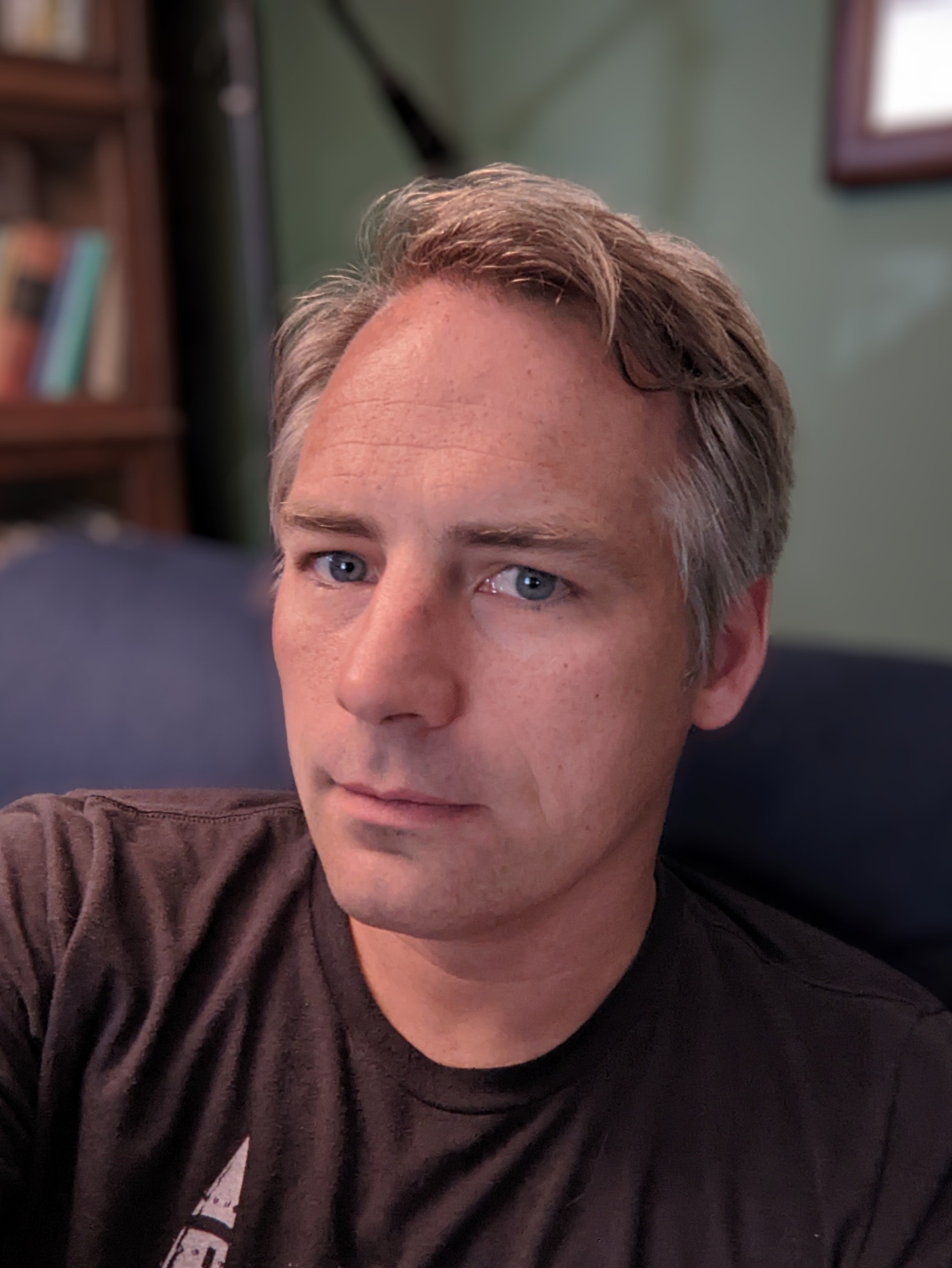 Robert Long Foreman wrote the novel Weird Pig and the short story collection I Am Here to Make Friends. His work has been in AGNI, Electric Literature, Cincinnati Review, and other magazines. He lives in Kansas City and at www.robertlongforeman.com.
***
Shayla Malone is a 2024 spring intern at the Missouri Review. She is a senior at the University of Missouri-Columbia, where she is majoring in English and minoring in Business.
SEE THE ISSUE
SUGGESTED CONTENT
Featured Prose
Feb 05 2026
A Conversation with Julia Ridley Smith
Fall 2025 Missouri Review interns Graham Medric George ’27 and Sofia Louise Ottolini ’27 interviewed Julia Ridley Smith about Sex Romp Gone Wrong, her recent short-story collection, when she visited… read more

Featured Prose
Aug 21 2025
An Interview with Peter Mountford
Anne Gimm interviewed Peter Mountford about his collection of short stories, Detonator, published by Four Way Books in September 2025. “Love of Her Life,” a story about a woman who… read more
Featured Prose
Jun 13 2025
An Interview with Tate Gieselmann
TMR intern Haley Schmid interviewed Tate Gieselmann about “Mouse,” a story about a drug addict hustling to pay a debt. First published in TMR issue 47.4 (Winter 2024), the story… read more