
Poem of the Week | October 27, 2025
“The Long Hedge, 1948” by Kip Zegers
“The Long Hedge, 1948” by Kip Zegers is our Poem of the Week.
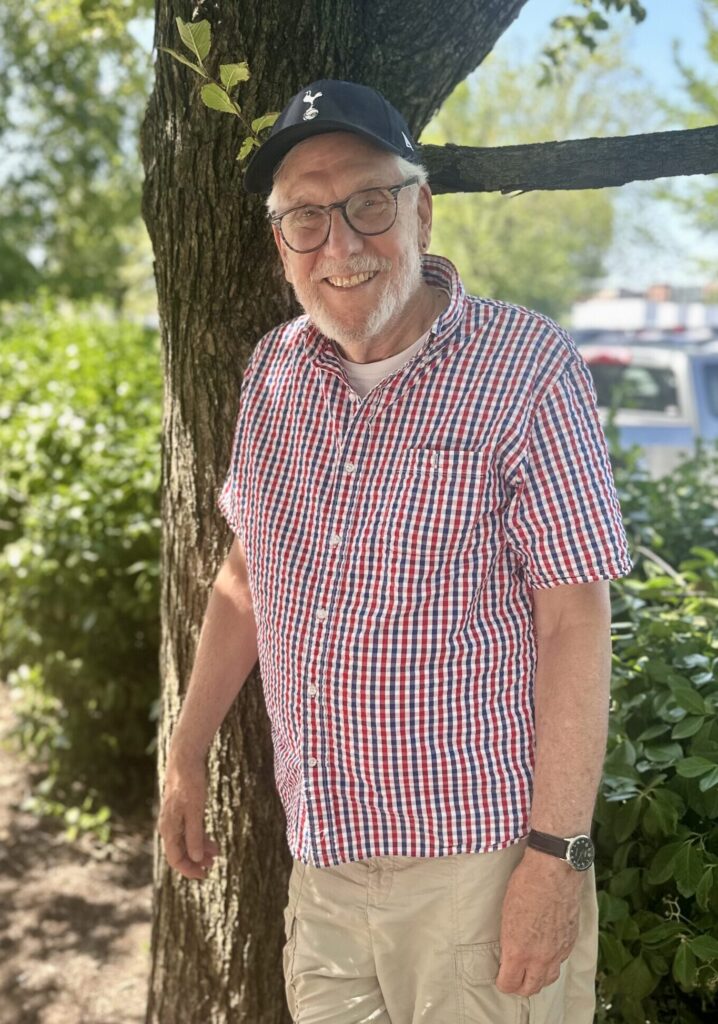
Kip Zegers is from Chicago and was educated at John Carroll University, Northwestern University, and Union Theological Seminary. He applied for and received conscientious objector status and did alternate service from 1969 to 1971. He then began to work with poetry. He has published full-length volumes and chapbooks, most recently The Poet of Schools (Dos Madres Press, 2013), The Pond in Room 318 (Dos Madres Press, 2015), and A Room in the House of Time (Dos Madres Press, 2020). He trained as a teacher at Hunter College (CUNY) and began teaching in 1984 at Hunter College High School, a public high school for gifted students. Retired in 2017, he began working with writers at New York Hospital Community Outreach and Service and Advocacy for Gay Elders (SAGE).
The Long Hedge, 1948
In those days, the city blocks close to us
were long built up, but north, past Touhy Avenue,
lay the open fields of a Chicago stalled
by the Great Depression and World War 2.
Now machines were pushing good black dirt
away, cutting the clay beneath, cementing
rows of homes whose owners would have
to buy back good black dirt, then begin
a lawn. So I was told.
Chicago’s grid was blocks of boxy lots,
rectangles in rows. My parents’ lot
was triangular, lined by a long high hedge
of mock orange, dividing us from them.
My dad was drafted anyway, aged 39
and scared, lonely among 18-year-olds
on a long grey train, is my best guess,
shipped to Okinawa, the invasion,
the bloody afterward, and still shaken,
gaunt, his buried life was far beyond
a boy’s imagining. My mother was orphaned
by her father, Pastor Swartz, for marrying
a man not Baptist. Living away
among the Catholics in St. Juliana’s Parish,
she took naps, had headaches, sorrows I wore
beneath my shirt, like a scapular.
I was an inside child, our house like a burrow
in the good black dirt that bore a currant patch,
apples, pear, and crab apples my mother added to
with a bushel of “good Michigan peaches,”
then all came down to the basement
to fill sterilized jars, gleaming in rows,
like a barricade. From here, I see a child
on Saturday after Confession as he resumes
the lawn mower, cutting careful rows
in the private grass he stands on,
sweaty, pious, and afraid.
Author’s Note
“The Long Hedge” began when I found myself thinking about the mock orange hedge that ran along the side of our house and yard. As I wrote, the hedge became a metaphor. The hedge was us, the three of us, who did not fit in Edison Park, on the furthest northwest side of Chicago. Now, as I have moved closer to, then passed eighty, I can see myself there, not as the sad character I’d always thought myself to be but as “a boy,” “an inside child,” an interesting kid. I could also see what that child saw of the two adults he lived with. In this story there is a look back but no resolution, no judgement: I leave the boy “sweaty, pious, and afraid.” Those are the exact words for who he was, words I did not have until now. This poem is an important part of an almost finished book, The Third Person, and in those pages, it has been good to find and get to know him and his world, at last.
SEE THE ISSUE
SUGGESTED CONTENT
Poem of the Week
Aug 17 2026
“In Another Life” by Amanda Gaines
Amanda Gaines is an Appalachian writer with a PhD in creative writing from Oklahoma State University. Her work has been published in Passages North, Cleaver, Potomac Review, Barrelhouse, Fugue, december,… read more

Poem of the Week
Aug 10 2026
“Anonymous Report of Unsafe Conditions” by Mike Carlson
Mike Carlson is the author of Tips to Help You Do Your Best, published in 2025 by Tupelo Press. His first collection of poems, Cement Guitar, was awarded the Juniper… read more
Poem of the Week
Aug 03 2026
“Still at Work, the Fault Opens” by Gina Franco
Gina Franco is the author of The Accidental, winner of the CantoMundo Prize, and The Keepsake Storm. Her poems have appeared in AGNI, The American Poetry Review, Narrative, Poet Lore, Poetry, 32 Poems, and elsewhere. Her poem “The… read more