
Foreword | November 04, 2025
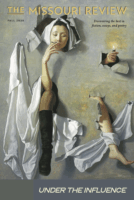
Under the Influence
Speer Morgan
Under the Influence
Much of this issue concerns altered states of consciousness caused by illness, personal struggles, and drugs. In written world history, the dominant mood-altering drug has been alcohol. Alcohol generates itself from microorganisms that convert sugar into ethanol. Leave grape juice sitting around, and, presto, you can hope to stumble forth buzzed from your Neolithic cave—or in my case, from my backyard clubhouse with my ten-year-old buddies.
While young Americans seem to drink less now and there has been a slight decrease in all Americans’ alcohol consumption over the past forty years, our drinks per capita have begun to creep back up since 2020. Still, as a nationality we are relative teetotalers, downing an average of less than three gallons per person of pure alcohol per year, while citizens of some Eastern European countries manage almost twice that amount.
In the years when we moved toward independence, colonial Americans drank more than the most bibulous nations today. Rick Atkinson’s wonderful new history of the American Revolution mentions that the fifty-five signers of the Declaration of Independence consumed on that sparkling occasion 114 bottles of wine, 8 bottles of whiskey, 12 bottles of beer, and 7 large bowls of well-spiked punch. John Hancock—with the bold, standout signature on the Declaration—had made much of his money importing rum from the West Indies. Rum was one of the causes of the Revolution, with the British taxation in the Sugar Act of 1764 infuriating people more than the Tea Act did in 1773, a fact vividly shown in newspapers and private letters. During the war, George Washington, who was remarkably politic and persistent at badgering the Congress, insisted that they keep his troops in drink, since it was one of the few things they had to look forward to during the eight-plus-year grind. After his presidency ended, at the suggestion of his farm manager, James Anderson, Washington carried on the good cheer, founding one of the largest distilleries in America.
My own age group, growing up in Western Arkansas a couple of centuries later, did our share of drinking, leaving me personally with a complicated attitude toward it. I freely partook in high school and college, and it did help me worry less about my bad complexion and big ears. While none of my immediate friends or family died or suffered serious injury from car accidents, it was a matter of sheer luck since alcohol flowed freely in the veins of too many drivers then. My own escapes included three seat-beltless alcohol-related accidents—two rollovers in cars, one caused by an angry drunken country boy knocking my brother and me off the highway in our open-sunroof Renault, another by a hungover friend as we drove home from college. The third, a fatal nighttime accident, was caused by an inebriated young soldier-in-training who flew (literally) at high speed over a hill and hit a police car head-on with such momentum that it bounced backwards and demolished the Nash Rambler that I fortunately was driving alone at some distance behind, leaving me to wake up walking aimlessly in circles beside the highway.
If you are a student, faculty member, or staff member at an institution whose library subscribes to Project Muse, you can read this piece and the full archives of the Missouri Review for free. Check this list to see if your library is a Project Muse subscriber.
Want to read more?
Subscribe TodaySEE THE ISSUE
SUGGESTED CONTENT
Foreword
Apr 23 2026
The Cost of Living
The Cost of Living The rise in cost of living throughout much of the world is a current concern for good reasons, though the value of money in the United… read more

Foreword
Jan 13 2026
Strange Bedfellows
Strange Bedfellows Shakespeare used the phrase “strange bedfellows” in The Tempest when court jester Trinculo, shipwrecked on a stormy island, crawls under the cloak of the beastly Caliban: “Misery acquaints a man with strange bedfellows.” In 1611, this could be taken as half literal and… read more
Foreword
Nov 04 2025
Under the Influence
Under the Influence Much of this issue concerns altered states of consciousness caused by illness, personal struggles, and drugs. In written world history, the dominant mood-altering drug has been alcohol.… read more