
Blast | September 15, 2023
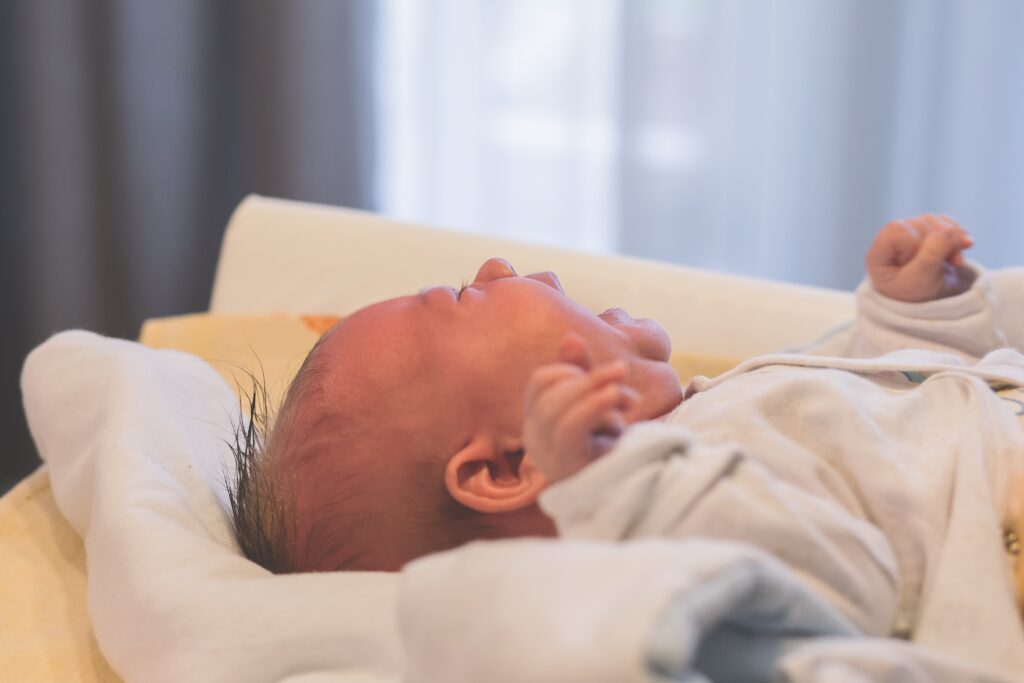
“Lullaby Machines” by Caitlin Horrocks
BLAST, TMR’s online-only prose anthology, features prose too vibrant to be confined between the covers of a print journal. In her poignant essay on “Lullaby Machines,” Caitlin Horrocks processes the psychological impact of listening to the same album of lullabies over 20,000 times in the course of parenting her newborn children. She bears witness to the desperate lengths we go in search of peace, quiet, and sleep.
Lullaby Machines
Caitlin Horrocks
My maternity leave was nearly over when a large envelope showed up in the mail from my employer. Inside was a mishmash of pamphlets and grainy photocopies about infant care and HR benefits. At six weeks postpartum, most of the information was already irrelevant. A final item slid out of the package, a CD whose full, weird title is Baby-Go-To-Sleep “Stops Crying” Original Heartbeat Lullabies. This was in 2016, and probably many of my coworkers no longer even owned CD players. I did, but I assumed the CD would be about as useful as the rest of the envelope’s contents and shoved the album back inside. I still can’t decide whether I wish I’d left it there.
This particular CD turned out to be an obscure reissue of a 1997 reissue of a 1987 recording: our cover illustration of fluffy clouds and sheep made no promises, but the most widely available album cover is almost entirely large, purple letters promising miracles:
STOPS CRYING GUARANTEED
OVER 3.4 MILLION COPIES SOLD
MUSIC TO HELP YOUR CHILD SLEEP
HEARTBEAT MUSIC THERAPY
The words “HEARTBEAT MUSIC THERAPY” are overlaid with a little illustration of an electrocardiogram line, the spikes and dips communicating that this is science, not snake oil.
I’m not sure if this cover, with the words “STOPS CRYING GUARANTEED,” would have prompted me to play the album sooner or never, if it would have more powerfully triggered my cynicism or my desperation. As it was, for months we limped along without it: for eight weeks of maternity leave, and then months more of work-from-home, I nursed our baby to sleep, exactly the way all the baby guides tell you not to. I was supposed to feed him, then put him down in an empty crib, where he would supposedly lie motionless on his back and sleep. I believe that this has worked for somebody, somewhere, the same way I accept in the abstract the existence of people who like to eat Marmite. I believe those peaceful babies are out there, or those parents sufficiently dedicated to sleep training. But the particular baby I had was one who demanded to be held, and the particular parent I found myself to be was one who would allow this, who would attempt to type for hours one-handed, laptop precariously perched on the couch arm, while our son sprawled across my lap. I made social media posts for my university department about events I couldn’t attend, and I completed edits to stories that took place in far-flung locations I felt no hope of returning to. My life, broken into small increments of silence, felt small in every way except the enormity of my baby’s needs.
My husband would come home in the evenings and take bedtime duty after the last feeding, bouncing our son on an exercise ball while singing Soundgarden’s “Black Hole Sun,” then gingerly placing the baby in the bassinet, where he might stay for an hour or two. He woke not only from hunger. He also woke with nearly every wet diaper, and sometimes startled at his own farts and sneezes, wailing with outrage at this strange, damp, noisy body he occupied. Once we’d picked him up to investigate the inevitably anticlimactic source of his distress, he reacted to any attempt to put him back in the bassinet as if we were lowering him into boiling lava.
At some point, we rediscovered the CD. We figured it couldn’t make things worse. Our son didn’t immediately drop off to sleep, but it seemed to relax him better than Soundgarden, easing him into sleep and keeping him there when we left the recording playing. We would let it play all night. Since our son still slept in our bedroom, that meant we slept to the same half-hour loop of lullabies.
The album starts with the slow, measured thump of a heartbeat, a bass line that undergirds every song. Then comes an arpeggio of chimes, then the vocals. London Bridge is falling down, but the singer sounds blissfully unconcerned. Let it fall, let it all fall down: she is on the verge of sweet, sweet sleep. She, and her fellow vocalists stay similarly detached through songs like “Twinkle, Twinkle Little Star” and “Rock-a-Bye Baby,” all delivered in slow, soporific sincerity. Everything is a recognizable children’s song, complete with lyrics, but not all of them are lullabies: the album finishes with a bizarrely down-tempo version of “Old MacDonald (Had a Farm),” the ee-i-ee-i-o delivered as a mournful dirge. The follow-up album, Baby-Go-To-Sleep “Stops Crying” Original Heartbeat Lullabies: Volume 2, includes “My Bonny Lies Over the Ocean,” with the lyrics inexplicably altered so that the singer begs a nameless god to bring back my daddy to me, to me.
In the wee hours of the night, with a child sleeping on top of me, it is possible for this song to hit me just right and feel like the saddest thing I’ve ever heard. But mostly, as a matter of sanity and survival, I taught myself not to hear this music at all, to let it blur into a long wash of gratitude that these were the sounds that filled the night hours, and not shrieking or sobbing. We played the album so relentlessly that it created a Pavlovian sort of response in all of us, so that when we used it for car naps, even the driver was filled with a dangerous languor.
We depended on the music until we didn’t, until our son was a toddler who would still climb into our bed, but the lullabies no longer made any discernible difference. We then managed to put it out of both our lives and our heads so effectively that our twins were a few months old when we remembered that this album existed, that we had in fact downloaded it onto multiple phones, iPads, and computers. One of the iPads by then was ancient and barely functional. We pulled it back out, marveling at how much of our early parenthood had been erased, blanked out by sleep deprivation and whatever evolutionary amnesia prompts people to want more children, to believe that if they survived the first one, they’re equipped for the next. We dubbed the iPad “the lullaby machine,” since that was nearly the only thing it still did, and put it on a shelf in the twins’ bedroom.
***
The concept of “heartbeat music therapy” does not exactly have the backing of medical science, but it doesn’t not have the backing of medical science. It was created by a record producer in Muscle Shoals, a town with an outsized reputation for music, like a tiny Nashville. Starting in the 1960s, FAME Studios lured singers to northwest Alabama to record hits like “Mustang Sally” and “When a Man Loves a Woman.” The FAME house band, The Swampers, eventually founded their own recording studio, and hired recent college grad Terry Woodford to run the music publishing department.
Woodford had written songs for his high school band, one of which made enough money to finance his degree in textile engineering. “Because I had that engineering background, I decided I would study all the hits,” Woodford recalled for the “Roots of American Music Trail,” a documentary project and tourist trail. “I looked at the chart records, listened to them, and I realized there were about fifty things that all hit songs seemed to have in common… So that is what I taught the songwriters, and it worked.” He went on to found Wishbone, an independent production company. Rather than trying to lure established stars, Wishbone combined Woodford’s mercenary analysis with the talents of up-and-coming regional songwriters and musicians. The approach worked, culminating in a Wishbone song winning Billboard‘s “Song of the Year” in 1977. By 1987, Woodford had shut down Wishbone to run Audio-Therapy Innovations, Inc., devoting himself exclusively to heartbeat lullabies.
Supposedly at the request of a daycare provider desperate to help kids nap, Woodford devoted Wishbone resources to a new, unlikely, project. The album info reads “Artist: Heartbeat Lullabies Singers,” but there was never any such group. The album was recorded by session musicians and vocalists from the Muscle Shoals community. The singer of “London Bridge” is Cindy Richardson-Walker, who moved to Muscle Shoals as a teenager to make it big in country music. She never launched a solo career, but she’s worked steadily for decades as a backup singer and songwriter, performing with artists like Garth Brooks and Shania Twain. The 1984 Sheena Easton hit “Almost Over You” is by Richardson-Walker. She’s also a longtime friend and collaborator to Marie Tomlinson Lewey, who sings lead on “Twinkle, Twinkle Little Star.” Lewey has performed with artists like Lionel Richie, Roy Orbison, and Tammy Wynette. The heartbeat itself turns out to belong to Brandon Barnes, a songwriter who arranged all the tracks on both albums, and whose pop, country, and R&B songs went on to receive four Grammy nominations and sell 15 million records for artists including Boys II Men and Brian McKnight.
In the context of these resumes, the lullaby album looks like a blip, a quick buck for the musicians involved and for producer Woodford, who had no particular reason to care whether or not it actually worked—very few of the sleep aids that parents plunk down money for have much evidentiary backing. But nurses reported, of an initial 1985 trial run at a hospital nursery, that the music really did calm crying newborns. Cardiac Intensive Care Unit nurses, working with infants recovering from surgery for congenital heart anomalies, said that “the tapes… seem to reach something in them that helps them relax and go to sleep.” After documenting this success, Woodford embraced heartbeat lullabies with missionary zeal.
Between 1985 and 2010, a handful of studies were performed using the music: researchers at the Indiana University School of Nursing found that babies who listened to heartbeat lullabies maintained better oxygen saturation during and after circumcision, and a study at the Children’s Hospital Medical Center of Akron found that playing heartbeat lullabies for premature infants could result in less time in the NICU. Meanwhile, Woodford began marketing his music not just to new parents, but to animal shelters and dementia wards. “It would have been irresponsible not to share the dramatic successes animal care providers were having playing the CD for their upset dogs,” Woodford wrote.
***
So it was unfortunate, and maybe counterintuitive, that heartbeat music therapy eventually inspired in me a murderous rage.
If we say a child’s sleep night is between 10-12 hours, then a 30-minute album can repeat up to 24 times per night. Times 365 nights, times years, times multiple children: I have probably heard Baby-Go-To-Sleep “Stops Crying” Original Heartbeat Lullabies over 20,000 times. Minus nights we didn’t use it, or when the iPad ran out of charge, or when I turned it off in a fit of…— I don’t know what to call it, but it’s the feeling that comes over you when you suddenly hear again the music you have taught yourself not to hear, and you think you might either spontaneously combust or toss your sleepless baby out the window.
Babies’ stomachs are so tiny that they need to eat every few hours around the clock, meaning that sleep deprivation is a biological inevitability for new parents. But a constant lack of sleep, an inability to defuse the tiny bomb constantly detonating in your house, does not feel inevitable or routine. It feels annihilating, and a person will do nearly anything to alleviate it, within the bounds of financial reason. Parents might pay $1,695 for a bassinet that senses when your child is restless, and adjusts its automatic rocking accordingly, or $35 for a Baby Shusher, a small battery-operated cone that says “Shhhhhhh….” They buy the books, they join the Facebook groups, they follow self-proclaimed sleep experts online, they sign up for classes and private consultations. They are gifted copies of the satirical picture book Go the F**k to Sleep, which the Boston Globe says, without irony, “Resonates powerfully with almost everyone.”
Parents get so desperate they harm their children, which is where Audio-Therapy Innovations makes the most strenuous case for its products. Their website touts that their music literally saves lives, not in reference to NICU or surgical outcomes, but because babies without the benefit of Audio-Therapy’s heartbeat lullabies are at risk of being so aggravating that their parents might attempt to shut them up by any means. Babies are fragile; Shaken Baby Syndrome, which can mean death or permanent brain damage, is generally not the result of sustained abuse, but of an explosion of frustration in an overwhelmed and exhausted adult. The company describes itself as a U.S. Department of Defense contractor, by which it means that its lullaby albums are distributed to service members with newborns, the same way my employer distributed it to me; if our babies can be put to sleep more easily, there is less risk of parental violence.
I never harmed my children, but I understand how it happens. I understand it best when I hear the dirge-like version of “Old MacDonald (Had a Farm)” that ends Baby-Go-To-Sleep “Stops Crying” Original Heartbeat Lullabies: Volume One, because I know it plays exactly 27 minutes after “London Bridge,” meaning that I am now 27 minutes closer to death, and I have spent 27 minutes of my one wild and precious life trying to cajole a being who is awake to become a being who is asleep and it hasn’t even worked, and in those 27 minutes I have done nothing else that needs doing, like grading papers or washing the dishes or getting my older child to bed or showering or sleeping myself, and there are untold minutes ahead of me tonight, and the next night, and the night after that, and all the nights stretching out before me. The feeling is something like the frustration I feel trying to wedge a storm window into its frame, or stubbing my toe on a rock. Neither the baby nor the window nor the rock can be reasoned with or made to yield. They are what and who they are, and their nature is entirely outside of my own.
Which the twins probably perceived, could feel my Old MacDonald-inspired anguish electroshocking them as I cradled and rocked them, usually one at a time, my husband taking the other while we left our older child downstairs to be raised by Minecraft YouTubers. We traded babies on alternate nights with the unspoken hope that this time we’d get the easy one, even though there was no discernable easy one. We’ve all heard the airplane announcement about putting your own oxygen mask on first, either on an actual airplane or as metaphor: take care of yourself, or you won’t be able to care for others. But its non-aviation manifestations are rarely so clear-cut: what did it cost me, really, to hear a CD I did not want to hear anymore, especially when I could successfully no longer even “hear” 90% of it, when the sound could slide by me unmarked? Of all the sacrifices parenting might entail, why not play this album?
Well, because it made me want to crawl out of my skin. But that somehow wasn’t enough to make me stop playing it. The success of the heartbeat album had once felt both miraculous and fragile, and sleep so very precious. There was never, ever enough of it: why would I risk the amount we had? Of course, it wasn’t really a “success,” not anymore. This album had reached a point of diminishing returns, where whatever sleep incentive it offered the babies was less and less equal to the rageful despair it prompted in me. But sleep deprivation doesn’t make anyone smarter or better at problem solving.
Finally one evening, I heard new sounds coming from the room where my husband had taken one of the babies, a blur of rain sounds and piano notes, a few chords that sounded vaguely Erik Satie-ish. These white noise lullabies may not have had the backing of medical science, but they also had no recognizable tunes or lyrics or sharp edges for the brain to snag on. I couldn’t tell where any track began or ended. There was nothing to mark the passage of time. There was nothing to hate.
***
At some point, Audio-Therapy Innovations stopped innovating. The company never went into white noise or diverged from the original vision of “heartbeat music therapy.” Woodford at one time announced he was working on songs with “lyrical messages based on the 12 step program.” But I can find no such album available for purchase. In the 32 years since Audio-Therapy’s third album, Jesus Loves Me Fast Asleep – 9 Christian Heartbeat Lullabies, Audio-Therapy has released and rereleased its three albums in different editions and formats, but not recorded any new music. There are no versions of “My Bonny Lies Over the Ocean” rewritten for dogs or dementia patients.
I reached out to the contact email on the Audio-Therapy website, asking if there were any plans to ever release more music. I have not received a reply. I don’t know whether Woodford felt that, with the proceeds of his original three albums enough to live off of, there was simply no financial need to make more. Or maybe he felt he’d reached a pinnacle of both commercial and artistic success, that Baby-Go-To-Sleep “Stops Crying” Original Heartbeat Lullabies, Volumes 1 and 2 were the perfect expressions of heartbeat music therapy, the alpha and omega, never to be surpassed. Either seems possible.
Most of the Audio-Therapy website looks like it was designed only slightly later than the 1997 CD edition I have, but it’s e-commerce capable: you can, for example, buy “The ‘LullaBeat Comfort’ Speaker/Player with Preloaded Heartbeat Lullabies” for $49.95 to $64.95, depending on how many songs come preloaded. As far as I can tell, the small wireless speaker is a literal “lullaby machine” that can’t be used to play or download any other music. It’s a monstrous invention and something I might actually have purchased had I seen it earlier.
***
After the night I heard the white noise lullabies wafting down the hallway, I asked my husband the kind of questions I might have asked had he suddenly invented the theory of gravity. What paradigm-shifting vision had it taken, to queue up a new lullaby album? He’d searched Spotify for “white noise lullabies,” he said, and this was what had come up. I asked how he had known that it would work at least as well as the old songs, as if the risk involved was akin to stunt-deviling his way over a gorge in the family minivan. It seemed worth a shot, he shrugged, refusing to claim any special vision. It just looked that way to me in the light of my own spectacular failure of vision, the way I’d clung to something that no longer worked, the way I worried I’d cling to other rituals or practices that had once served. I’d be the parent dragging my kid to music lessons they no longer wanted to go to, trying to sustain friendships they’d moved on from, or doing something truly humiliating, like holding their hand at school pickup when they were way, way over it. How was I supposed to recognize those moments and adapt, to change as a person and a parent, if I couldn’t even pull up a new lullaby album on Spotify?
How do you know, and when do you leap? When do you set aside your decades-long career as a soul and country producer and sink all your time and money into a music “therapy” you invented? Or when do you keep showing up to auditions, booking gigs, making a life in music that’s different from the starring role you might have envisioned, but still sustains you? When do you decide to leave music altogether, as my nemesis, the singer on “Old MacDonald (Had a Farm),” chose to do? As far as I can tell, she never appeared on any other albums of any kind. Her Instagram highlights her historic Craftsman farmhouse. She has children and grandchildren and worked in early-childhood education. She participated in Colbert County Tomato Sandwich Day. I assume she would be dismayed to learn that her singing of ee-i-ee-i-o makes me contemplate my own mortality. I want her to have lived happily, and I want to know how she knew what would make her happy, how she saw past whatever phase of her life she was in when she recorded “Old MacDonald (Had a Farm).” Maybe singing ee-i-ee-i-o made her contemplate her mortality, too.
***
The heartbeat lullaby era did me the favor of definitively ending one night when I couldn’t log into the paid Spotify account to play the white noise lullabies. I had to choose instead between the interruptions of Hot Cheetos ads on a free account or our old lullaby album. The twins noticed, all of a sudden, that the sleepy, throbbing lullabies were actual songs with words, which they now knew. They’d sung these songs at daycare. Some of these songs had accompanying hand gestures. They reached for me during “Row, Row, Row Your Boat,” wanting to yank me back and forth in a game they’d learned. When I wouldn’t play, when I told them it was sleep time, they then reasonably asked for their sleep music: “White music! White music!” they demanded, and I didn’t know whether my husband had referred to the album as “white noise” or if they meant the album’s cover image, a large black and white image of a pale baby head wearing a white flower headband. Either way, they were telling me what they needed. Learning to listen to them isn’t as easy as the parenting gurus on Instagram try to tell me it is, but I have to trust that it’s possible, that between all five of us, we can make it to our children’s adulthood without anyone throwing anyone else out a window. One of the twins another night pressed his forehead hard against my own. “You beautiful, you good,” he said. “You beautiful, you good.” And oh, how I’m not, but here I am, trying: to be both my own person and the person he needs. He understands I am a person, now. Not a person whose musical tastes he cares about, but a person. There’s hope in that.
That was the second-to-last time I ever played the album. The last: one night, the six-year-old announced that he couldn’t sleep. “Help me go to sleep,” he insisted, an open-ended demand I had no idea how to fulfill. He kept thinking about the horror movie The Ring, he explained, whose plot I had sketched out for him one day in response to a line of questioning I can no longer recall nor even imagine. Did I say I’ve never harmed my children? Allow me to retract the statement.
The white noise lullabies were playing in the next room, the house otherwise quiet. My husband had fallen asleep with both twins on the mattress on the floor they preferred to their beds. I sketched a fantasy beach picnic that was a mash-up of Pokémon: Sun and Moon and Avatar: The Last Airbender, with my son the guest of honor. “Can you try to sleep now?” I asked, aware of the clock, the hours remaining until we’d need to pry him out of bed for school.
“I keep thinking about it,” he said. “Help me stop thinking about it.”
I felt as helpless as I’d ever felt trying to get the twins to sleep. Perhaps it was that same sense of helplessness, or guilt, that prompted my suggestion. “Do you want to try the lullabies?” I asked. “The old music you used to go to sleep to?
To my surprise, he eagerly nodded. My phone was old, and the storage situation had gotten so dire that I had deleted every music album except the lullaby one, which by then I hadn’t used in months. But I just couldn’t do it. I’d imagined I might still need it, somehow. The heartbeat started in, then London Bridge started falling down, all over again. My son put his head on my shoulder. His body, long and lean and transformed unrecognizably from his infant self, slackened against mine. His breath slowed and he slid, miraculously, into sleep. Long before Old MacDonald could rear his accursed head, I pulled my arms free and turned off the music. I held my breath. He stayed asleep.
***
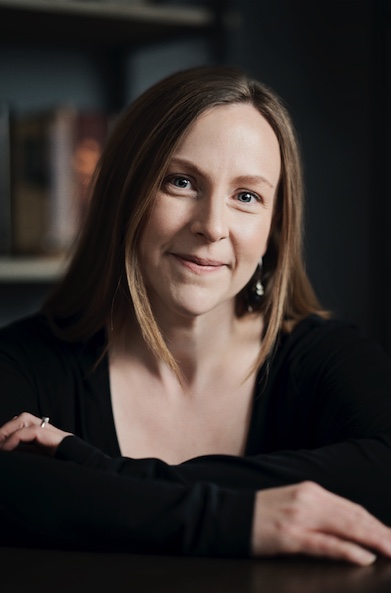
Caitlin Horrocks is author of the story collections Life Among the Terranauts and This is Not Your City, both New York Times Book Review Editor’s Choice titles. Her novel The Vexations was named one of the 10 best books of 2019 by the Wall Street Journal. Her stories and essays appear in The New Yorker, The Best American Short Stories, The PEN/O. Henry Prize Stories, and elsewhere. She lives with her family in Grand Rapids, Michigan.
SEE THE ISSUE
SUGGESTED CONTENT
Blast
May 07 2026
“Handsome Crying Boy” by Lee Conell
In this black comedy by Lee Conell, the emotionally repressed pay for group crying sessions administered by attractive men. “Handsome Crying Boy” asks what it means to be vulnerable with… read more

Blast
Apr 23 2026
“Coyote Map” by Justin Taroli
Justin Taroli‘s atmospheric short story follows a photographer who returns to Albuquerque after their grandmother’s death. Intertwining themes of grief, spirituality, and collective memory, the mystery of “Coyote Map” takes… read more

Blast
Apr 09 2026
“The Dogs” by Zoe Ballering
In this sparkling, spare sci-fi by Zoe Ballering, the descendants of Earth’s elite trawl space for “the barest hint of life,” aching for what, and who, they left behind. Most… read more