
Blast | March 14, 2025
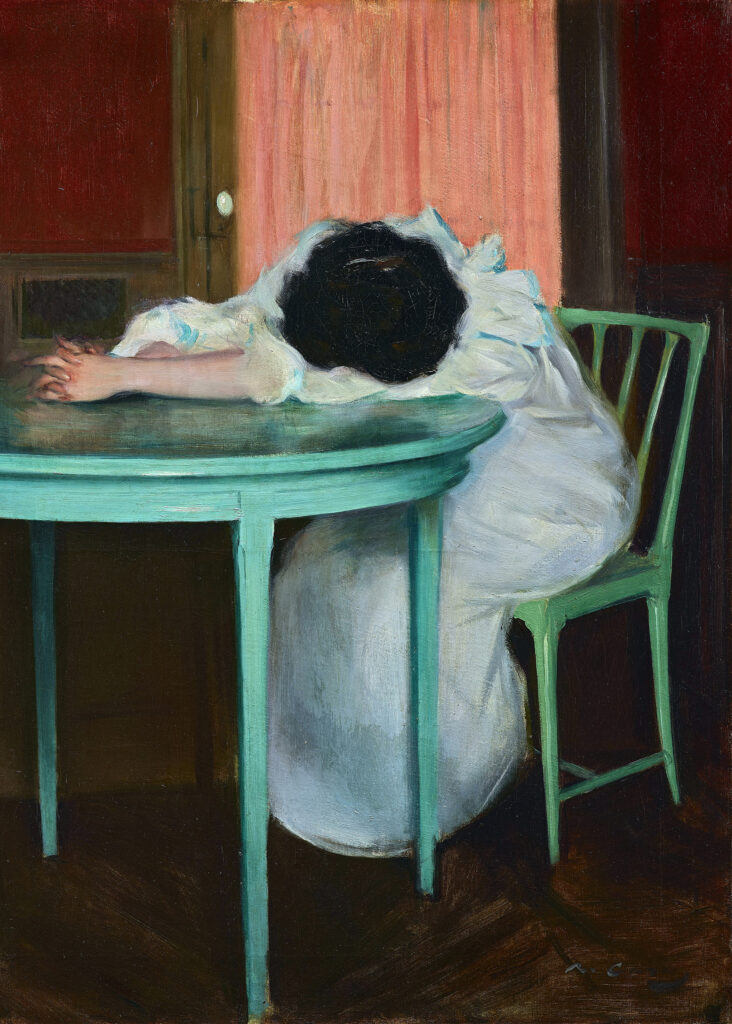
“The Boredom Circuit” by Carrie Hall
BLAST, TMR’s online-only prose anthology, features prose too vibrant to be confined between the covers of a print journal. In “The Boredom Circuit,” Carrie Hall travels to Canada to meet with two scholars whose research focuses on boredom—how it works and who it afflicts. Everyone gets bored, but some people are more prone to it than others, often due to factors outside of their control. Hall’s essay describes a personal evolution from a fear of boredom to a fascination with what it can tell us about ourselves and our purpose in life.
“The Boredom Circuit”
Carrie Hall
Life, friends, is boring. We must not say so.
After all, the sky flashes, the great sea yearns,
we ourselves flash and yearn . . .
-John Berryman, “Dream Song #14”
It’s early March, but in Canada, there’s still no hint of spring. We’re just coming down from the height of the pandemic, so my masked cab driver has the windows wide open, despite the fact that a wet, thick snow is falling. We slip on a turn and he slows to about ten miles an hour. I worry this will make me late for my meeting with neuroscientist James Danckert. He has graciously agreed to let me interview him at his lab at the University of Waterloo, where he and his graduate researchers study everything about boredom: its relationship to time, attention, head trauma, psychopathy, the gamut. Later in the week, I’ll visit his colleague, psychologist John Eastwood, in Toronto. He, too, studies boredom. In fact, Danckert and Eastwood are two of the biggest players on what psychologist Sally Mann once dubbed “The Boredom Circuit,” the group of scientists, philosophers, economists, and other researchers who’ve dedicated their lives to the study of being bored. I’m here to learn more about this reviled feeling and the people who research it, not so much to cure it (which I don’t think is possible or even desirable) but to understand what it can teach us and why we should listen.
The fact is, I was bored for most of my life; I’ve spent a great deal of time trying to escape the feeling. But in a PhD program for teaching writing, I found myself obsessed with it—first the boredom I saw in my students, then the boredom I saw in myself. I read everything I could find on the subject: a nearly two-hundred-page treatise by Heidegger, Buddhist reflections, educational and economic theory, and paper upon paper by Danckert and Eastwood.
Boredom researchers distinguish between a fleeting feeling (“state boredom”) and the predisposition toward boredom known as “boredom proneness.” When I first read about boredom proneness in an article by Danckert, I felt a cold shock of recognition. He describes it as characterized by “frequent and intense feelings of boredom” and a “perceived lack of meaning.” Boredom proneness, he writes, is “an enduring individual . . . trait associated with a raft of negative outcomes.” Those outcomes include dropping out of school, addiction, promiscuity, vandalism, distraction and risk-taking in general. Boredom-prone folks aren’t just predisposed to being bored; we tend to hate the feeling more than the average person. We do all kinds of dangerous things to avoid it, no matter the cost. By the time I’d reached twenty, I’d done almost everything on Danckert’s raft (save that I wasn’t much of a gambler). It was clear to me that my level of boredom proneness was high enough that it could blow up the scale. I made all my decisions—good and bad—trying to escape the dull, hollow feeling of being bored. I went to the bar, moved across country every six months, even went to grad school, but I could never get rid of it—boredom followed me wherever I went.
The Goldilocks Zone
James Danckert’s office is in a labyrinthine building. I have a hard time finding him, first of all because I have a hard time finding anything—I could get lost in a paper bag—but also because the building’s numbering system seems to be a psychological experiment of its own. Room numbers follow no consecutive order, popping up out of nowhere. When I finally do make it to the office, I’m ten minutes late and frazzled. Danckert waves me in. I assume he’s smiling, since his bright eyes brighten even more, but he’s wearing a mask, so I can’t say for sure.
“No worries!” he says before I can even apologize.
“Oh,” I announce, surprised at his accent, “you’re Australian!”
He sounds almost confused. “Yeah. I’m Australian. You didn’t know that?” I’m not sure why I would, although the fact that he wrote “no worries” in every one of our email exchanges ought to have clued me in.
I chew at my fingernails, a habit I thought I’d given up long ago. The fact is, I’m star-struck. I’ve been reading Danckert’s work for decades. Even though I wrote my PhD dissertation about boredom’s effect on learning, I worry that when Danckert looks at me he’ll see the scrawny college student who sighed loudly and rolled her eyes at her teachers, eventually dropping out after a year and a half.
Danckert is one of the world’s foremost neuroscientists studying attention and boredom, but I’m struck by how, well, rock-and-roll he is. He’s got long red hair, a long red beard peeking out from beneath his mask. He’s wearing jeans and a T-shirt. Later, in the grad lounge, I’ll see a huge painting of Jim Morrison and Jimi Hendrix hanging on the wall. It was painted by Danckert himself.
“How did you get into studying boredom?” I ask. This is something people on the boredom circuit do all the time: ask each other our boredom “origin stories.” I’m still pulling off my layers and layers of winter gear, because even though it’s freezing outside, it’s sauna-hot in the office. I barely have my pen out as he starts telling me his story.
Part of it is widely known; he’s written about it before. When he was young, his brother got into a motorcycle accident and got a traumatic brain injury. After that, even though he’d seemingly healed, Danckert’s brother was bored all the time. Just bored, bored, bored, even by the things he used to enjoy, like playing the drums. The relationship between traumatic brain injury and boredom proneness is well-documented, by the way, some of it by Danckert himself (also linked to boredom proneness are: ADHD, PTSD, and addiction, but whether boredom is the cause or effect of these disorders is unknown).
Then, though, Danckert tells me another story, one I hadn’t read before. After his plans to get a degree in creative writing were thwarted as a teenager, he felt at a loss about his future. “My father,” he says, “described me as a person who liked to keep himself to himself.” Directionless, he spent the summer wandering alone through the empty playground in his neighborhood, shooting hoops by himself. While he talks, I notice two crows having a chat of their own on a huge snowy pine outside his window. I imagine Danckert bouncing the basketball against a thick concrete slab in the park, staring at grass that needed cutting, paint wearing off the asphalt, day after day after day.
At least an hour later, Danckert sits at his computer, clacking away and sending me articles, like one that theorizes that in certain situations a boredom-driven agent learns more than a curiosity-driven agent. “They use a computer simulation to get their data,” he explains, “but the idea is that if a curious person wanders through a maze and sees a video with a lot of random imagery, they’ll stay and watch it: ‘Hmm, what’s this? That’s cool!’ It’s interesting to them. Everything is interesting to them. But a high-boredom person sees the same video and thinks, ‘That’s stupid. There’s nothing for me here.’ And they quickly move on to the next screen and the next and the next and the next until they find a video that has information that tells them how to get the hell out of the maze.”
In other words, even the skin-crawling, anger-inducing combination of hatred for and propensity toward boredom known as boredom proneness can have its benefits. I definitely have the tendency to keep moving until something grabs my attention. Put another way, when I was young, I felt easily trapped and would keep trying new things until I felt a sense of freedom. Sometimes this was good—I did a lot of reading and drawing—and sometimes it was bad: I did a lot of drugs.
Boredom is a change signal, like pain—it alerts us that we need to do something differently. Like putting your hand in a fire, it’s uncomfortable. Pre-pandemic, a spate of articles suggested that we seek out boredom based on the unfounded theory that this would make us feel more creative (I’ve never read a research study that backed this idea up). Now, post-pandemic, the benefits of imposed boredom are far less frequently touted. Boredom certainly has it’s uses, usually to deliver the message to get your metaphorical hand out of the metaphorical fire and find something more engaging to do. In other words, boredom is a valuable tool, a message. We shouldn’t avoid it—and by the way, good luck trying—but we shouldn’t wallow in it either.
Danckert describes it this way: the human mind wants to be in the “Goldilocks Zone” of cognitive engagement. This is the place where we’re using our mental resources—our brains and our emotions and our experiences—in just the right way or just the right amount. We’re challenged but not bewildered. We’re not doing busywork or tasks that seem useless or out of our zone of interest. We’re doing things that we’re good at and, most importantly, that we care about, but we’re still learning. According to Danckert, “This is a genuine drive, like the drive for satiety (from hunger or thirst) or the drive to be the right temperature. Boredom is the message that you’re out of the Goldilocks Zone and you need to make a change.” Boredom-prone people seem to have a harder time reaching the Goldilocks Zone than other folks, or maybe we get knocked out of the zone more easily. There could be a number of different reasons for this: attentional issues might make it harder for us to get engaged or stay engaged, we might have a lower threshold for disinterest, or environmental and emotional factors might make us feel easily trapped in situations where we feel our mental resources are going to waste.
Boredom is by nature hazy. When we’re bored, we know we don’t want to do what we’re doing, but we usually don’t know what we’d rather do instead. Listening to boredom is a difficult skill. “This is why it doesn’t work for the parent of a bored child to provide a list of options,” Danckert says. “The parent says, ‘do that, do this, do that, do that.’ The child isn’t stupid. They’ve contemplated all the available options, and they’ve decided those options suck.”
A parent might, Danckert suggests, sit down with the child when they’re not bored and write a list together of four or five possible activities for them to choose from when they find themselves in the state again. That way, they have a voice in the matter, some agency over their lives. They’re choosing to do something that’s important to them.
Of course, this list of solutions won’t always work. Sometimes our desire isn’t available to us: we want to go out during a pandemic, but we’re on lockdown; we want to read a book, but we’re distracted by chronic pain; we want to get out of solitary confinement, but the cell is locked. In short, sometimes bored people simply feel trapped, and sometimes they really are trapped by systems that don’t allow them the opportunities or safety to engage with the Goldilocks Zone.
This brings me to my own boredom origin story. As a child growing up in Minnesota, my nights were lived in fear: I’d lay awake, sometimes in the closet or under the bed, with a child’s hope that somehow my father wouldn’t be able to find me there. But in the hours between the time I came home from school and the time he came home from work, I didn’t feel scared; I felt bored. Every day, I sat in front of the heater blasting as hot as I could get it (I was always cold), staring at the striped carpet or looking longingly at the dog who usually sat just out of arm’s reach. It always smelled like burning dust. I sat doing nothing, forcing myself to think about nothing. This went on for years, literally years, but it registers in my memory as just one endless day. I was so far from the Goldilocks Zone I couldn’t even imagine it: my attention was focused on survival, not how to be pleasantly cognitively engaged.
It’s not clear why some people, like me, might fairly consistently find themselves out of the Goldilocks Zone and in the Boredom-Prone Zone. In my own case, I suspect I just got used to it. At first, my boredom was a message that I wanted some control in my own life. Long after I left my parents’ house, boredom was my way of coping, telling me to seek out constant distraction. Because if things slowed, even for a moment, I felt like I was in front of that old heater again, waiting for my father to come home.
Outside Danckert’s window, the crows have left the pine. On the ground, one squirrel looks up at the tree as if he’s heard something, decides he hasn’t, then starts walking, trudging really, through the snow.
Danger and Opportunity
A few days later, I meet John Eastwood, director of York University’s Boredom Lab, at the Icha Tea House in Toronto. We sit in front of a tall, thin calligraphic scroll in the back of the shop. Eastwood, too, is tall and thin, awkwardly graceful. He looks more traditionally professorial than Danckert: glasses, blazer, beard (neatly coiffed, one half more grey than the other).
“I don’t really have a good story about it,” he says when I ask how he came to study boredom. “I just wanted something I could study for a long time and boredom has its tentacles in everything.” Eastwood counts under his breath to time the steeping of the tea as we chat. I sort of wonder why he doesn’t time it on his phone, but there’s something about counting that seems correct, old school. He mentions that he got interested in tea ceremony when he studied Tai Chi as a teenager and I assume someone told him this was more respectful or traditional, counting it out.
“This one is called Heavy Red Robe,” he says, pouring the tea from the small clay pot into the small clay cups. His hands are thin and his gestures are expressive but compact. After I take a sip, he asks me, “What do you think it tastes like?” I’m not sure. The tea surprises me; it pours out almost clear, but it’s thick and has a strong flavor I can’t quite pin down. Maybe flowers and oak?
I do not match Eastwood’s calm at all, much as I might like to. I’m wearing a subdued black-and-brown sweater, but I have on bright magenta lipstick and my nails are painted turquoise. My blonde hair, no matter how I try to tame it, has an electrocuted Einstein quality I’ve never been able to quell. My gestures, unlike Eastwood’s, are huge. I have to be sure I don’t break something with every hand wave.
We talk for five hours. And during that time, I realize that Eastwood is profoundly interested in almost everything. I guess that makes sense; wanting to know what drives people to care about the things they do might also make you want to know why people get bored. Our conversation glides in and out of personal stories and scientific studies and philosophical writing on boredom as well as our thoughts on teaching and the reasons that students get bored. This tentacle-like quality is why I love boredom too; it weaves through everything I know.
These days, Eastwood’s research focuses mostly on the idea of boredom as a “crisis of agency.” We’re agents in our own lives when we feel our lives have meaning and purpose. When we don’t have control over our situation and we don’t feel our time has value, we often call that feeling boredom.
“[Boredom] is a crisis in the true definition of a crisis,” Eastwood says. “It’s full of both danger and opportunity. It can help us break out of routine and pause and reflect on activity that we maybe ought not to be doing and then it can help us reorient and engage in life in a more meaningful, purpose-driven way.” For example, a student bored by a major they’ve taken on in order to please their parents might need to take on a major more aligned with their own interests in order to get out from under boredom’s thumb. Either that or they’ll have to find a personal purpose (not just pleasing others) in the major they’ve already declared. In this way, Eastwood says, boredom is incredibly useful. Without it, “a whole life could go by and at the end you could say, ‘Well, did I do what really mattered to me?’” But Eastwood warns that being bored is like being in a stairwell. “It has utility insofar as it helps you move from one floor to the other. There’s nothing to be gained by standing in a stairwell forever. It only has value insofar as it leads to a transition, and I would say that same thing with boredom.”
It’s important to acknowledge that not only the bored person but also their situation can bear some of the blame for chronic boredom. We like to say that “only boring people get bored”; we paint the bored person as a spoiled child who can’t decide which of their toys to play with. But more and more, researchers acknowledge boredom can be more dire than that. “When someone complains of boredom,” Eastwood says, studying the teapot for a minute, a deep red clay, “we tend to see them as flawed,” but people often get trapped in boredom’s stairwell by no fault of their own. For example, boredom is prevalent amongst the homeless and for people working jobs where they don’t feel challenged or useful (where, as Danckert would say, they’re outside their Goldilocks Zone). Soldiers often report boredom, just as prisoners do. Studies show that boredom proneness has increased among young people in the past few years, especially during the pandemic. It’s hard to feel like the author of your own life when you can’t even go outside, when the future you’ve been imagining disappears without warning.
As a professor, I’ve noticed students express boredom the most when they feel forced to do something that discredits their goals or their personhood—for example, consistently being assigned books that don’t represent or even acknowledge their identity. In other words, boredom isn’t only an inward emotion that helps us realize we’re not fully utilizing our powers, it’s also communication: an outward expression that we want to be allowed to use those powers and to know that our talents are valued. Simply put, boredom is the pain of feeling we don’t matter.
“This is an overshare,” I say, pressing my hand to my chest, “but I have PTSD. You’ve probably figured that out by now.” Eastwood smiles gently, like this is an absolutely regular thing to reveal, either because he did figure it out already or because he sees no shame in the condition.
“And I’m boredom prone. I mean, I don’t get bored much these days, but the thought of it still makes my skin crawl.” I notice I’ve started to fidget in my seat, though whether this is from overcaffeination or the recollection of boredom, I’m not sure. That said, my sense that there’s a relationship between boredom and trauma is the reason I think the study of boredom is so important: the feeling is written off as laziness or apathy, but I think it can be much more dire than that. Once, when a student who’d grown up around a lot of gun violence told me he thought reading was boring, I asked him why. He looked at me like I was stupid. “How am I supposed to watch a little piece of paper,” he said, “when someone might be coming at me?”
Eastwood pours more tea in the cups, every movement thoughtful. By now we’ve switched to a new tea, a smoky pu-erh. It comes in a tight ball that unravels slowly the more it steeps.
Boredom is such an uncomfortable feeling that we’ll do almost anything to escape it, but this escape can be dangerous. A 2014 study showed that 67 percent of men and 25 percent of women would rather repeatedly self-administer a small but painful electric shock than sit alone with their feelings of boredom. According to Eastwood, we turn to distractions to numb our boredom, but that only works while the entertainment (or the electric shock) lasts. Put another way, technology doesn’t cause boredom, but certain technologies developed for distraction can divert us from listening to boredom’s cry for meaning and purpose, thereby keeping us stuck in its jaws. While it might be tempting to drift from the pain of boredom into a two-hour game of Angry Birds, we may do better to sit in that discomfort for a while and try to figure out a deeper, more permanent solution.
So what is the solution to boredom? Both Eastwood and Danckert suggest that when you feel bored, you should reflect on what it’s trying to tell you. Then choose an action (perhaps from a list you’ve written for yourself in a more engaged state). Even when the problem is systemic and our boredom chronic, making some small move toward a personally significant goal will help us find where we are most challenged and capable.
Eastwood and I wrapping up our talk at the tea shop is like a comedy skit about Minnesotans and Canadians. We both keep trying to be more polite than the other, insisting on paying the bill. Eventually, Eastwood wins (by sneaking off and paying the thing). I guess this is no surprise; I’ve been away from Minnesota too long to out-nice a Canadian.
Walking back to my hotel, I can almost physically feel the thoughts, too many of them hopping around in my head—thoughts about boredom proneness, Goldilocks, stairwells. I need a nap. Not because I’m tired, but because my brain needs to stop taking in new information so it can put all these thoughts away on the right shelves. I try to concentrate on the icy snow crunching underfoot; I always did like that feeling.
I rarely get bored anymore. Or rather, when I do, it fascinates me. To some extent, I gamed the system by becoming interested in the feeling I hate the most, but I did myself a great service by replacing my revulsion for boredom with curiosity. Plus, when I started teaching, my experiences with boredom became useful, which helped me combat the overwhelming feeling of uselessness I’d battled for years. I was able to encourage my students to have the same curiosity about boredom and agency that I have.
My boredom was trying to tell me I had a place in the world. All the things I’d done to escape myself—drinking, drugs, distraction—took me further from a meaningful life. When I started to listen to boredom, my purpose and the obstacles to it became more clear. Boredom is a thick smoke that, at some time or another, obscures everyone’s view. Smothered by that smoke, we can’t see what we want, what matters to us, or where we matter. But boredom is also a marker, a sign that something worth obscuring is hidden in just that spot.
***
 Carrie Hall has recently published essays in New Letters, Pleiades and december magazine. Her work has been supported by grants and residencies from the RF CUNY Foundation, UCross Foundation and Millay Arts. Hall is working on a memoir called MURDERAPOLIS about punk rock and political turmoil in Minneapolis in the early ’90s. She works as an assistant professor of English at CUNY’s New York City College of Technology, where she also studies boredom’s effect on literacy learning.
SEE THE ISSUE
SUGGESTED CONTENT

Blast
Apr 23 2026
“Coyote Map” by Justin Taroli
Justin Taroli‘s atmospheric short story follows a photographer who returns to Albuquerque after their grandmother’s death. Intertwining themes of grief, spirituality, and collective memory, the mystery of “Coyote Map” takes… read more

Blast
Apr 09 2026
“The Dogs” by Zoe Ballering
In this sparkling, spare sci-fi by Zoe Ballering, the descendants of Earth’s elite trawl space for “the barest hint of life,” aching for what, and who, they left behind. Most… read more

Blast
Mar 26 2026
“The Art of Falling Water” by Darryl J. Benjamin
Darryl J. Benjamin’s “The Art of Falling Water” is a short story about a man who applies for a challenging new job to support his daughter’s future. Learning the traditional… read more