
Blast | October 11, 2024
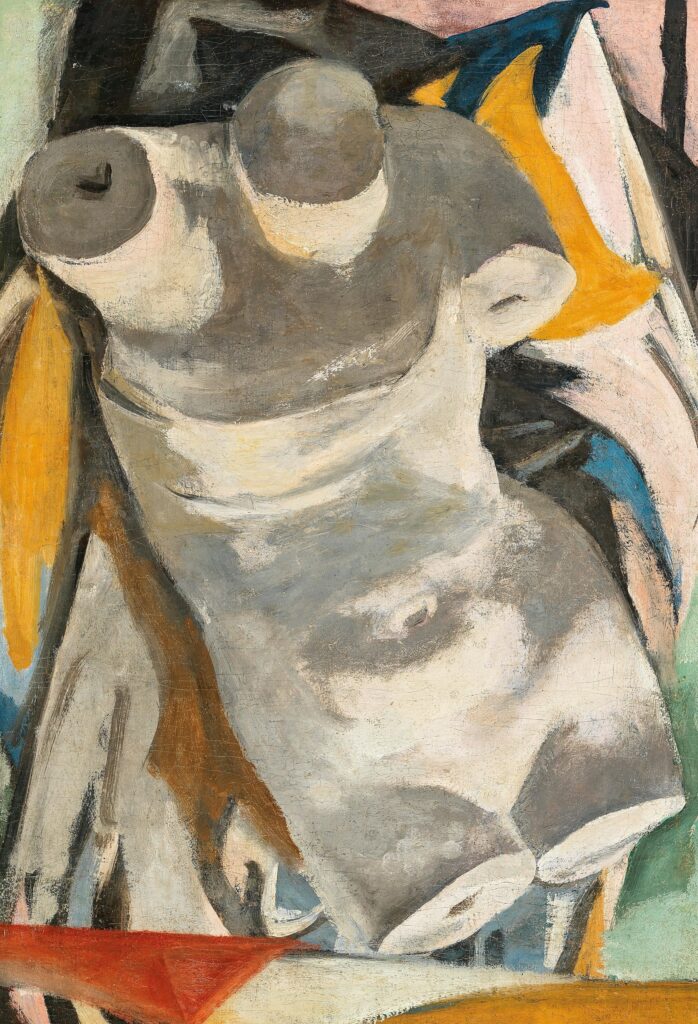
“Yesterday’s Disasters” by Elisha Emerson
BLAST, TMR’s online-only prose anthology, features prose too vibrant to be confined between the covers of a print journal. In Elisha Emerson’s short story, “Yesterday’s Disasters,” an artist diverted by motherhood reckons with lost youth and missed opportunities after the death of a former mentor. She finds a surprising source of wisdom in her gender-questioning ten-year-old, who teaches her how to embrace the inevitability of change.
“Yesterday’s Disasters”
Elisha Emerson
I click another video labeled “Watch Ocean Take House!” and again, there’s Jules’s house, severed. His studio lost to the storm.
“What’s that?” Laura points. I didn’t hear her come in. Them come in. I didn’t hear them come in. I overturn my phone. Wipe my face.
“Nothing,” I say, think twice, then show Laura my screen. “A friend used to live here. Crazy, right? I used to work for him.”
“Oh.” They study the image, their mouth a straight line. “Is your friend okay?”
“He’s dead,” I say.
They look startled.
“No, he was old,” I say. “He died a couple of years ago. Of old age,” I add. “He doesn’t live there anymore.”
She—they—give me a look, like no duh, Mom, he doesn’t live there anymore.
“Dad asked me to get you,” they say. “He needs help with the boiler. It’s overflowing, I think. He’s in a bad mood.”
“And you can’t help him because . . . ?”
They give me two thumbs up. “I’m a kid.” They have this way of standing that reminds me of a ten-year-old Fonz. Feet planted, sharp elbows, shoulders popped like a collar. Happy days.
“That doesn’t mean you can’t help,” I say and pocket my phone. Yesterday’s disasters be damned.
“I’m out.” They hook their thumbs in their jeans and saunter out of the room.
Nick and I are still getting used to Laura as a they/them rather than the she/her we celebrated with pink frosting and streamers before they were born. They announced the change last week over breakfast.
“So, Mom,” they said. “I don’t really feel like a girl, but I don’t feel like a boy, either.”
I stopped scrolling through the morning’s headlines and gave my daughter my full attention. “What’s that mean?” I tried to sound more curious than defensive. A lilting “What’s that mean?” But to be honest, I wasn’t sure how a young person felt like a girl. Was it a physical thing? Laura is prepubescent, solemn, expressing an equal interest in illustrated nonfiction animal books and choose-your-own-adventure faery stories. I didn’t feel like a girl until I French-kissed Peter Hasbro and he put his hand up my shirt.
Laura flicked the overcooked crumbs off an otherwise perfectly toasted bagel. “I don’t know. I just prefer they/them.”
“The pronouns,” I said knowingly and tried to ignore the crumbs flitting across the table. I was open. Progressive. I’d be okay with this.
They chewed, mouth closed. Nodded. Held my eyes as they swallowed and said, “Yeah. The pronouns.”
The first time I entered Jules’s studio, I was eighteen and he was . . . sixty-five? Seventy, maybe? His skin was distinctly wrinkled. Thin, bordering on frail, he stood upright in expensive linen pants, a beret, and leather slip-on shoes. When he spoke or thought, when he referenced this or that, he used a panoply of elegant gestures. A wrist flick, an elbow’s bend, his long fingers sparking the air.
Within minutes of entering his studio, I would take off my clothes. I removed my shirt with that cross-hand method women use in movies. At home, I tossed, kicked, and crumpled my pants, underwear, and bra across a stained carpet, but in front of Jules, I took ginger steps. I folded a neat pile, acutely aware of my skin, my folds, goose pimples, a missed patch of prickly hair. Whether I crouched, leaned, or bent.
Each Monday night, Jules drew while I posed for three-hour sessions. He liked to quote Nikos Kazantzakis, author of The Last Temptation of Christ. Like Kazantzakis, Jules worshiped abundance: goblets of wine, fine cheeses, incense, and beautiful curves. He welded enormous sculptures and painted on canvases, eight feet by six, set in gold frames. I sat on a high wooden stool while my naked feet dangled. He sat across from me, sky blue ashtray balanced on his slant desk.
“Girl, you’ve got to give up that ambition,” he’d quote from Zorba the Greek. “To be happy, you must surrender. And yet. Yet.” He aimed his cigarette like a dart. “You still got to work like a horse.”
He’d quote, “Madness is the salt that keeps good sense from rotting,” and then, “Life is trouble, Becca B. Only death is not. To be alive is to undo your belt and look for trouble.” He played Stravinsky and made a promenade of the room, his hands clapping soft bursts by his cheek.
He paid me twenty dollars an hour, which, in the early 2000s, felt like easy cash, but I wasn’t there for the money. I was there for the conversation. My art professors lauded Jules a genius. He was renowned in the restaurants where he treated me to expensive hors d’oeuvres and throughout the art galleries where he introduced me to collectors. On campus, his many sculptures swooped grandly, the colorful steel, an abstract monument to extravagance and life. I considered it a privilege to stand naked in his studio and overran him with questions.
How do you know if you’re an actual artist?
What’s the difference between art and craft?
How do you hear your ideas over the noise in your head?
How can you tell if a painting is finished?
Can you still call it art if it’s making a point?
“You’ve got to insist,” he’d say. When he smoked, his eyes caught the light. I would smoke, too, forgoing my cheaper Camel Lights tucked away in my purse for his silky Sobranie Blacks. I’d lean into his zippo. Click, it would shut, and together, we’d examine the latest sketch: black-and-white me, slouched on a stool, blank-faced, pouch of lips, hips, and breasts.
“The world is going to want things from you, my dear,” he would say, “but if you’re going to be an artist, you must insist. Insist!” His smoke curled like brushstrokes through golden flecks of dust.
But back then, insisting felt easy. What could the world want, anyway? My attention? Time? Sex? As with Jules, this wanting could be courted. Concretely, all Jules required was that I stand in his studio, exposed. I was an artist. Exposure was necessary, and if I didn’t paint, I would die. I told Jules this, and he laughed. “You’d be surprised how many deaths one can die in one’s life.”
More often, I returned to my efficiency, electric with inspiration, and painted long into the night. No longer the clammy bourgeoisie who waited on Jules, breaking the cork of his Santorini Assyrtiko, I insisted a new version of myself onto the canvas. This woman wasn’t shy. She referred to her hookups as “lovers.” She didn’t care about achieving straight As, or offending her family, or what anyone had to say from the small town in Connecticut where she was raised. This woman was uninhibited, fearless, comfortable crossing the room without any clothes to protect her, warmed by her own madness, unironically using words like “truth,” “pleasure,” and “desire.” Fearless, she insisted she was.
Laura insists we call them Nova. They say, “It better represents who I am.”
It’s been one week since the ocean took Jules’s studio. We eat Chinese takeout for dinner. Red-and-white cardboard boxes, soy and duck sauce packets clutter the table.
“OK, Baby. Whatever you want. We support you.” Nick is so eager to express his support that one elbow knocks and spills white rice onto the table. He offers Laura his hand and she—they—is kind enough to not appear inconvenienced as they must drop their chopsticks to receive it.
“Thank you.” They pat Nick’s hand.
Slowly, I chew my lo mein. “Definitely,” I add. “It might take me a minute to get used to, though.”
A thin trench appears between Nick’s eyebrows, but he is nodding like he agrees.
“Why Nova, may I ask? And not something similar to Laura? Like Lauren, for example. That’s gender neutral.”
They grimace, and the memory springs, a clown from a box: baby name encyclopedias, thebump.com. Nick and I sprawled across my thin, Kmart futon. “Patricia, Lucy, Matilde.” Turns out one can get pregnant with an IUD. “Hailey, Ella, Felicity.” Up until these moments, our relationship felt dangerous, flame-like, fleeting. Nick drove a motorbike and wrote poems. He was an anthropology major on course to move abroad. I was headed to New York City. We had no business falling in love.
I was seven weeks by the time I realized my increased breast size wasn’t dumb luck. Nick begged me to keep the pregnancy. “We’ll move in together. I can sell my bike. I love you. Let’s do this.”
I loved him, too, so we reappropriated the word settle to mean the soft landing a feather might make. The pleasant sigh after sinking in a bath. We named our baby Laura after my favorite great aunt, who appeared to me in a dream. While alive, she was hilarious and crude, a pianist who attended Julliard, never married, never had kids. In my dream, she assured me motherhood could be an act of creation.
“Nova means new,” my child explains. “And I associate it with stars, so that’s nice.”
“I love it,” Nick says, cleaning his spill.
“Isn’t a supernova when a star explodes?” I ask.
“Yeah, but a nova is when a star shines bright. Without exploding,” they add.
Nick returns to the table. “Well, I think it’s great. I would have loved to change my name as a kid.”
Laura, now Nova, points at Nick with their chopsticks. “You still can.”
He makes a face. “I’m too old. I’d get confused.”
I stab my mouth full of noodles and baby corn. “Oh, yeah? What would you change your name to?”
He leans back, his head thoughtfully tipped to one side. “I’ve always loved Anthony.”
“Anthony?” I’m baffled.
“Yeah. It gives me this feeling. It’s hard to explain.”
“Anthony,” I repeat and stand to clear the table.
“I can call you Anthony,” Nova says. Then to me, “Can you leave the fried rice? I want more.”
I want to see the erasure in person, so I wake Nova early.
“We’re going to the beach,” I say.
“It’s freezing outside.” They are groggy, their face half smothered in pillow.
“We can bundle up. It’ll be fun.”
A slick of hair catches, dried, on their bottom lip. “I don’t want to.” They groan. Hands cover face. Tiny spaceships pattern their sleeves.
For most of Nova’s life, Nick has worked Saturdays, at first in food service, and now as an in-home health aide. I tend toward the nine-to-five, and when Nova was a baby, I would try to use Saturdays to paint. Between diaper changes and feedings, I’d throw on Baby Einstein and flip on the mechanical swing, but I was lucky to get ten, twenty minutes of uninterrupted focus before she needed me.
I never understood what rage was until those interruptions. A bloom through the chest. I would just barely, not quite, mix the perfect shade of pink, achieve the exact almost curve of a line, when wah, or, eventually, Mama! Rage filled and frightened me, swollen tight beneath my skin, so hot and near my child. And it never got easier. Laura toddled, wanted things, chattered, needed help. Impossible to find time. Sundays overfilled with obligations to family, friends, and home, and come evenings, I collapsed into bed. It wasn’t until I stopped painting, altogether, that my rage went away. And, just as Jules insinuated, I didn’t die. Mainstream domesticity is chock full of friendly consolation, so long as one keeps moving, shopping, or turning on a screen.
Now, we take field trips on Saturdays. State and national parks, playgrounds, museums. Occasionally, Target is enough.
Nova carries their notebook and a small bag of colored pencils to the car. Our breath puffs around us. They’re too small for the front and must sit in the back with our brown-bagged snacks: egg salad sandwiches and a couple of green apples. The drive should take two hours, and I cushion the news with the promise that I’ll stop for fast food on the way home.
“But why the beach? It’s freezing outside. I don’t understand why you want to go.”
“Remember that storm last week? I want to see the damage along the coast. I used to spend a lot of time there. We can stop by the candy shop I used to love.”
They exhale loudly and roll their head against the window, resigning to whatever the day throws at them. “Can I at least use your phone during the drive?”
“I wanted to listen to music.” I feel a twinge of guilt, but this is my life, too. “I thought we could listen to something from back in the day.”
“Back in what day?”
The car idles, increasingly warm in the driveway, while I scroll through Spotify’s Indie from Early 2000s. All the songs I want to hear are too sad or explicit or angry for my ten-year-old. PJ Harvey, Cat Power, Peaches, CSS. I give up and hand Nova the phone.
The first time I visited Jules’s studio, I knocked on the front door of his large, seaside home and met his blonde wife. I didn’t know about the private stone path that wound around the back between a menagerie of Jules’s gesticulating statues and his wife’s garden beds. Steel. Zinnias. Steel.
“Abigail Occam,” she offered her hand. A whiff of cinnamon gum. Vibrant and in her early to mid-thirties, she wore thick, high-waisted denim and stood a few inches taller than me. “Jules will be a minute. Come on in.”
She led me through a grand but sparse hallway, past a floor-to-ceiling nude with thin pencil lines that brought heat to my face. “Jules said you met at the winery? How long have you worked there?”
“Not very long. I’m a student.” She seemed too young for Jules, still she carried herself like an adult down the hallway and into her beautiful kitchen. She offered me a glass of water and cucumber and sat on the granite countertop, her knees caked in dirt. She wore no makeup and I found myself touching my face as if to block her view, my lipstick too bold, my hair dyed box-red.
“Jules says you paint?” she asked.
I nodded. “Yes. I work mostly with acrylics, though I’m interested in oil.” The countertops were high and I had to tilt my head to address her.
Jules’s “Halloooo” wafted ahead of his arrival, a rolling silk scarf, one end for each of us. “You’ve met my new model.” He kissed his wife on the mouth.
“She’s charming.” Her assessment delivered, she patted his cheek, and I was surprised to believe that she meant it. Her blue eyes rose to meet mine. “Let me know if he gives you any trouble.” She squeezed my hand in parting.
Back in the days of Jules’s studio, sex pulsed beneath everything. Society was, to my eighteen then nineteen then twenty-year-old self, a thin coat of paint over our best and worst impulses. Healthy and free, I enjoyed this view of things. It was fun.
More than anything, I fancied my relationship with Jules as a game. I wanted to use him, his proximity to success, achievement, and he wanted to use me in all the same, boring ways a man might want to use a woman. Not that we were having sex, just that it seemed important that Jules had the freedom to pursue it. There’s nothing new about the dynamic. In fact, it’s so typical, I’m embarrassed to admit it.
He had a fascination with cocaine and would often ask me to travel with him to New York. He knew a woman there, an academic, who might be able to help me place my work. We might get a hotel, stay a couple of days. Oh, the wild things we could do! When he was my age, he and his friends were lunatics! Beautiful and unfazed by social constraints.
He quoted Zorba the Greek, “A man needs a little madness, or else he never dares cut the rope and be free,” and despite his wrinkles, his bird-like bones and papery skin, a part of me considered these offers. To peel out of myself, to exist in madness, to be free. His golden haze of studio led me to believe I could truly shed all inhibition. That I could lose my head in favor of my body—but then I was never really sure who I was. Was I the girl in Jules’s sketches? Or the girl in my paintings? The girl whirring about my thoughts? I yearned to keep stripping until I found her.
Still, I said no to New York. The hotel. I couldn’t get past his old man jowls. Impossible, the notion of pressing my lips, of receiving pleasure from his hairy fingers. I was too provincial, beneath it all, for the madness he esteemed.
“This isn’t the beach,” Nova observes flatly.
I’ve parked us across from Jules’s driveway.
“Where are we?” they ask, their voice muted, far away, unreal to my devolving self. Eighteen years old, head lacy with ego and possibility. I haven’t driven down this road in over a decade, and it’s clear the storm took a toll. A stretch of white pines blocks my view of his house, but debris whorls the pavement and surrounding lawns.
“Mom,” Nova repeats, “this isn’t the beach,” and I remember Jules is dead, and this was a stranger’s house lost at sea.
“The ocean’s right there,” I point. “I just want to stop in real quick. We’ll go to an actual beach in a minute.”
“Where are we?”
“I told you,” I say and turn off the car. The sun is hard and brisk. Through the windows, I hear ocean, a shush of pressure and release.
“Here’s your phone.” They lean across the middle console. “Grammie texted while you were driving. She called me Laura. You should correct her.” The dark screen looks too large in their hand. Another loss. Laura. Little girl I used to bathe. A celebration of running water, downy hair. This girl who twirled, arms chopping sprinklers and sunshine. The girl I raised to be strong, to value, not diminish, her eventually burgeoning hips, breasts, her ability to create life. Our past falls away. This affinity, another death.
“Look,” I say, a bubbling impulse, acid in my throat. “Just like your dad said, I support you, but your name is important. I mean, you were named after Grammie’s sister. She’s not going to take that well.” My attempt to sound casual turns whiny.
Villain, I think. I’m a villain in a contemporary coming-of-age novel.
And here they sit, so willingly present, awaiting instructions, poised with their hand on the latch. “I like Nova,” they say, nonplussed. “Lauren can be my middle name.” This expectation that they can choose what the world calls them, choose how the world sees them.
“I just want you to love who you are.”
“I do. I love who I am.”
“No, you know what I mean. I mean who you are, like I don’t want you to want to be someone else.” Wiley E. Coyote, stupid and over the cliff.
“Oh my god, Mom.” At last, Nova raises their voice. “Are you yourself? I mean, what are you even talking about?”
“What are you talking about?” I yell back, and the question lingers like a fart, embarrassing us both.
They throw open the door. “Let’s just go.”
But everything feels wrong. From the street, I see planks, a sloppy pile of driftwood through trees. “Wait. I’m sorry,” I say. “This will only take a minute.”
The last time I stood for Jules, he greeted me at the door, whisky on his breath, the usual kiss on the mouth. He’d called me a few days earlier to reschedule our Monday session to Tuesday. “I’m dropping Abby at a rehab clinic in Boston. We’re taking the day and I won’t be home until late.”
“Oh no. I’m so sorry,” I said. I was stunned. Though I did not see her often, I saw her enough, a wave tossed across the garden bed. Even while on hands and knees, she appeared elegant beneath her tilted straw hat, raised chin, squinty eyes. “Are you well?” she would call. Never, How are you? Always, Are you well?
“You don’t want to just cancel?” I stammered into the phone. “I don’t mind. I totally understand.” I was too naive to appear so proximal to something I didn’t understand, like marriage or addiction.
“No,” he said. “I insist we meet. I must continue as usual. Our sessions give me something important. Abby will be fine.” I hoped she wasn’t in the room. His eagerness to rendezvous sounded cold. His wife was in trouble. “She’s a strong woman,” he added. “And she’s getting the help that she needs.”
In his studio, his kiss lingered. There was an air of catastrophe, of amped sexuality, as though we stood so near disaster that all regular boundaries were off.
Over his shoulder, I noticed he’d spread an oilcloth in place of a stool. A vat of Vaseline. A pile of bandages. A bowl.
The suck singe of Jules’s cigarette, as he watched me take it in.
“I want to cast your breasts,” he explained, at last. “They’re so beautiful, I want to immortalize them. Imagine you—” A smoky gesture toward my breasts, my torso. “Immortalized. Gorgeous, in bronze!” A punctuation of smoke, but the idea was irksome, this break in routine. I cared little for immortalized breasts.
I asked after his wife, and he grew quickly somber.
“Yes, Abby has her struggles. But she’ll be fine. She’s a strong girl. A goddess. All women are.” That curlicue of gesture. “You know, Kazantzakis says there’s only one woman in the world. One woman with many faces.” A quick flick of ash toward his sketchpad and desk. “The problem is Abby doesn’t know her own power. She just needs a break. She’ll be fine.” He sounded so sure. “Now, let’s immortalize you.”
His wording felt like loss. I returned to the cloth, the bowl and Vaseline, which appeared medicinal and cold. Back then, I still held onto the belief that I might immortalize myself. Dismal, this idea that Jules’s blank-faced nudes, that a bronze torso might survive me as myself and not my own work.
I did not undress until he asked me, and when I did my joints ached, my spine wrenched. I felt ancient.
I told myself that it was for money, that it was my job going on three years, that I allowed him to spread Vaseline across my breasts. His fingers slow, his breath even. Down my stomach. This was a genius, draping one wet bandage after the next, his hands shaking, but precise.
I tried to picture this singular woman Jules spoke of, this monster with many faces, all those lips, those mouths chewing nothing, tasting nothing, saying nothing. Faces colorless, blank. I believed this one woman might swallow me up.
The cast hardened, and while it drew tighter about my chest, he smoked and talked of New York. All those wild days I would never know.
Blue tarps flap, a cartoonish ocean, where the house has been severed. I’m shocked that not a single sculpture remains. I had always believed those giant steel shapes would endure as long as bone. Of course, I’m sure it’s not the ocean that swept them away. The only thing I recognize is the front façade, the steps leading to the porch.
Although we are strangers here, no one stops Nova and me as we pick our way over wooden beams, rocks, siding, an ugly smatter of sand. If someone stops us, I plan to tell the truth: I loved this place, once. Worst case, they ask us to leave.
“So, how did you know this guy again?” Nova’s interest, a fleeting gift.
“He was an artist. I worked for him.”
“Back when you painted?”
“Yeah.”
They stand over a sink tilted on its side. “It’s weird to think of you painting.”
I balk, “Why?”
“I don’t know. I’ve just never seen you do it.”
“I used to,” The loud rustle of tarp in the wind. “Before you were born. It meant everything to me.”
“So why don’t you do it now?”
“It’s not that easy. Sometimes the world doesn’t cooperate with you, and you just have to suck it up.”
“Suck what up?”
My thoughts are a mash of the past, Jules, my baby, Laura, Nova, now. “I don’t know. Just suck it up. Suck it up.” Bewildered, Nova stands surrounded by rubble; their popped shoulders droop. I realize I’m scowling. My voice raised. I don’t mean to shout.
“I’m going to look at the water,” Nova says, tight smile. Double thumbs up, and I watch this human pick their way, confident but careful, over the embankment and onto the rocks. Before them, the ocean is a sparkling purr, so I let them go, relieved to stand in this wreck alone.
I came back one last time. Two years after I moved away, I called Jules on impulse. Newly pregnant, I wasn’t showing. I told Nick I planned to spend the night with an old friend.
Motherhood terrified me. The looming financial, emotional, and executive debt. Those pink strips set off a Rube-Goldberg series of suburban pomp. Doctor visits, vitamins. I watched what I ate and drank. Nick cut his hair. We subscribed to Netflix. I visited the department store at least once a week.
That artist born in Jules’s studio, I struggled to see where she fit. I shaved, slathered lotion, a mixture of rose and sage. Jules had the house to himself by then, long divorced from Abby.
“Halloo!” We kissed. He squeezed my face with both hands.
“It’s been so long.” My palms sweat as he led me down the sparse hallway, past all that extravagant art. I noted his stoop, how his clothes hung from his shoulders.
A flourished announcement: he had Fortnum and Mason tea, and while he stood at the stove to boil water, I unbuttoned a third button on my blouse.
“I regret we never went to New York,” I said once we settled on the couch. In my chest, my heart pounded. If he reached for me, I would have let him, although I still don’t know what I wanted to occur.
He said it was probably for the best that we never made it to the city. He announced he was writing a book inspired by his lifelong obsession with baseball.
“Baseball?” I said.
His eyes danced across the walls as he nodded, all those gorgeous paintings and sketches. “There’s a lot of art to the sport.”
“I wouldn’t know,” I said, so he explained.
We sat side by side for another hour, although he was often somewhere else, in Sportsman Park with the St. Louis Cardinals, five blocks from his childhood home. “World War II picked off the best of them,” he said. “But Stan the Man, he sure could swing.” The conversation exhausted me, and when he asked after my painting, I told him I was pregnant.
“Oh, darling,” he said, eyes dewy. “That’s wonderful.” Another pat on the cheek.
“Yes,” I said, speaking truthfully. “But we’re broke, and I’m afraid I won’t have time to paint, and if I don’t paint, I don’t know who I am. I’ll die. I just want to make art.”
“If it’s important enough, you’ll insist.” Then he quoted Kazantakis, “You must die every moment, but say: Death does not exist.”
Out of all the times I’ve gone to Jules’s house, I’ve never climbed on these rocks, and as I make my way to my child, I take cautious, crab-like steps.
“It’s pretty,” they say when I arrive. Their eyes trained on the satin flat horizon. “It’s weird to think a storm was just here.”
Indeed, the water appears serene. “What’s so weird to me is that there’s an entire studio under there,” I say.
“A lot of it’s back there. Just in pieces.” They gesture with their head to indicate the mess fanned out behind us, and I wonder what Jules would have said. How easily he found it to survive, to thrive, his paintings, sketches, sculptures, that damned book I never read. I lose track of the silence between Nova and me, although I can feel them breathing beside me. They seem comfortable. At rest. I try to follow their gaze but can’t tell what they’re looking at.
“You know, somewhere out there’s a sculpture of my breasts.”
“What? In the water?” They stare at me, incredulous. “Is that why you wanted to come?”
“No. I mean, kind of. Somewhere in the world, I mean.”
After a moment, they ask, “Just your breasts?”
“Well, my torso. It’s a thing. You know, in art museums.”
“Huh.” Their eyes return to the water. “That’s weird.”
“Yeah,” I laugh. “I guess it is.”
Below us, a couple of seagulls examine what appears to be a piece of an armchair caught in rocks.
“Did the artist do it? The one you worked for?”
I nod.
“Do you think you would recognize it, if you saw it? Like in a museum, would you know it was you?”
The question surprises and delights me. I consider it before I shake my head no. “I mean, probably, not.”
“Yeah, you’ve probably changed a lot since then, so you couldn’t even check to be sure.”
This makes me laugh. “Hopefully, I haven’t changed that much.”
“What’s wrong with change?” they ask, eyes so wide I believe their astonishment.
***
 Elisha Emerson’s work has appeared in the Dalhousie Review, Solstice Magazine, Literary Mama, SBLAAM, and other places. Her nonfiction won Solstice’s 2022 Nonfiction Contest and has been nominated for a Pushcart Prize and Best of the Net. She volunteers as a screener for Ploughshares and lives in Maine with her family.
SEE THE ISSUE
SUGGESTED CONTENT
Blast
Apr 23 2026
“Coyote Map” by Justin Taroli
Justin Taroli‘s piece, “Coyote Map,” follows a photographer who strangely encounters coyotes throughout the city of Albuquerque, after returning once their grandmother passes away. As the mysterious sightings progress, they… read more
Blast
Apr 09 2026
“The Dogs” by Zoe Ballering
In this sparkling, spare sci-fi by Zoe Ballering, the descendants of Earth’s elite trawl space for “the barest hint of life,” aching for what, and who, they left behind. Most… read more
Blast
Mar 26 2026
“The Art of Falling Water” by Darryl J. Benjamin
Darryl J. Benjamin’s “The Art of Falling Water” is a short story about a man who applies for a challenging new job to support his daughter’s future. Learning the traditional… read more